Thank you for visiting SNEWPapers!
Sign up free
The Indianapolis Journal
Indianapolis, Marion County, Indiana
What is this article about?
Prof. J. W. Jenks of State University lectured at the Propylaeum on money's definition, qualities (portability, durability, divisibility), economic effects of stringency vs. inflation, gold/silver stability, and bimetallism implications of the silver bill. Attended closely with questions answered.
Clipping
OCR Quality
Full Text
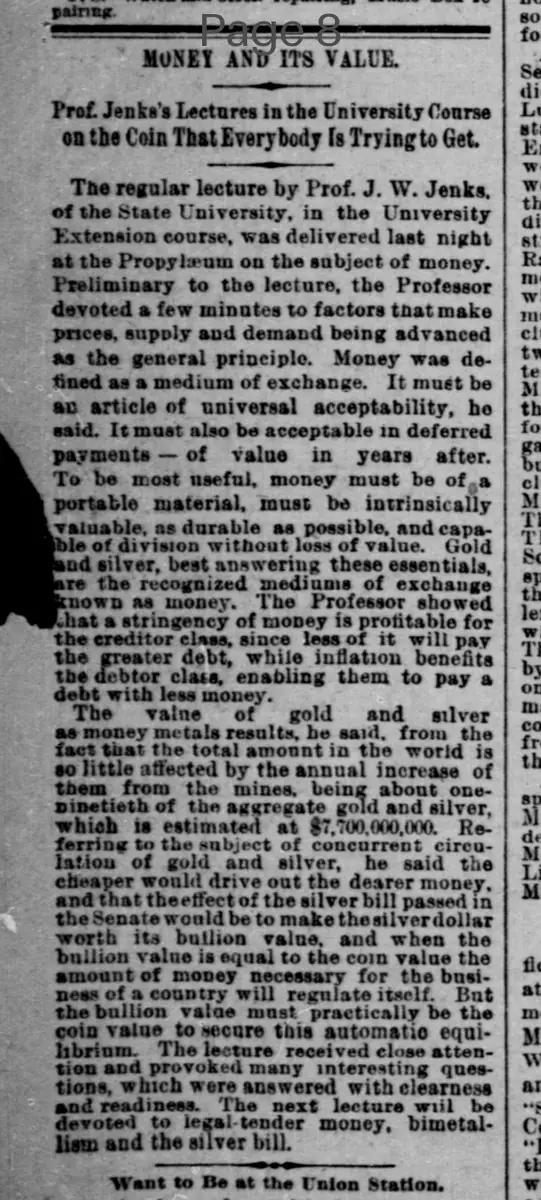
Prof. Jenks's Lectures in the University Course on the Coin That Everybody Is Trying to Get.
The regular lecture by Prof. J. W. Jenks, of the State University, in the University Extension course, was delivered last night at the Propylaeum on the subject of money.
Preliminary to the lecture, the Professor devoted a few minutes to factors that make prices, supply and demand being advanced as the general principle. Money was defined as a medium of exchange. It must be an article of universal acceptability, he said. It must also be acceptable in deferred payments - of value in years after.
To be most useful, money must be of a portable material, must be intrinsically valuable, as durable as possible, and capable of division without loss of value. Gold and silver, best answering these essentials, are the recognized mediums of exchange known as money.
The Professor showed that a stringency of money is profitable for the creditor class, since loss of it will pay the greater debt, while inflation benefits the debtor class, enabling them to pay a debt with less money.
The value of gold and silver as money metals results, he said, from the fact that the total amount in the world is so little affected by the annual increase of them from the mines, being about one-fiftieth of the aggregate gold and silver, which is estimated at $7,700,000,000. Referring to the subject of concurrent circulation of gold and silver, he said the cheaper would drive out the dearer money, and that the effect of the silver bill passed in the Senate would be to make the silver dollar worth its bullion value, and when the bullion value is equal to the coin value the amount of money necessary for the business of a country will regulate itself. But the bullion value must practically be the coin value to secure this automatic equilibrium. The lecture received close attention and provoked many interesting questions, which were answered with clearness and readiness. The next lecture will be devoted to legal-tender money, bimetallism and the silver bill.
What sub-type of article is it?
What keywords are associated?
What entities or persons were involved?
Where did it happen?
Story Details
Key Persons
Location
Propylaeum
Event Date
Last Night
Story Details
Prof. Jenks defined money as a medium of exchange with qualities like portability, intrinsic value, durability, and divisibility. Gold and silver best fit these. Discussed how money stringency benefits creditors and inflation debtors. Explained stability of gold and silver values due to low annual production relative to total stock. Addressed concurrent circulation where cheaper money drives out dearer, and effects of silver bill on dollar value.