Thank you for visiting SNEWPapers!
Sign up free
The Daily Union
Washington, District Of Columbia
What is this article about?
In the U.S. Senate, Mr. Slidell submits a resolution requesting the Committee on Foreign Relations to inquire into authorizing the President to suspend neutrality laws during congressional recess amid concerns over Cuba's Africanization and slave trade revival. Debate ensues with senators expressing views; the resolution is referred to the committee.
Clipping
OCR Quality
Full Text
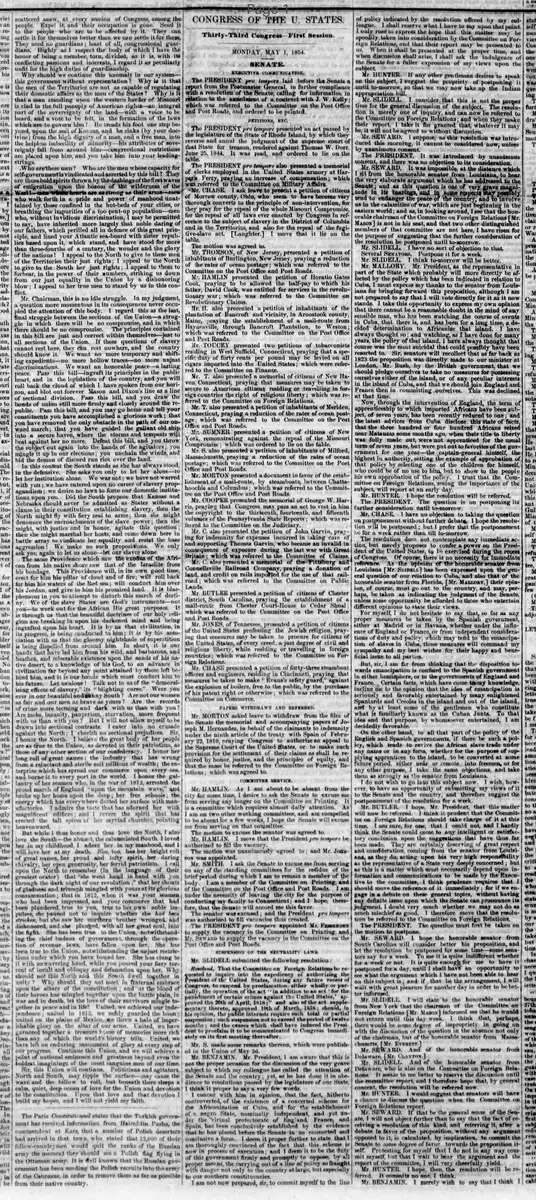
Mr. SLIDELL submitted the following resolution:
Resolved, That the Committee on Foreign Relations be requested to inquire into the expediency of authorizing the President of the United States, during any future recess of Congress, to suspend by proclamation, either wholly or partially, the operation of the act "in addition to an act 'for the punishment of certain crimes against the United States,' approved the 20th of April, 1818" and also of the act supplementary thereto, approved 10th of March, 1838; should, in his opinion, the public interests require such total or partial suspension; such suspension not to exceed the period of twelve months; and the causes which shall have induced the President to proclaim it to be communicated to Congress immediately on its first meeting thereafter.
Mr. S. made some remarks thereon, which were published in the Union of May 2d.
Mr. BENJAMIN. Mr. President, I am aware that this is not the proper occasion for the discussion of the very grave subject to which my colleague has called the attention of the Senate and the country; yet, as he has done it in obedience to resolutions passed by the legislature of our State. I think it proper to say a very few words.
I concur with him in opinion, that the fact, hitherto controverted, of the existence of a concerted scheme for the Africanization of Cuba, and for the establishment of a negro State, nominally independent, and yet under the virtual protectorate of England, France, and Spain, has been conclusively established by the evidence that he has placed before the Senate in so connected and conclusive a form. I deem it proper further to state that I am thoroughly convinced of the fact that this scheme is now in process of execution; and I deem it to be the duty of this government firmly and promptly to oppose, by all proper means, the carrying out of a line of policy so fraught with danger not only to the country at large, but especially to our southern constituencies.
I am not now prepared, sir, to commit myself to the line of policy indicated by the resolution offered by my colleague. I shall reserve what I have to say upon that point. I only rose to express the hope that this matter may be speedily taken into consideration by the Committee on Foreign Relations, and that their report may be presented to us. When it shall be presented at the proper time, and when discussion shall arise, I shall ask the indulgence of the Senate for a fuller expression of my views upon the subject.
Mr. HUNTER. If any other gentleman desires to speak on this subject, I suggest the propriety of postponing it until to-morrow, so that we may now take up the Indian appropriation bill.
Mr. SLIDELL. I consider that this is not the proper time for the general discussion of the subject. The resolution is merely one of inquiry, and can now be referred to the Committee on Foreign Relations; and when they make their report, I take it for granted that, whatever it may be, it will not be agreed to without discussion.
Mr. SEWARD. I suppose, as this resolution was introduced this morning, it cannot be considered now, unless by unanimous consent.
The PRESIDENT. It was introduced by unanimous consent, and there was no objection to its consideration.
Mr. SEWARD. It was impossible, at the distance which I sit from the honorable senator from Louisiana, to hear the very elaborate argument which he has addressed to the Senate; and as this question is one of very grave magnitude in its bearings, and in some respects may possibly tend to endanger the peace of the country, and to involve us in the calamities of war, which are just beginning in the eastern world; and as, in looking around, I see that the honorable chairman of the Committee on Foreign Relations [Mr. Mason] is not in his seat, and that two other distinguished members of that committee are not here, I have risen for the purpose of suggesting that the further consideration of the resolution be postponed until to-morrow.
Mr. SLIDELL. I have no sort of objection to that.
Several SENATORS. Postpone it for a week.
Mr. SLIDELL. I think to-morrow will be better.
Mr. MALLORY. Mr. President, as the representative in part of the State which probably will more directly be affected by the policy which has been indicated in relation to Cuba, I must express my thanks to the senator from Louisiana for bringing forward this proposition, although I am not prepared to say that I will vote directly for it as it now stands. I take this opportunity to express my own opinion that there cannot be a reasonable doubt in the mind of any sensible man, who has been watching the course of events in Cuba, that there is, and has been for a long time, a decided determination to Africanize that island. I have always thought so; and watching, as I have done for many years, the policy of that island, I have always thought that course was the most suicidal that could possibly have been resorted to. Sir, senators will recollect that as far back as 1823 the proposition was directly made to our minister at London, Mr. Rush, by the British government, that we should pledge ourselves to take no measures for possessing ourselves either of the island, or of any peculiar interests in the island of Cuba, and that we should join England and France then in committing ourselves. This was declined at that time.
Now, through the intervention of England, the term of apprenticeship to which imported Africans have been subject, of seven years, has been recently reduced to one; and the latest advices from Cuba disclose this state of facts. that the three hundred or four hundred Africans seized near Matanzas some months ago, when their title to liberty was fully made out, were not apprenticed for the usual term of seven years, but were put out to favorites of the government for one year—the captain-general himself, the highest in authority, setting the example of approbation of that policy by selecting one of the children for himself, who could be of no use to him, but to show to the people his own approbation of the policy. I trust that the Committee on Foreign Relations, seeing the importance of the subject, will report at an early day.
Mr. HUNTER. I hope the resolution will be referred.
The PRESIDENT. The question is on postponing its further consideration until to-morrow.
Mr. CHASE. I have no objection to taking the question on postponement without further debate. I hope the resolution will be postponed; but I prefer that the postponement be for a week rather than till to-morrow.
The resolution does not contemplate any immediate action, but merely proposes to confer a power on the President of the United States, to be exercised during the recess of Congress. Of course, there is no necessity for immediate reference. As the opinion of the honorable senator from Louisiana [Mr. SLIDELL] has been expressed upon the general question of our relation to Cuba, and also that of the honorable senator from Florida, [Mr. MALLORY,] their opinion, of course, must go out to the country, and may, perhaps, be taken as indicating the judgment of the Senate unless some opportunity be afforded to those who entertain different opinions to state their views.
For myself, I do not hesitate to say that, so far as any proper measures be taken by the Spanish government, either at Madrid or in Havana, whether under the influence of England or France, or from independent considerations of duty and policy, which may tend to the emancipation of slaves in Cuba, those measures will command my sympathy and my best wishes for their happy and beneficial issue to all parties.
But, sir, I am far from thinking that the disposition towards emancipation is confined to the Spanish government in either hemisphere, or to the governments of England and France. Certain facts, which have come to my knowledge incline me to the opinion that the idea of emancipation is seriously and favorably entertained by many enlightened Spaniards and Creoles in the island and out of the island, and by at least some of the gentlemen who constitute what is familiarly known as the Cuban Junta. To that idea and that purpose, by whomsoever entertained, I am decidedly favorable.
On the other hand, to all that part of the policy of the English and Spanish governments, if there be such a policy, which tends to revive the African slave trade under any name or in any form, whether for the purpose of supplying apprentices to the island, to be converted at some future period, either near or remote, into freemen, or for any other purpose, I take the same objections, and take them as strongly as the senator from Louisiana.
I do not wish to go into this subject now. I wish, however, to have an opportunity of submitting my views of it to the Senate and the country, and therefore suggest the postponement of the resolution for a week.
Mr. BUTLER. I hope, Mr. President, that this matter will now be referred. I think it prudent that the Committee on Foreign Relations should take charge of it at this time. I am sure, for one, that I could not, and I hardly think the Senate could come to any intelligent or satisfactory conclusion upon the suggestions that have thus far been made. They are certainly deserving of great respect and consideration, coming from the senator from Louisiana, as they do, acting upon his very high responsibility as the representative of a State very deeply concerned; but as this is a matter which must necessarily depend upon information and communications to be made by the Executive to the committee, I think prudence requires that I should move the reference of it immediately; for if we engage in a debate on these general topics, without having any definite issue upon which the Senate can pronounce its judgment, I doubt very much whether we may not do as much mischief as good. I therefore move that the resolution be referred to the Committee on Foreign Relations.
The PRESIDENT. The question must first be taken on the motion to postpone.
Mr. SEWARD. I hope the honorable senator from South Carolina will consider better his proposition, and let the resolution be postponed for some time—some senators say for a week. To me it is quite indifferent whether for a week or not. It is quite enough for me to have it postponed for a day, until I shall have an opportunity to see what the argument which I have not been able to hear on this subject is; and if that be the arrangement, I will wait with great pleasure for another day in order to be better informed.
Mr. SLIDELL. I will state to the honorable senator from New York that the chairman of the Committee on Foreign Relations [Mr. Mason] informed me that he would not return until this day week. I think that, perhaps, there would be some degree of impropriety in going on with the discussion of the question in the absence not only of the chairman, but of the honorable senator from Massachusetts, [Mr. Everett.]
Mr. SEWARD. And of the honorable senator from Delaware. [Mr. CLAYTON.]
Mr. SLIDELL. And of the honorable senator from Delaware, who is also on the Committee on Foreign Relations. It seems to me better to reserve the discussion until the committee report, and I therefore hope that, by general consent, the resolution will be referred now.
Mr. HUNTER. I would suggest that senators will have a chance to discuss the question when the Committee on Foreign Relations report.
Mr. SEWARD. If that be the general sense of the Senate, I will not object further than to say that the fact of receiving a resolution of this kind, and referring it, after a debate in favor of the proposition, without any argument opposed to it, is calculated, by implication, to commit the Senate to some degree of favor towards the proposition itself. Protesting for myself that I do not in any way commit myself, but that I wait to hear the argument and the report of the committee, I will very cheerfully yield.
Mr. HUNTER. I hope, then, the resolution will be referred. It commits no one, I think.
Mr. BENJAMIN. I merely wish that I think I
Mr. CHASE. As it seems to be the general sense of the Senate that the subject should be referred, I withdraw the motion.
The resolution was then agreed to.
What sub-type of article is it?
What keywords are associated?
What entities or persons were involved?
Domestic News Details
Key Persons
Outcome
the resolution was referred to the committee on foreign relations.
Event Details
Mr. Slidell submitted a resolution requesting the Committee on Foreign Relations to inquire into the expediency of authorizing the President to suspend neutrality laws during congressional recess if public interests require it, in response to concerns about a scheme to Africanize Cuba and revive the slave trade. Senators debated the matter, expressing varied opinions on Cuba policy, emancipation, and the slave trade. The resolution was postponed and then referred to the committee.