Thank you for visiting SNEWPapers!
Sign up free
Imperial Valley Press
El Centro, Imperial County, California
What is this article about?
British forces repelled a major German tank attack in Ousseltia Valley, Tunisia, on Feb. 13, 1943. Allied patrols captured prisoners, while Axis forces built fortifications in Tunis-Bizerte area amid poor weather hindering operations. Eighth Army engaged in patrols and artillery duels southeast.
Clipping
OCR Quality
Full Text
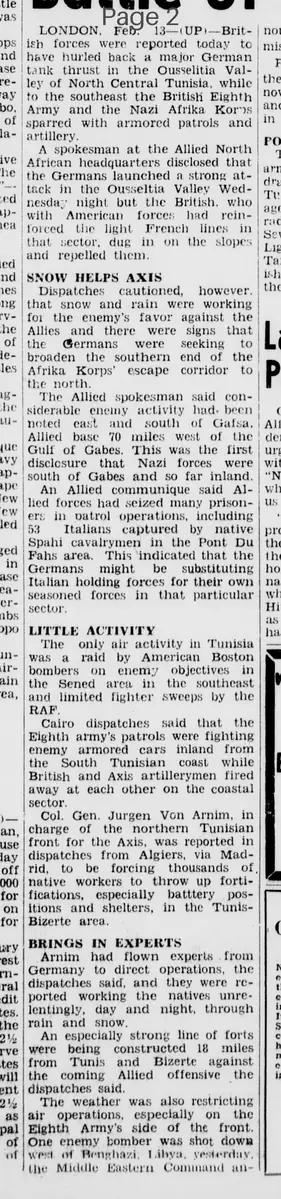
A spokesman at the Allied North African headquarters disclosed that the Germans launched a strong attack in the Ousseltia Valley Wednesday night but the British, who with American forces had reinforced the light French lines in that sector, dug in on the slopes and repelled them.
SNOW HELPS AXIS
Dispatches cautioned, however, that snow and rain were working for the enemy's favor against the Allies and there were signs that the Germans were seeking to broaden the southern end of the Afrika Korps' escape corridor to the north.
The Allied spokesman said considerable enemy activity had been noted east and south of Gafsa, Allied base 70 miles west of the Gulf of Gabes. This was the first disclosure that Nazi forces were south of Gabes and so far inland.
An Allied communique said Allied forces had seized many prisoners in patrol operations, including 53 Italians captured by native Spahi cavalrymen in the Pont Du Fahs area. This indicated that the Germans might be substituting Italian holding forces for their own seasoned forces in that particular sector.
LITTLE ACTIVITY
The only air activity in Tunisia was a raid by American Boston bombers on enemy objectives in the Sened area in the southeast and limited fighter sweeps by the RAF.
Cairo dispatches said that the Eighth army's patrols were fighting enemy armored cars inland from the South Tunisian coast while British and Axis artillerymen fired away at each other on the coastal sector.
Col. Gen. Jurgen Von Arnim, in charge of the northern Tunisian front for the Axis, was reported in dispatches from Algiers, via Madrid, to be forcing thousands of native workers to throw up fortifications, especially battery positions and shelters, in the Tunis-Bizerte area.
BRINGS IN EXPERTS
Arnim had flown experts from Germany to direct operations, the dispatches said, and they were reported working the natives unrelentingly, day and night, through rain and snow.
An especially strong line of forts were being constructed 18 miles from Tunis and Bizerte against the coming Allied offensive the dispatches said.
The weather was also restricting air operations, especially on the Eighth Army's side of the front. One enemy bomber was shot down west of Benghazi, Libya, yesterday, the Middle Eastern Command announced.
One Allied plane was missing.
Reports reaching London said the biggest German concentration now was in the Tunis-Bizerte area, and that many Italians formerly in the area had been sent south.
POWERFUL FORMATIONS
The Germans said the Eighth army had powerful formations drawn up against them in Lower Tunisia.
A German official news agency dispatch, broadcast by radio Berlin, said the British Seventh Tank division, the Fourth Light Tank brigade, the 22nd Tank brigade and the Seventh British Rifle division were south of the coastal road.
What sub-type of article is it?
What keywords are associated?
What entities or persons were involved?
Where did it happen?
Foreign News Details
Primary Location
Ousseltia Valley, North Central Tunisia
Event Date
Feb. 13
Key Persons
Outcome
british repelled german attack; allies seized many prisoners including 53 italians; one enemy bomber shot down, one allied plane missing
Event Details
British and American forces repelled a major German tank thrust in Ousseltia Valley Wednesday night. Eighth Army and Afrika Korps engaged in patrols and artillery southeast of there. Enemy activity noted east and south of Gafsa. Air raids by American bombers on Sened and RAF sweeps. Axis forcing native workers to build fortifications in Tunis-Bizerte area under Arnim. Weather favoring Axis and restricting air ops. German reports on British tank divisions south of coastal road.