Thank you for visiting SNEWPapers!
Sign up free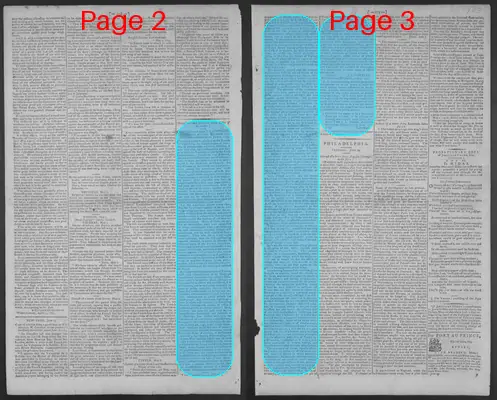
National Gazette
Philadelphia, Philadelphia County, Pennsylvania
What is this article about?
Letter from J.L. Cotelle in Cayes, St. Domingo, to French Minister Genet, denouncing civil commissioners Santhonax and Polverel for tyrannical rule, fomenting anarchy, favoring mulattoes, and plotting slave emancipation amid the colony's revolution, published in U.S. newspapers in June 1793.
Merged-components note: Continuation of the translated letter from J.L. Cotelle regarding events in St. Domingo across pages.
Clippings
1 of 2
OCR Quality
Full Text
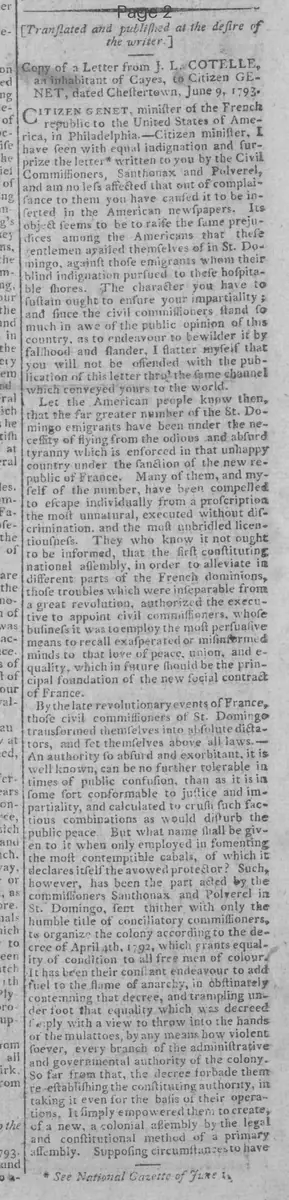
Copy of a Letter from J. L. COTELLE, an inhabitant of Cayes, to Citizen GENET, minister of the French Republic to the United States of America, in Philadelphia.—Citizen minister, I have seen with equal indignation and surprise the letter* written to you by the Civil Commissioners, Santhonax and Polverel, and am no less affected that out of complaisance to them you have caused it to be inserted in the American newspapers. Its object seems to be to raise the same prejudices among the Americans that these gentlemen availed themselves of in St. Domingo, against those emigrants whom their blind indignation pursued to these hospitable shores. The character you have to sustain ought to ensure your impartiality; and since the civil commissioners stand so much in awe of the public opinion of this country, as to endeavour to bewilder it by falsehood and slander, I flatter myself that you will not be offended with the publication of this letter thro' the same channel which conveyed yours to the world.
Let the American people know then, that the far greater number of the St. Domingo emigrants have been under the necessity of flying from the odious and absurd tyranny which is enforced in that unhappy country under the sanction of the new republic of France. Many of them, and myself of the number, have been compelled to escape individually from a proscription the most unnatural, executed without discrimination, and the most unbridled licentiousness. They who know it not ought to be informed, that the first constituting national assembly, in order to alleviate in different parts of the French dominions, those troubles which were inseparable from a great revolution, authorized the executive to appoint civil commissioners, whose business it was to employ the most persuasive means to recall exasperated or misinformed minds to that love of peace, union, and equality, which in future should be the principal foundation of the new social contract of France.
By the late revolutionary events of France, those civil commissioners of St. Domingo transformed themselves into absolute dictators, and set themselves above all laws.—An authority so absurd and exorbitant, it is well known, can be no further tolerable in times of public confusion, than as it is in some sort conformable to justice and impartiality, and calculated to crush such factious combinations as would disturb the public peace. But what name shall be given to it when only employed in fomenting the most contemptible cabals, of which it declares itself the avowed protector? Such, however, has been the part acted by the commissioners Santhonax and Polverel in St. Domingo, sent thither with only the humble title of conciliatory commissioners, to organize the colony according to the decree of April 4th, 1792, which grants equality of condition to all free men of colour.
It has been their constant endeavour to add fuel to the flame of anarchy, in obstinately contemning that decree, and trampling under foot that equality which was decreed solely with a view to throw into the hands of the mulattoes, by any means how violent soever, every branch of the administrative and governmental authority of the colony. So far from that, the decree forbade them re-establishing the constituting authority, in taking it even for the basis of their operations. It simply empowered them to create, of a new, a colonial assembly by the legal and constitutional method of a primary assembly. Supposing circumstances to have
* See National Gazette of June 1.
Required that all the public functionaries generally known to be disaffected, or only suspected of disaffection, should be recalled. Pursuant to the powers which no one ever disputed the commissioners had a right to exercise, the same decree in authorizing a provision for successors understood without doubt, that it should be by constitutional means. It certainly never meant that they themselves should appoint officers that ought only to be nominated by the jurisdiction, or that they should violate all the formalities prescribed by ancient as well as modern laws, to confer the sacred character of judge. Or that like the Sultan of Turkey, they would usurp the sacred rights of citizenship, or appoint any others for judges except men whom the people esteemed and had confidence in.
If it should be proved that the commissioners have suffered the assemblies of the communes to elect municipal officers, there are grounds to say that it would have been equally easy to assemble them for the election of all other public officers, whose nomination is constitutionally vested in the people. The assembly of the communes might even have appointed delegates to form another colonial assembly and send deputies to the convention. But perhaps the mulatto party, of which the civil commissioners have declared themselves the patrons, were not the prevalent one, or perhaps it was the intention of these legislators that neither party should get the better of the other, but to suspend them both, and the rights of both, in perfect equilibrium.
However, there is not much to complain of on this head: for by the first nomination, to which the mulattoes assented, there was not a single municipal jurisdiction in the colony where they were not admitted, notwithstanding that at this period, in most of them the whites had a majority; and this is a sufficient proof of the submission of the latter to the decree of the 4th of April, and of their desire to concur by all possible means in re-establishing peace. The civil commissioners, then, will always be under the reproach of having been the first instigators of our late troubles, and, as far as concerns the citizens, having tyrannically usurped all the powers of government, and in order to appropriate them to themselves, constantly opposed the appointment of delegates, either to form a new assembly, or to be sent to the convention.
Such, citizen minister, are the truths which the civil commissioners have not imparted to you in their letter, and which are nevertheless necessary to be disclosed to the Americans. They ought also to be informed that the great crime of the commune of Port-au-Prince was, their demanding the formation of a colonial assembly, and for having against their inclination, though authorized by the decree of the 4th of April (as it authorized all the other communes of the island) proceeded to the nomination of its deputies for this assembly and to the national convention. It may be necessary to add, that the community of Cayes had expressed the same wish for the formation of such an assembly, and for sending delegates to the national convention.
This object of the whites was to enforce that law of equality, which they had long wished for to no purpose; an equality which could no longer be realized, since the mulattoes, grown richer than the whites by pillage and robbery, had inclined the balance of wealth to their side.
Such are the real motives of that general proscription of the white citizens most devoted to the revolution. This conduct of the civil commissioners, doubtless, conceals another design which the mulattoes may not be aware of, but the effects of which they may yet feel as well as the whites; this is no less than a plan for the general emancipation of the slaves.
After having fomented the troubles, given strength to anarchy, aided the revolts of the slaves, and reduced to ashes the produce of the colony; and having, consequently, ruined the national concern for the preservation of this invaluable possession, would it now be very difficult to persuade all France that the only means to restore St. Domingo to prosperity is a general emancipation of the slaves? Would it be difficult to persuade her that this is the only method whereby she can indemnify herself for the enormous expense, that will in future be incurred, and to no purpose? Or to assure her that such is the military skill of the civil commissioners Santhonax and Polverel, that it behoves her to know that the first was for a long time before his colonial dictatorship, hired editor to the seditious revolutionary gazette of Prudhomme; and that both Polverel and himself are both well known agents, I will not say of a particular sect, but of a faction, more inclined to disseminate its own particular principles than to assert the prosperity of French republicanism, established as it is on a basis more consonant to human reason, and therefore more solid than any other system.
The commune of Cayes, equally assembled under the authority of the municipality, took the liberty to make known to commissioner Polverel the constitutional representations advanced in their proces-verbal of the 29th of January last, and in an address made to him, relative to the deprivation and arbitrary imprisonment of certain citizens. He answered, a month afterwards, by a proclamation of the 4th of March following. These are the two pieces which I subjoin hereto, by way of extract, submitting them to the decision of the people of America. They will be the best judges of the enormity of the crime imputed to the members of the abovementioned assembly (one of whose secretaries I was) and may form an opinion what credit is due to these gentlemen in the report they gave in of their subsequent operations against the town of Port-au-Prince; and finally they will best judge what respect our French demagogues pay to the eternal immutable principles of sacred equality and universal justice, under colour of which, they impose upon a too credulous and much abused people, like certain false priests who preach up mysteries they do not believe in, and a morality the austerity of which they well know how to relax when it affects themselves.
(Signed) J.L. COTELLE.
Chester-town (Maryland) June 9, 1793.
P.S. In transcribing the two pieces that accompany the above letter, I could not avoid adding several reflections on the second in order, which you are at liberty to retrench if you judge proper, or publish with my letter. If I could have gone to the expense of the impression, I would have given the whole entire, accompanied with an English translation, as I am not certain that merely at my requisition they would be inserted in the public papers.
I certify the above to be a true copy from the original, to be printed according to a request made of me in a letter from J.L. Cotelle, dated the 9th instant. Philadelphia, June 27th, 1793.
EsNAULT.
The two pieces referred to will appear in future papers.
What sub-type of article is it?
What keywords are associated?
What entities or persons were involved?
Where did it happen?
Foreign News Details
Primary Location
St. Domingo
Event Date
April 4, 1792 Onwards
Key Persons
Outcome
general proscription of white citizens, fomenting of anarchy and slave revolts, ruin of the colony's produce, plan for general emancipation of slaves
Event Details
J.L. Cotelle accuses French civil commissioners Santhonax and Polverel of transforming into dictators in St. Domingo, ignoring the decree of April 4, 1792, favoring mulattoes, usurping government powers, opposing colonial assemblies, proscribing whites, aiding slave revolts, and plotting emancipation to justify the colony's ruin.