Thank you for visiting SNEWPapers!
Sign up free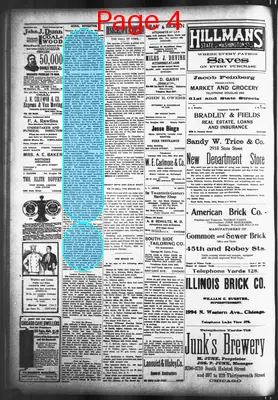
Story
March 30, 1907
The Broad Ax
Salt Lake City, Salt Lake County County, Utah
What is this article about?
Article discusses inventors' pursuit of 'heavier than air' flying machines, spurred by prizes in England and France. Highlights limitations of balloons and airships, progress by Santos-Dumont, and challenges in achieving practical aerial navigation, predicting advances in the current year.
Clipping

OCR Quality
98%
Excellent
Full Text
"Heavier Than Air" Flying Machines
Now the Goal of Inventors.
Prizes aggregating many thousands
of dollars for the production of a flying
machine of the "heavier than air" va-
riety, offered by English and French
enthusiasts, have caused great activity
among would-be inventors, and some
of the most prominent aeronautic ex-
perts predict that the year just begun
will be marked by remarkable ad-
vances in the science and practice of
aerial flight. To the gasoline engine
and to the extraordinary mechanical
progress made in automobilism is due
the hope that something definite and
worthy may be achieved by those who
seek to solve the problem of aerial trav-
el.
The ordinary balloon, it is agreed,
has little practical value save as an ex-
citing form of sport and for purposes
of observation in calm weather. In
anything like a stiff breeze it is the
sport of the winds and quite useless
from a practical point of view. Better
things are said of the cigar shaped con-
trivances utilizing both the gas bag
and the gasoline engine. Six years ago
Santos-Dumont was able to steer an
airship of this kind around the Eiffel
tower, running with and against the
wind. Since that time hundreds of
similar steerable balloons have been
built in France until today they are
nearly as common as the spherical gas
bag. Nevertheless it is realized that
these are far from representing a solu-
tion of the problem of practical naviga-
tion of the air. They have, in fact,
only stimulated the desire for some-
thing that will represent a radical im-
provement, such as the successful
"heavier than air" vessel would be.
The latter would mean, naturally, a dir-
igible vessel which could be driven in
any kind of weather and in any de-
sired direction. A fortune in prizes al-
ready awaits the inventor of such a
vessel, to say nothing of the monetary
return in a business way. Two prizes
of $50,000 each, one in England, the
other in France, await the inventor of
the successful aeroplane.
The mechanical difficulties in the
way of producing a perfectly dirigible
airship are immense because of the
number of contingencies that must be
provided for in traveling through such
a mobile and treacherous element as
the air. Machinery that can be de-
pended on not to fail and precipitate
the "heavier than air" machine to the
earth is the most necessary qualifica-
tion, but this can be provided, it is
known, if the method of propulsion
can be invented. The screw propeller
idea is by no means ideal because of
its great bulk, its poor lifting power
and its enormous waste of energy. A
flapping propeller, moving from side to
side, seems to give promise, but many
sound thinkers favor an approximation
to the bird method of flight, though
serious difficulties lie in the way of
converting circular motion derived
from a motor into the complicated and
various motions performed by the
wings of a bird. Even if such motion
could be approximated by mechanical
means great skill would be required in
directing the controlling mechanism,
as the constantly changing aerial con-
ditions would have to be instinctively
provided against.
Toy models working after the man-
ner of a bird's wings have successfully
traveled a few yards, but have failed
of success when enlarged to any ex-
tent. That the air is a region in
which man can travel has been proved,
however, and that under conditions he
can sail or fly through it by the aid of
mechanical power has also been dem-
onstrated, but many years are likely
to elapse before any practical method
of aerial navigation can be attained.
It is a problem that will not be solved
hurriedly, but that a solution will come
eventually is now almost a settled con-
viction with students of aeronautics,
and the incentives offered abroad with-
in the past few months give the hope
that great progress, if not actual
achievement, will mark the current
year. - New York Sun.
Now the Goal of Inventors.
Prizes aggregating many thousands
of dollars for the production of a flying
machine of the "heavier than air" va-
riety, offered by English and French
enthusiasts, have caused great activity
among would-be inventors, and some
of the most prominent aeronautic ex-
perts predict that the year just begun
will be marked by remarkable ad-
vances in the science and practice of
aerial flight. To the gasoline engine
and to the extraordinary mechanical
progress made in automobilism is due
the hope that something definite and
worthy may be achieved by those who
seek to solve the problem of aerial trav-
el.
The ordinary balloon, it is agreed,
has little practical value save as an ex-
citing form of sport and for purposes
of observation in calm weather. In
anything like a stiff breeze it is the
sport of the winds and quite useless
from a practical point of view. Better
things are said of the cigar shaped con-
trivances utilizing both the gas bag
and the gasoline engine. Six years ago
Santos-Dumont was able to steer an
airship of this kind around the Eiffel
tower, running with and against the
wind. Since that time hundreds of
similar steerable balloons have been
built in France until today they are
nearly as common as the spherical gas
bag. Nevertheless it is realized that
these are far from representing a solu-
tion of the problem of practical naviga-
tion of the air. They have, in fact,
only stimulated the desire for some-
thing that will represent a radical im-
provement, such as the successful
"heavier than air" vessel would be.
The latter would mean, naturally, a dir-
igible vessel which could be driven in
any kind of weather and in any de-
sired direction. A fortune in prizes al-
ready awaits the inventor of such a
vessel, to say nothing of the monetary
return in a business way. Two prizes
of $50,000 each, one in England, the
other in France, await the inventor of
the successful aeroplane.
The mechanical difficulties in the
way of producing a perfectly dirigible
airship are immense because of the
number of contingencies that must be
provided for in traveling through such
a mobile and treacherous element as
the air. Machinery that can be de-
pended on not to fail and precipitate
the "heavier than air" machine to the
earth is the most necessary qualifica-
tion, but this can be provided, it is
known, if the method of propulsion
can be invented. The screw propeller
idea is by no means ideal because of
its great bulk, its poor lifting power
and its enormous waste of energy. A
flapping propeller, moving from side to
side, seems to give promise, but many
sound thinkers favor an approximation
to the bird method of flight, though
serious difficulties lie in the way of
converting circular motion derived
from a motor into the complicated and
various motions performed by the
wings of a bird. Even if such motion
could be approximated by mechanical
means great skill would be required in
directing the controlling mechanism,
as the constantly changing aerial con-
ditions would have to be instinctively
provided against.
Toy models working after the man-
ner of a bird's wings have successfully
traveled a few yards, but have failed
of success when enlarged to any ex-
tent. That the air is a region in
which man can travel has been proved,
however, and that under conditions he
can sail or fly through it by the aid of
mechanical power has also been dem-
onstrated, but many years are likely
to elapse before any practical method
of aerial navigation can be attained.
It is a problem that will not be solved
hurriedly, but that a solution will come
eventually is now almost a settled con-
viction with students of aeronautics,
and the incentives offered abroad with-
in the past few months give the hope
that great progress, if not actual
achievement, will mark the current
year. - New York Sun.
What sub-type of article is it?
Curiosity
Historical Event
What themes does it cover?
Exploration
Triumph
What keywords are associated?
Flying Machines
Aeroplane
Aerial Navigation
Invention
Santos Dumont
Prizes
Aeronautics
What entities or persons were involved?
Santos Dumont
Where did it happen?
France, England
Story Details
Key Persons
Santos Dumont
Location
France, England
Story Details
Inventors pursue heavier-than-air flying machines amid prizes from England and France, building on balloon and airship limitations demonstrated by Santos-Dumont's 1901 Eiffel Tower flight; challenges in propulsion and control persist, but progress in aerial navigation is anticipated.