Thank you for visiting SNEWPapers!
Sign up free
Editorial
March 27, 1820
Daily National Intelligencer
Washington, District Of Columbia
What is this article about?
An editorial critiques the common practice of publishing overly effusive obituary notices in newspapers, arguing they cheapen genuine grief, spread falsehoods, and should be limited to truthful accounts known to the editor. It quotes the Portland Gazette's editor on preferring private mourning over public panegyrics.
Clipping
OCR Quality
95%
Excellent
Full Text
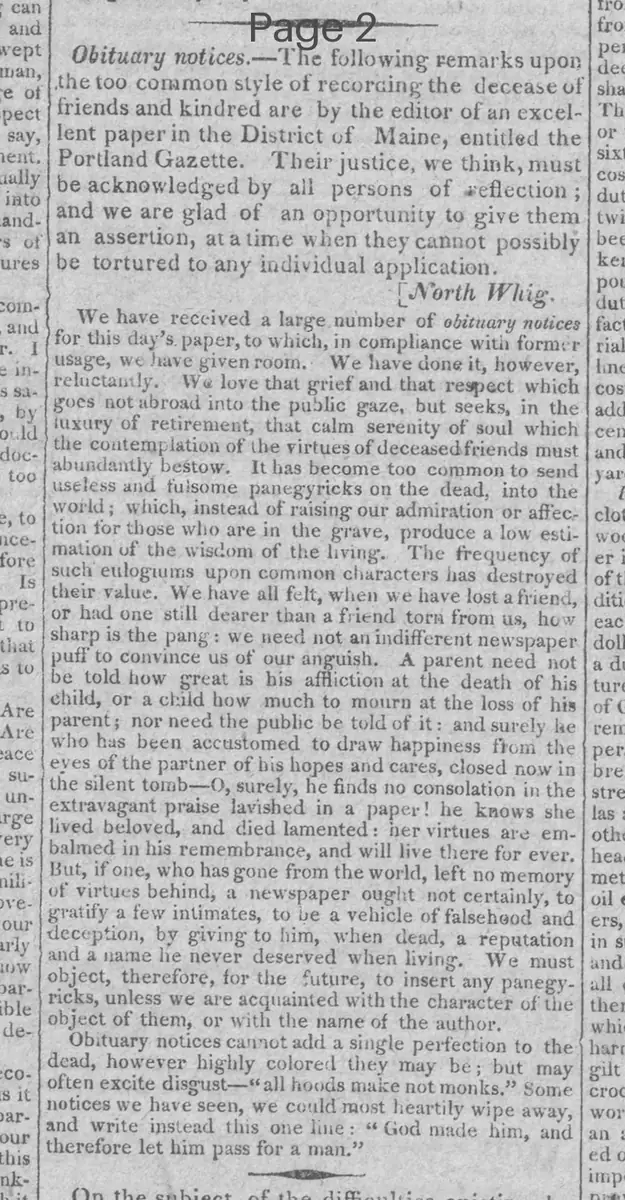
Obituary notices.—The following remarks upon the too common style of recording the decease of friends and kindred are by the editor of an excellent paper in the District of Maine, entitled the Portland Gazette. Their justice, we think, must be acknowledged by all persons of reflection; and we are glad of an opportunity to give them an insertion, at a time when they cannot possibly be tortured to any individual application.
North Whig.
We have received a large number of obituary notices for this day's paper, to which, in compliance with former usage, we have given room. We have done it, however, reluctantly. We love that grief and that respect which goes not abroad into the public gaze, but seeks, in the luxury of retirement, that calm serenity of soul which the contemplation of the virtues of deceased friends must abundantly bestow. It has become too common to send useless and fulsome panegyrics on the dead, into the world; which, instead of raising our admiration or affection for those who are in the grave, produce a low estimation of the wisdom of the living. The frequency of such eulogiums upon common characters has destroyed their value. We have all felt, when we have lost a friend, or had one still dearer than a friend torn from us, how sharp is the pang: we need not an indifferent newspaper puff to convince us of our anguish. A parent need not be told how great is his affliction at the death of his child, or a child how much to mourn at the loss of his parent; nor need the public be told of it: and surely he who has been accustomed to draw happiness from the eyes of the partner of his hopes and cares, closed now in the silent tomb—O, surely, he finds no consolation in the extravagant praise lavished in a paper! he knows she lived beloved, and died lamented: her virtues are embalmed in his remembrance, and will live there for ever.
But, if one, who has gone from the world, left no memory of virtues behind, a newspaper ought not certainly, to gratify a few intimates, to be a vehicle of falsehood and deception, by giving to him, when dead, a reputation and a name he never deserved when living. We must object, therefore, for the future, to insert any panegyrics, unless we are acquainted with the character of the object of them, or with the name of the author.
Obituary notices cannot add a single perfection to the dead, however highly colored they may be; but may often excite disgust—'all hoods make not monks.' Some notices we have seen, we could most heartily wipe away, and write instead this one line: 'God made him, and therefore let him pass for a man.'
North Whig.
We have received a large number of obituary notices for this day's paper, to which, in compliance with former usage, we have given room. We have done it, however, reluctantly. We love that grief and that respect which goes not abroad into the public gaze, but seeks, in the luxury of retirement, that calm serenity of soul which the contemplation of the virtues of deceased friends must abundantly bestow. It has become too common to send useless and fulsome panegyrics on the dead, into the world; which, instead of raising our admiration or affection for those who are in the grave, produce a low estimation of the wisdom of the living. The frequency of such eulogiums upon common characters has destroyed their value. We have all felt, when we have lost a friend, or had one still dearer than a friend torn from us, how sharp is the pang: we need not an indifferent newspaper puff to convince us of our anguish. A parent need not be told how great is his affliction at the death of his child, or a child how much to mourn at the loss of his parent; nor need the public be told of it: and surely he who has been accustomed to draw happiness from the eyes of the partner of his hopes and cares, closed now in the silent tomb—O, surely, he finds no consolation in the extravagant praise lavished in a paper! he knows she lived beloved, and died lamented: her virtues are embalmed in his remembrance, and will live there for ever.
But, if one, who has gone from the world, left no memory of virtues behind, a newspaper ought not certainly, to gratify a few intimates, to be a vehicle of falsehood and deception, by giving to him, when dead, a reputation and a name he never deserved when living. We must object, therefore, for the future, to insert any panegyrics, unless we are acquainted with the character of the object of them, or with the name of the author.
Obituary notices cannot add a single perfection to the dead, however highly colored they may be; but may often excite disgust—'all hoods make not monks.' Some notices we have seen, we could most heartily wipe away, and write instead this one line: 'God made him, and therefore let him pass for a man.'
What sub-type of article is it?
Moral Or Religious
Social Reform
What keywords are associated?
Obituary Notices
Panegyrics
Grief
Eulogies
Newspaper Practices
Falsehood In Praise
Private Mourning
What entities or persons were involved?
Portland Gazette Editor
North Whig
Editorial Details
Primary Topic
Criticism Of Fulsome Obituary Notices
Stance / Tone
Critical Of Excessive Public Eulogies, Advocating Private Grief And Journalistic Restraint
Key Figures
Portland Gazette Editor
North Whig
Key Arguments
Public Obituary Panegyrics Cheapen Genuine Grief And Respect.
Fulsome Eulogies On Ordinary People Diminish Their Value And Reflect Poorly On The Living.
Newspapers Should Not Publish False Praises To Deceive About The Deceased's Character.
Obituaries Add Nothing To The Dead But Can Cause Disgust If Exaggerated.
Future Insertions Require Editor's Knowledge Of The Subject Or Author's Name.