Thank you for visiting SNEWPapers!
Sign up free
Summit County Labor News
Akron, Summit County, Ohio
What is this article about?
Walter P. Reuther, president of the Auto Workers union, testifies before the Senate Anti-trust subcommittee, proposing a 'consumers council' to require major corporations to justify price increases publicly. He criticizes auto industry pricing for causing unemployment and outlines UAW's profit-sharing plan.
Merged-components note: Merged with continuation on page 4 for complete story on Reuther's proposal to Congress.
Clippings
1 of 2
OCR Quality
Full Text
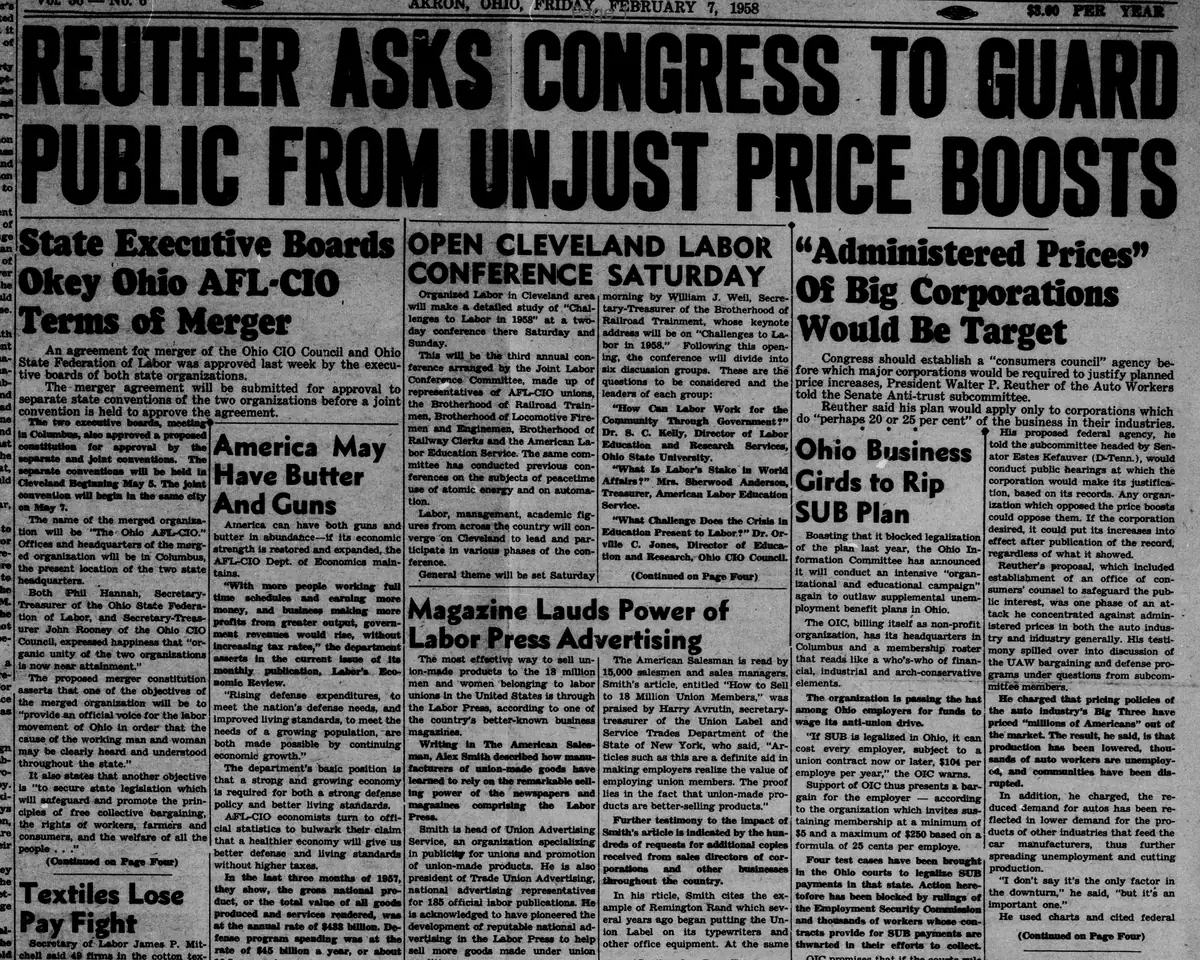
PUBLIC FROM UNJUST PRICE BOOSTS
Congress should establish a "consumers council" agency before which major corporations would be required to justify planned price increases, President Walter P. Reuther of the Auto Workers told the Senate Anti-trust subcommittee.
Reuther said his plan would apply only to corporations which do "perhaps 20 or 25 per cent" of the business in their industries.
His proposed federal agency, he told the subcommittee headed by Senator Estes Kefauver (D-Tenn.), would conduct public hearings at which the corporation would make its justification, based on its records. Any organization which opposed the price boosts could oppose them. If the corporation desired, it could put its increases into effect after publication of the record, regardless of what it showed.
Reuther's proposal, which included establishment of an office of consumers' counsel to safeguard the public interest, was one phase of an attack he concentrated against administered prices in both the auto industry and industry generally. His testimony spilled over into discussion of the UAW bargaining and defense programs under questions from subcommittee members.
He charged that pricing policies of the auto industry's Big Three have priced "millions of Americans" out of the market. The result, he said, is that production has been lowered, thousands of auto workers are unemployed, and communities have been disrupted.
In addition, he charged, the reduced demand for autos has been reflected in lower demand for the products of other industries that feed the car manufacturers, thus further spreading unemployment and cutting production.
"I don't say it's the only factor in the downturn," he said, "but it's an important one."
He used charts and cited federal
"Administered Prices Of Big Corporations Would Be Target"
(Continued from Page One)
statistics to show that if wages had increased at the same rate as profits between 1947 and 1955. UAW members at General Motors would now be averaging $6.60 an hour instead of $2.18, and at Ford would be receiving $12.79 instead of the $2.18.
"For every dollar of wage increase the industry gave us between 1944 and 1955," he declared, "they raised prices $5."
If such "selfish and socially irresponsible" pricing policies were followed by other major corporations, Reuther maintained, the economy would be in "complete and total depression." Should auto manufacturers alone continue them, he added, the result would be "disaster and chaos."
The fact that the big auto firms are taking "more than their share" means that purchasing power has declined, he said. The only difference between the depression and the present is that "built-in cushions" now prevent the "impact of unemployment" from "snowballing" as it did during the late 1920s and the 1930s, he added.
Reuther warned that the margin of unemployment now can represent "the margin of freedom's survival."
"I'd feel a lot better if Russia were using only 60 per cent of its steel capacity," he observed.
Instead, he went on, Russia is using "every ounce of muscle" while we are dragging our feet" and "limping along in low gear."
He outlined the UAW profit sharing plan, approved at the union's recent special convention, under which workers and consumers would receive benefits, the latter in the form of rebates when a company's profits were high.
Had this plan been in effect during the last 10 years, he said. GM stockholders and top executives would have a total of $9.3 billion, while consumers would have received rebates of $2.8 billion, and workers a like amount above their wages.
Kefauver asked if the union would stick with its plan if the profits were not high enough to share.
"Obviously, we can't share something which is non-existent," Reuther answered. "If there ever comes a time that GM does not make a profit, it will be the beginning of the end of America. Russia will send us a note asking how we want to give up. GM made profits through the great depression. We'll take our chances."
Reuther had two brushes with Senator Everett Dirksen, ultra conservative Illinois Republican.
At the start of Reuther's two days on the stand, Dirksen maintained the UAW president should be required to read his 110-page statement paragraph by paragraph. However, Kefauver ruled that, as usual, Reuther could file his statement and summarize it orally.
As the hearing drew to a close, Dirksen challenged the UAW profit sharing plan as a "possible public relations gimmick" and hinted that some of Reuther's statistics would "not stand the light of day."
"You have a right to be their (General Motors) representative here," Reuther rejoined.
Dirksen, denying he had "one cent" of interest in GM, complained he had treated "the witness like a gentleman but if he wants to roll up his sleeves," it was all right with him too. He suggested Reuther withdraw the charge.
Kefauver broke in to say that Dirksen did not represent GM, but "he may represent some of their viewpoints, just as others represent other viewpoints."
"That's what I meant," Reuther broke in. "He represents GM's views."
If he gave any other impression, he added, he withdrew it.
Dirksen questioned Reuther about a news story which attributed to him a statement that the UAW's 1945 attempt to get GM to open its books was a "publicity gimmick."
"That charge has been kicked around by the industry for years," Reuther replied. "Obviously we wanted to expose their hypocrisy. If you want to call that a public relations stunt, OK."
Dirksen asked if the union were not indulging in another public relations stunt with the profit sharing and price cut proposals.
"This is not a maneuver," Reuther shouted. 'We are dead serious about getting the price of automobiles down so the consumer won't be short changed. The corporations had better understand we are dead serious about what we are talking here today."
The union is committed not to get "one cent in wage increases which come out of our consumers," he added.
"On that we take our stand," he said.
What sub-type of article is it?
What themes does it cover?
What keywords are associated?
What entities or persons were involved?
Where did it happen?
Story Details
Key Persons
Location
Senate Anti Trust Subcommittee
Story Details
Walter P. Reuther proposes a consumers council agency for public hearings on corporate price increases, criticizes auto industry pricing for unemployment, outlines UAW profit-sharing plan, and clashes with Senator Dirksen during testimony.