Thank you for visiting SNEWPapers!
Sign up free
Randolph County Journal
Winchester, Randolph County, Indiana
What is this article about?
Detailed report on U.S. Congressional proceedings in late January, including debates on Homestead bill, Pacific Railroad routes, Slavery defense, Kansas Lecompton Constitution, Neutrality laws regarding filibusters, Army increase, and Minnesota statehood admission.
Clipping
OCR Quality
Full Text
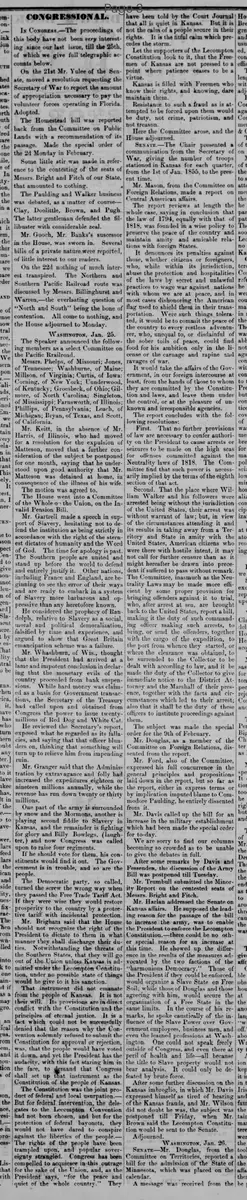
In Congress.-The proceedings of this body have not been very interesting since our last issue, till the 25th, of which we give full telegraphic accounts below.
On the 21st Mr. Yulee of the Senate, moved a resolution requesting the Secretary of War to report the amount of appropriation necessary to pay the volunteer forces operating in Florida. Adopted.
The Homestead bill was reported back from the Committee on Public Lands with a recommendation of its passage. Made the special order of the 2d Monday in February.
Some little stir was made in reference to the contesting of the seats of Messrs. Bright and Fitch of our State, that amounted to nothing.
The Paulding and Walker business was debated, as a matter of course-- Clay, Doolittle, Brown, and Pugh. The latter gentleman defended the filibuster with considerable zeal.
Mr. Gooch, Mr. Banks's successor in the House, was sworn in. Several bills of a private nature were reported. of little interest to our readers.
On the 22d nothing of much interest transpired. The Northern and Southern Pacific Railroad route was discussed by Messrs. Billinghurst and Warren,-the everlasting question of "North and South" being the bone of contention. All come to nothing, and the House adjourned to Monday.
WASHINGTON. Jan. 25.
The Speaker announced the following members as a select Committee on the Pacific Railroad.
Messrs. Phelps, of Missouri; Jones, of Tennessee; Washburne, of Maine: Millson, of Virginia; Curtis, of Iowa: Corning, of New York; Underwood of Kentucky; Groesbeck, of Ohio; Gilmore, of North Carolina; Singleton of Mississippi: Farnsworth, of Illinois; Phillips, of Pennsylvania; Leach, of Michigan; Bryan, of Texas, and Scott, of California.
Mr. Keitt, in the absence of Mr. Harris, of Illinois. who had moved for a resolution for the expulsion of Matteson, moved that a further consideration of the subject be postponed for one month, saying that he understood upon good authority that Mr. Matteson was detained at home, in consequence of the illness of his wife. The motion was agreed to.
The House went into a Committee of the Whole on the Union, on the Invalid Pension Bill.
Mr. Gartrell made a speech in support of Slavery, hesitating not to defend the institution as being strictly in accordance with the sternest dictates of humanity and the Word of God. The time for apology is past. The Southern people are united and stand up before the world to defend and entirely justify it. Other nations, including France and England, are beginning to see the error of their ways and are ready to embark in a system of Slavery more barbarous and oppressive than any heretofore known.
He considered the prophecy of Randolph, relative to Slavery as a social moral and political demoralization. falsified by time and experience, and argued to show that Great Britain emancipation scheme was a failure.
Mr. Washburn. of Wis.. thought that the President had arrived at a lame and impotent conclusion in declaring that the monetary evils of the country proceeded from bank suspensions. While hard money was claimed as a basis for Government transactions, the Secretary of the Treasury had called upon and obtained from Congress the power to issue twenty-millions of Red Dog and White Cat.
He reviewed the Secretary's report, exposed what he regarded as its fallacies, and saying that that officer blunders on, thinking that something will turn up to relieve him from impending ruin.
Mr. Granger said that the Administration by extravagance and folly had increased the expenditures eighteen or nineteen millions annually, while the revenue has run down twenty or thirty millions.
One part of the army is surrounded by snow and the Mormons, another is playing second fiddle to Slavery in Kansas, and the remainder is fighting for glory and Billy Bowlegs, (laughter,) and now Congress was called upon to raise four regiments.
If he should vote for them, his constituents would find it out. The Gov. ernment is in trouble, and so are the people.
The Democratic party, so called, turned the screw the wrong way when they passed the Free Trade Tariff Act. If they were wise they would restore prosperity to the country by a protective tariff with incidental protection.
Mr. Brigham said that the House should not recognize the right of the President to dictate to them in what manner they shall discharge their duties. Notwithstanding the threats of the Southern States, that they will go out of the Union unless Kansas is admitted under the Lecompton Constitution, under no possible state of things would he give to it his sanction.
That instrument did not emanate from the people of Kansas. It is not their will." Its provisions are in direct conflict with the Constitution and the principles of eternal justice. It is a fact which could not be successfully denied that the reason why the Convention solemnly refused to submit the Constitution for approval or rejection, was, that the people would have voted it down, and yet the President has the audacity, with this fact staring him in the face, to demand that Congress shall set up that instrument as the Constitution of the people of Kansas.
The Constitution was the joint product of federal and local usurpation. But for federal intervention. the delegates to the Lecompton Convention had not been chosen. and but for the protection of federal bayonets, they would not have dared to conspire against the liberties of the people. The rights of the people have been trampled upon, and popular sovereignty strangled. Congress has been compelled to acquiesce in this outrage for the sake of the Union, and, as the President says, "for the peace and quiet of the whole country." They have been told by the Court Journal that all is quiet in Kansas. But it is not the calm of a people secure in their rights. It is the fitful calm which precedes the storm Let the supporters of the Lecompton Constitution look to it, that the Free-men of Kansas are not pressed to a point where patience ceases to be a virtue.
Kansas is filled with Freemen who know their rights, and knowing, dare maintain them. Resistance to such a fraud as is attempted to be forced upon them would be duty, not crime, patriotism, and not treason.
Here the Committee arose, and the House adjourned.
SENATE.-The Chair presented communication from the Secretary of War, giving the number of troops stationed in Kansas for each quarter, from the 1st of Jan. 1855, to the present time.
Mr. Mason, from the Committee on Foreign Relations, made a report on Central American affairs.
The report reviews at length the whole case, saying in conclusion that the law of 1794. equally with that of 1818, was founded in a wise policy to preserve the peace of the country and maintain amity and amicable relations with foreign States.
It denounces its penalties against those, whether citizens or foreigners who. while within its jurisdiction abuse the protection and hospitalities of the laws by secret and unlawful practices to wage war against nations with whom we are at peace, and in most cases dishonoring the American flag used to shield them in their transportation. Were such things tolerated, it would be to commit the peace of the country to every restless adventurer, who, unequal to, or disdainful of the sober toils of peace, could find food for his ambition only in the license or the carnage and rapine and ravages of war.
It would take the affairs of the Government, in our foreign intercourse at least, from the hands of those to whom they are committed by the Constitution and laws, and leave them under the control, or at the pleasure of unknown and irresponsible agencies.
The report concludes with the following resolutions:
First. That no further provisions of law are necessary to confer authority on the President to cause arrests or seizures to be made on the high seas for offenses committed against the Neutrality laws of 1818. The Committee find that such power is necessarily implied by the terms of the eighth section of that act.
Second. That the place where William Walker and his followers were arrested being without the jurisdiction of the United States, their arrest was without warrant of law: but, in view of the circumstances attending it and its results in taking away from a Territory and State in amity with the United States, American citizens who were there with hostile intent, it may not call for further censure than as it might hereafter be drawn into precedent if suffered to pass without remark.
The Committee, inasmuch as the Neutrality Laws may be made more efficient by some proper provision for bringing offenders against it to trial. who, after arrest at sea, are brought back to the United States, report a bill, making it the duty of such commanding officer making such arrests, to bring, or send the offenders, together with the cargo of the expedition, to the port from whence they started, or where the clearance was obtained, to be surrendered to the Collector to be dealt with according to law, and it be made the duty of the Collector to give immediate notice to the District Attorney and the Marshal of their presence, together with the facts and circumstances which led to their arrest; also that it shall be the duty of these officers to institute proceedings against them.
The subject was made the special order for the 9th of February.
Mr. Douglas, as a member of the Committee on Foreign Relations, dissented from the report.
Mr. Ford, also of the Committee. expressed his full concurrence in the general principles and propositions laid down in the report, but so far as the report, either in express terms or by implication imputed blame to Commodore Paulding, he entirely dissented from it.
Mr. Davis called up the bill for an increase in the military establishment which had been made the special order for to-day.
We are sorry to find our columns becoming so crowded as to be unable to give the debates in full.
After some remarks by Davis and Fessenden, the discussion of the Army Bill was postponed till Tuesday.
Mr. Trumbull submitted the Minority Report on the contested seats of Messrs. Bright and Fitch.
Mr. Harlan addressed the Senate on Kansas affairs. He supposed the leading reason for the passage of the bill to increase the army, was to enable the President to enforce the Lecompton Constitution,-there could be no other special reason for an increase at this time. He showed up the difference in the results of the measures advocated by the two factions of the "harmonious Democracy." Those of the President if they could be enforced, would organize a Slave State on Free Soil; while those of Douglas and those agreeing with him, would secure the organization of a Free State in the same limits. In the course of his remarks. he spoke caustically of the influence of the Slave Power over Government employees, business men, and even the learned professions at Washington. One could not speak freely outside of Congress, and even there at peril of health and life--all because the title to Slave property would not bear analysis. It could only be defeated by brute force.
After some further discussion on the Kansas imbroglio. in which Mr. Davis expressed himself as tired of hearing of the Kansas frauds. and Mr. Wilson did not doubt he was, the subject was postponed till Friday, when Mr. Brown said the Lecompton Constitution would be sent to the Senate.
Adjourned.
WASHINGTON. Jan. 26.
SENATE Mr. Douglas. from the Committee on Territories, reported a bill for the admission of the State of Minnesota, which was placed on the calendar.
A message was received from the House announcing the death Messrs. Brenton and Lockhart, elected to Congress from Indiana. Messrs. Bright and Fitch delivered eulogies, and the usual resolutions of respect were adopted, and the Senate proceeded to the consideration of the bill to increase the efficiency of the army.
The bill was again discussed at length by a number of Senators. But, without taking the question the Senate adjourned.
HOUSE-The House appointed Committee to investigate the charges against members or officers of the last Congress, growing out of the disbursement of money by Lawrence, Stone & Co., to employ stenographers.
The House went into a Committee of the Whole on the State of the Union on the Invalid Pension bill.
Mr. Anderson, belonging to neither of the prominent political parties, said the only course left him to pursue was to support the Administration in every attempt to resist this fearful encroachment on the Constitutional rights of the South. He thought by so doing he should represent the American party in Missouri, which has no sympathy with the Republican party.
The present excitement in Kansas will soon pass away. In advocating the Lecompton Constitution he could see no reason to refuse the admission of Kansas under that instrument.
Clark B. Cochrane spoke with interest and force against the Lecompton Constitution, saying that it had been refused by the people four to one, and he had no doubt the Free State officers were elected, and that they would be counted out he was just as certain, to make up by frauds what was wanting in numbers. This was the object of the Lecompton or Calhoun movement.
The question was whether Congress was prepared to force that loathed and abhorred constitution on the people. not only without their consent, but against their recorded will? That constitution was a swindle reeking with fraud and branded with popular condemnation, and was recommended to the approval of Congress by the President not on the ground of justice, but on the plea of expediency. That constitution was a fugitive from justice, and smuggled here under the cover of the federal arms with the odor of death upon it. The constitution was buried by more than 10,000 freemen; instead of breathing into it the breath of life it should be carried back for interment. It was designedly made odious to keep away from the polls those who were not in the plot of seizing on the Executive and his followers to see it through. but the Administration has counted without its host. If the expectation in this is realized, the Democratic party will become geographically what it is in principle and fact, a mere sectional organization.
We cannot give the debate in full at this late hour. Several other Senators asked leave to introduce bills or resolutions. but not obtaining it nothing more was done. Adjourned
What sub-type of article is it?
What keywords are associated?
What entities or persons were involved?
Where did it happen?
Domestic News Details
Primary Location
Washington
Event Date
January 21 26
Key Persons
Outcome
deaths of messrs. brenton and lockhart announced; various bills postponed or reported; debates ongoing without resolutions on key issues like kansas and army increase.
Event Details
Summary of U.S. Congress proceedings including resolutions on Florida volunteers, Homestead bill scheduling, seat contests, filibuster debates, Pacific Railroad committee appointment, postponement of Matteson expulsion, speeches defending Slavery and criticizing Administration, debates on Kansas Lecompton Constitution, Neutrality laws report on Walker filibuster, Army increase bill discussions, Minnesota admission bill reported, and eulogies for deceased members.