Thank you for visiting SNEWPapers!
Sign up free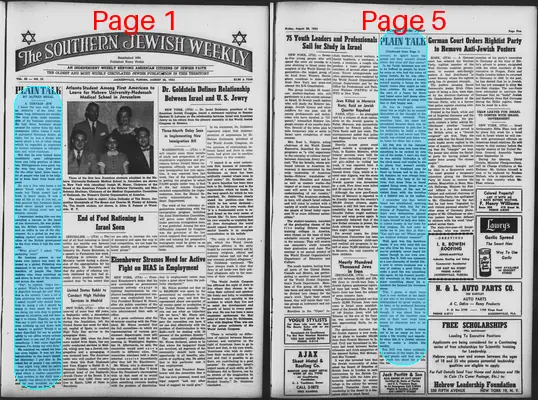
Editorial
August 28, 1953
The Southern Jewish Weekly
Jacksonville, Duval County, Florida
What is this article about?
Alfred Segal's tribute to Ben Z. Doll, a Jewish furniture dealer who embodied Torah values through social activism, including picketing the British consulate over the Palestine mandate, aiding evictees, and fundraising for Israel's defense, highlighting a life of character over fame.
Merged-components note: Continuation of 'PLAIN TALK' column across pages 1 and 5.
Clippings

1 of 2
OCR Quality
95%
Excellent
Full Text
PLAIN TALK
BY ALFRED SEGAL
A CERTAIN JEW
I knew the man well. He was no celebrity of the kind for whom long obituaries are written. The local press made considerable of his business connections. He had three furniture stores around the corner from the daily newspaper office where I work. A successful furniture dealer, all right, but he was a dealer who cared about a lot of other things which he regarded as important to human existence as refrigerators and wash-machines. Not that he ever looked down snobbishly upon refrigerators from any lofty position of idealism. Refrigerators were good, too, the way they keep food fresh. On the other hand, there were a lot of people who had to be helped to keep their lives fresh and good.
He was a Jew who knew a lot about Torah which he would quote but Torah wasn't just a book to know about. It was a way of life to try to live by; on that account this furniture dealer cared about people even more than for dining room sets and kitchen utensils.
I remember seeing him one day carrying a banner in the heart of our downtown. He was picketing the British consulate which had an office in one of the skyscrapers. As a picket he was protesting against some injustice or other of the British government in the time when it had the mandate.
"What gives?" I asked. "You picketing here!"
No business person in our town ever before had been detected as a picket. Picketing was supposed to be only the despised function of people like those waiters who were marching up and down in front of the restaurant across the street.
"Yes", he replied, "that's me—a picket. What's the matter Isn't it dignified enough for me? Well this is the answer. I saw a lot of kids picketing this consulate and I asked myself why should these kids be doing a job I should be doing in their stead. So here I am doing my own duty to protest against an injustice and not leaving it to others. Dignity, you say. You say it isn't nice for me to be seen walking up and down with a banner in public? Would it be more dignified for me to protest safely in my office where nobody could hear or see me? I'll tell you something: I feel more dignified because I'm doing my own duty."
He marched on, raised his banner even higher. It was my first introduction to the man's essential character: I put him in the select list of people I can admire.
One night long after he called me up at home. He was quite excited about a matter—something I had written in the daily press: A family was about to be evicted and he was troubled on their (Continued on Page 5)
THE SOUTHERN JEWISH WEEKLY
PLAIN TALK
(Continued from Page 1)
account; he didn't know the people and they weren't Jewish either. But what did that matter? In his Torah kindness was not to be limited to people he knew by name or who had the name of being Jewish. So he was offering a good contribution of money toward buying a house for this family where they might be safe from eviction. He was making the start of a home for them and hoped some half dozen other businessmen would go along with him to that happy end.
He was as happily excited about this as might be an ancient Maccabee at the thought of the temple being restored. Then, sometime later, his heart felt devastated because there was no other businessman to join him in his dedication to build a home for people he had never met. The family was evicted and there was no home for them but a slum.
All this was of his Judaism which to this man was more than something to be recited by rote out of the books. I can't say that he was strictly Orthodox in all the ritual sense and maybe he ate in places that weren't exactly kosher. As a furniture man he fixed up homes and in his Jewish function he was always busy with those who help to fix up lives. And since lives in Israel needed fixing most, Israel was a prime devotion of his, and he visited there with the devotion of a faithful son to his mother.
I remember one day, before Israel was established, entering a conspiracy with him for the defense of Palestine. The Jews there were defenseless against their enemies and he had taken it upon himself to help arm them, to collect money in our town for that purpose. He had come to invite me to join him in this-- "You can't say no! Where people are helpless without weapons".
Well, such was this furniture dealer. If you who read this are one who lives far from our town you've probably never heard his name; though in our own community Ben Z. Doll was esteemed as a rare character of Jewish life--a man to whom business was a way of making a good living to make a good life was something else again. At his funeral practically everybody in the big crowd knew something about his abundant life beyond his furniture stores.
This, I guess, is much more than is ever written at the death of one who in his lifetime wasn't distinguished by great wealth, or by fame, or by profound learning or by prominence. I thought, though, it was about time to notice one of the humbler ones who in their own ways have shown by character how to be Jewish.
So Ben Doll's obituary turns out to be an essay on how to make a life worthy and especially since this is a Jewish column how to make a Jewish life worthy.
Ben Doll was taken suddenly by a seizure of the heart. He was 56, and people said that was an age much too short for a life like his.
BY ALFRED SEGAL
A CERTAIN JEW
I knew the man well. He was no celebrity of the kind for whom long obituaries are written. The local press made considerable of his business connections. He had three furniture stores around the corner from the daily newspaper office where I work. A successful furniture dealer, all right, but he was a dealer who cared about a lot of other things which he regarded as important to human existence as refrigerators and wash-machines. Not that he ever looked down snobbishly upon refrigerators from any lofty position of idealism. Refrigerators were good, too, the way they keep food fresh. On the other hand, there were a lot of people who had to be helped to keep their lives fresh and good.
He was a Jew who knew a lot about Torah which he would quote but Torah wasn't just a book to know about. It was a way of life to try to live by; on that account this furniture dealer cared about people even more than for dining room sets and kitchen utensils.
I remember seeing him one day carrying a banner in the heart of our downtown. He was picketing the British consulate which had an office in one of the skyscrapers. As a picket he was protesting against some injustice or other of the British government in the time when it had the mandate.
"What gives?" I asked. "You picketing here!"
No business person in our town ever before had been detected as a picket. Picketing was supposed to be only the despised function of people like those waiters who were marching up and down in front of the restaurant across the street.
"Yes", he replied, "that's me—a picket. What's the matter Isn't it dignified enough for me? Well this is the answer. I saw a lot of kids picketing this consulate and I asked myself why should these kids be doing a job I should be doing in their stead. So here I am doing my own duty to protest against an injustice and not leaving it to others. Dignity, you say. You say it isn't nice for me to be seen walking up and down with a banner in public? Would it be more dignified for me to protest safely in my office where nobody could hear or see me? I'll tell you something: I feel more dignified because I'm doing my own duty."
He marched on, raised his banner even higher. It was my first introduction to the man's essential character: I put him in the select list of people I can admire.
One night long after he called me up at home. He was quite excited about a matter—something I had written in the daily press: A family was about to be evicted and he was troubled on their (Continued on Page 5)
THE SOUTHERN JEWISH WEEKLY
PLAIN TALK
(Continued from Page 1)
account; he didn't know the people and they weren't Jewish either. But what did that matter? In his Torah kindness was not to be limited to people he knew by name or who had the name of being Jewish. So he was offering a good contribution of money toward buying a house for this family where they might be safe from eviction. He was making the start of a home for them and hoped some half dozen other businessmen would go along with him to that happy end.
He was as happily excited about this as might be an ancient Maccabee at the thought of the temple being restored. Then, sometime later, his heart felt devastated because there was no other businessman to join him in his dedication to build a home for people he had never met. The family was evicted and there was no home for them but a slum.
All this was of his Judaism which to this man was more than something to be recited by rote out of the books. I can't say that he was strictly Orthodox in all the ritual sense and maybe he ate in places that weren't exactly kosher. As a furniture man he fixed up homes and in his Jewish function he was always busy with those who help to fix up lives. And since lives in Israel needed fixing most, Israel was a prime devotion of his, and he visited there with the devotion of a faithful son to his mother.
I remember one day, before Israel was established, entering a conspiracy with him for the defense of Palestine. The Jews there were defenseless against their enemies and he had taken it upon himself to help arm them, to collect money in our town for that purpose. He had come to invite me to join him in this-- "You can't say no! Where people are helpless without weapons".
Well, such was this furniture dealer. If you who read this are one who lives far from our town you've probably never heard his name; though in our own community Ben Z. Doll was esteemed as a rare character of Jewish life--a man to whom business was a way of making a good living to make a good life was something else again. At his funeral practically everybody in the big crowd knew something about his abundant life beyond his furniture stores.
This, I guess, is much more than is ever written at the death of one who in his lifetime wasn't distinguished by great wealth, or by fame, or by profound learning or by prominence. I thought, though, it was about time to notice one of the humbler ones who in their own ways have shown by character how to be Jewish.
So Ben Doll's obituary turns out to be an essay on how to make a life worthy and especially since this is a Jewish column how to make a Jewish life worthy.
Ben Doll was taken suddenly by a seizure of the heart. He was 56, and people said that was an age much too short for a life like his.
What sub-type of article is it?
Moral Or Religious
Social Reform
Foreign Affairs
What keywords are associated?
Jewish Life
Torah Principles
Social Activism
Palestine Mandate
Israel Support
Ben Doll Obituary
What entities or persons were involved?
Ben Z. Doll
Alfred Segal
British Consulate
Israel
Editorial Details
Primary Topic
Tribute To Ben Z. Doll's Exemplary Jewish Life And Activism
Stance / Tone
Admiring And Inspirational
Key Figures
Ben Z. Doll
Alfred Segal
British Consulate
Israel
Key Arguments
Living By Torah Principles Prioritizes Helping People Over Business
Activism Like Picketing For Justice In Palestine Is A Personal Duty
Kindness Extends To All People Regardless Of Familiarity Or Religion
Supporting Defenseless Jews In Palestine Through Fundraising Is Essential
A Worthy Jewish Life Involves Character And Action Beyond Wealth Or Fame