Thank you for visiting SNEWPapers!
Sign up free
The New Hampshire Gazette
Portsmouth, Rockingham County, New Hampshire
What is this article about?
Reports on U.S. congressional proceedings from January 5-11, 1832, including Senate debates on Indian goods duties, bill passages, and resolutions on tariffs and Bank of the United States charter renewal; House discussions on postage, claims, patents, naval appropriations, and revolutionary pensions.
Merged-components note: Components form a continuous report on U.S. Congress proceedings; relabeled the second from 'story' to 'domestic_news' for consistency as it covers national political news
Clippings
1 of 2
OCR Quality
Full Text
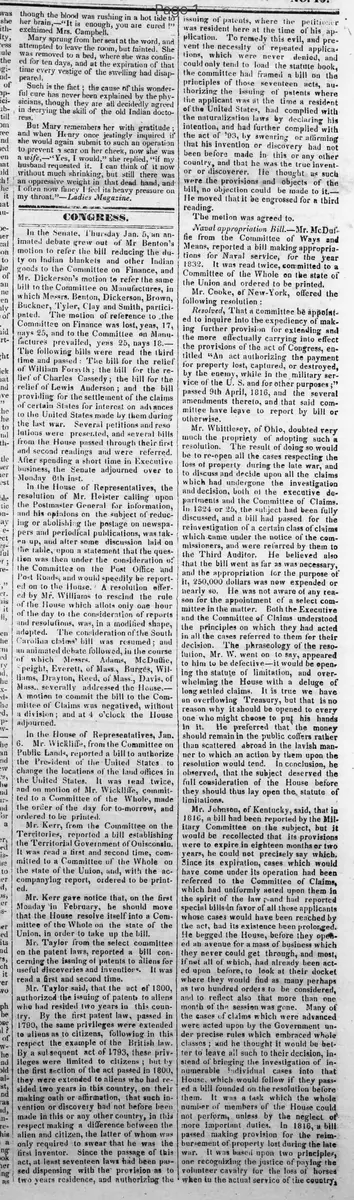
In the Senate, Thursday Jan. 5, an animated debate grew out of Mr Benton's motion to refer the bill reducing the duty on Indian blankets and other Indian goods to the Committee on Finance, and Mr. Dickerson's motion to refer the same bill to the Committee on Manufactures, in which Messrs. Benton, Dickerson, Brown, Buckner, Tyler, Clay and Smith, participated. The motion of reference to the Committee on Finance was lost, veas, 17, nays 25, and to the Committee on Manufactures prevailed, yeas 25, nays 18.
The following bills were read the third time and passed: The bill for the relief of William Forsyth: the bill for the relief of Charles Cassedy; the bill for the relief of Lewis Anderson: and the bill providing for the settlement of the claims of certain States for interest on advances to the United States made by them during the last war. Several petitions and resolutions were presented, and several bills from the House passed through their first and second readings and were referred.
After spending a short time in Executive business, the Senate adjourned over to Monday 9th inst.
In the House of Representatives, the resolution of Mr. Heister calling upon the Postmaster General for information, and his opinions on the subject of reducing or abolishing the postage on newspapers and periodical publications, was taken up, and after some discussion laid on the table, upon a statement that the question was then under the consideration of the Committee on the Post Office and Post Roads, and would speedily be reported on to the House. A resolution offered by Mr. Williams to rescind the rule of the House which allots only one hour of the day to the consideration of reports and resolutions, was, in a modified shape, adopted. The consideration of the South Carolina claims' bill was resumed; and an animated debate followed, in the course of which Messrs. Adams, McDuffie, Peight, Everett, of Mass., Burges, Williams, Drayton, Reed, of Mass., Davis, of Mass., severally addressed the House.
A motion to commit the bill to the Committee of Claims was negatived, without a division: and at 4 o'clock the House adjourned.
In the House of Representatives, Jan. 6. Mr. Wickliffe, from the Committee on Public Lands, reported a bill to authorize the President of the United States to change the locations of the land offices in the United States. It was read twice, and on motion of Mr. Wickliffe, committed to a Committee of the Whole, made the order of the day for to-morrow, and ordered to be printed.
Mr. Kerr, from the Committee on the Territories, reported a bill establishing the Territorial Government of Wisconsin. It was read a first and second time, committed to a Committee of the Whole on the state of the Union, and, with the accompanying report, ordered to be printed.
Mr. Kerr gave notice that, on the first Monday in February, he should move that the House resolve itself into a Committee of the Whole on the state of the Union, in order to take up the bill.
Mr. Taylor from the select committee on the patent laws, reported a bill concerning the issuing of patents to aliens for useful discoveries and inventions. It was read a first and second time.
Mr. Taylor said, that the act of 1800. authorized the issuing of patent to aliens who had resided two years in this country. By the first patent law, passed in 1790, the same privileges were extended to aliens as to citizens. following in this respect the example of the British law. By a subsequent act of 1793, these privileges were limited to citizens; but by the first section of the act passed in 1800. they were extended to aliens who had resided two years in this country, on their making oath or affirmation, that such invention or discovery had not before been made in this or any other country, in this respect making a difference between the alien and citizen, the latter of whom was only required to swear that he was the first inventor. Since the passage of this act, at least seventeen laws had been passed dispensing with the provision as to two years residence, and authorizing the issuing of patents, where the petitioner was resident here at the time of his application. To remedy this evil, and prevent the necessity of repeated applications, which were never denied, and could only tend to load the statute book. the committee had framed a bill on the principles of those seventeen acts, authorizing the issuing of patents where the applicant was at the time a resident of the United States, had complied with the naturalization laws by declaring his intention, and had further complied with the act of '93, by swearing or affirming that his invention or discovery had not been before made in this or any other country, and that he was the true inventor or discoverer. He thought as such were the provisions and objects of the bill, no objection could be made to it.
He moved that it be engrossed for a third reading.
The motion was agreed to.
Naval appropriation Bill.-Mr. McDuffie from the Committee of Ways and Means, reported a bill making appropriations for Naval service, for the year 1832. It was read twice, committed to a Committee of the Whole on the state of the Union and ordered to be printed.
Mr. Cooke, of New-York, offered the following resolution :
Resolved, That a Committee be appointed to inquire into the expediency of making further provision for extending and the more effectually carrying into effect the provisions of the act of Congress, entitled "An act authorizing the payment for property lost, Captured, or destroyed, by the enemy, while in the military service of the U. S. and for other purposes;" passed 9th April, 1816, and the several amendments thereto, and that said committee have leave to report by bill or otherwise.
Mr. Whittlesey, of Ohio, doubted very much the propriety of adopting such a resolution. The result of doing so would be to re-open all the cases respecting the loss of property during the late war, and to discuss and decide upon all the claims which had undergone the investigation and decision, both of the executive departments and the Committee of Claims. In 1824 or 25, the subject had been fully discussed, and a bill had passed for the reinvestigation of a certain class of claims which came under the notice of the commissioners, and were referred by them to the Third Auditor. He believed also that the bill went as far as was necessary, and the appropriation for the purpose of it, 250,000 dollars was now expended or nearly so. He was not aware of any reason for the appointment of a select committee in the matter. Both the Executive and the Committee of Claims understood the principles on which they had acted in all the cases referred to them for their decision. The phraseology of the resolution, Mr. W. went on to say, appeared to him to be defective-it would be opening the statute of limitation, and overwhelming the House with a deluge of long settled claims. It is true we have an overflowing Treasury, but that is no reason why it should be opened to every one who might choose to put his hands in it. He preferred that the money should remain in the public coffers rather than scattered abroad in the lavish manner to which an action by them upon the resolution would tend. In conclusion, he observed, that the subject deserved the full consideration of the House before they should thus lay open the statute of limitations.
Mr. Johnson, of Kentucky, said, that in 1816, a bill had been reported by the Military Committee on the subject, but it would be recollected that its provisions were to expire in eighteen months or two years, he could not precisely say which, Since its expiration, cases which would have come under its operation had been referred to the Committee of Claims. which had uniformly acted upon them in the spirit of the law; and had reported special bills in favor of all those applicants whose cases would have been reached by the act, had its existence been prolonged. He begged the House, before they opened an avenue for a mass of business which they never could get through, and most, if not all of which. had already been acted upon before, to look at their docket where they would find as many perhaps as two hundred orders to be considered, and to reflect also that more than one month of the session was gone. Many of the cases of claims which were advanced were acted upon by the Government under precise rules which embraced whole classes; and he thought it would be better to leave all such to their decision, instead of bringing the investigation of innumerable individual cases into that House, which would follow if they passed a bill founded on the resolution before them. It was a task which the whole number of members of the House could not perform, unless by the neglect of more important duties. In 1816, a bill passed making provision for the reimbursement of property lost during the late war. It was based upon two principles, one recognizing the justice of paying the volunteer cavalry for the loss of horses when in the actual service of the country,
and the other admitting, in like manner, the claim of the mounted infantry of the militia to the same allowance for such loss. The loss of a horse by an officer in the regular service could be easily provided for; but that of the officers of the militia, who were the mounted infantry, could not be so. These were the true principles upon which the bill was founded, he observed: they were equitable and sufficient to answer the purposes for which they were intended, and were acted upon by the Committee of Claims.
Mr. Johnson went on to comment on the delay which even now attended the passing of such claims through the House. His constituents were frequently writing to him on the subject of such claims, and if it was fortunate enough, by preferring them at an early period of the session, to obtain a favorable report and a bill, they were frequently delayed so long, from various causes, through the session, as not to receive their final action, and were swept away and numbered with the days beyond the flood. This was the case often from session to session; and how then could it be expected that they could wade through ten times the business which could be done elsewhere, where it ought to be done at all. It was better, he repeated, to send such subjects to the Executive Departments. The desolation of war he knew could not be paid by any Government; but there was not a more sacred claim upon any Government than those of the sufferers by war.
Mr. Hubbard here moved the order of the day.
The effect of the motion in this case is to suspend the discussion.
Mr. Hubbard subsequently, at the request of Mr. Ward, moved that when the House adjourned it adjourn till Monday next.
The motion was agreed to; and Mr. Hubbard renewed his motion that the House proceed to the order of the day; which was agreed to.
Revolutionary Pensions.--The House in committee of the whole, took up several bills for granting pensions for revolutionary services.
Upon four of the bills, Mr. Root objected to a concurrence of the House in the report of the committee. He thought the granting of pensions by special enactment extremely objectionable; but it was too late to resist the provisions of the laws of 1818 and '20, as they had already been acted on. It was a popular measure in that House and the country, to grant pensions to revolutionary soldiers, or those who pretended to be so, and as long as it was so, they should receive his vote in that House. He objected to the system, and should move that the bill be recommitted to the Committee of Revolutionary Pensions, with instructions to report a general bill, with such provisions as would embrace these four and all cases of a similar nature.
Mr. Hubbard said, those four cases had been year after year before the House, and their claims reported on favorably by different committees. The effect of the motion to recommit would be, that the suffering old men would be sent back again, for no bill for their relief would pass that session, and other cases would be lost to sight. He appealed to the magnanimity and justice of the House to negative the motion, or it would go forth that the petition of revolutionary soldiers met with but little attention indeed in that House.
Mr. Thomas, of Louisiana, said, he was sorry to see the gentleman from New-York (Mr. Root) was for driving out of that House those old soldiers who had fought to put them in. No general law could ever be framed to embrace every case, and claimants came there to obtain that justice which the prescribed rules of the departments did not admit. Their claims, if not legal according to the strict letter of the law, were equitable, and was it to be said that this House was not to grant a petitioner relief? Was that doctrine to be advanced, or would they grant justice to those who fought for liberty? It was not necessary for him to ask the House such questions. Perhaps the gentleman from New-York knew not what it was to shoulder a knapsack and march through mud and water. He, (Mr. T.,) had done so, and knew how to appreciate the services of those gallant soldiers who had endured nakedness and hunger for the establishment of the glorious liberty which this country enjoyed.
The question was then taken, and Mr. Root's motion was negatived. Eight of the bills were then ordered to be engrossed for a third reading. Before the others were acted upon, on motion of Mr. Evans, of Maine, the House adjourned.
In the Senate, Jan. 9, a message was received from the President of the United States, by the hands of Mr. Donelson, his Private Secretary.
The Tariff--Mr. Clay submitted the following resolutions--the consideration of which he gave notice, he should ask for to-morrow:
Resolved, That the existing duties upon articles imported from foreign countries, and not coming into competition with similar articles made or produced within the U. States, ought to be forthwith abolished, except the duties on Wines and Silks, and that they ought to be reduced.
Resolved, That the Committee on Finance report a bill accordingly.
On motion of Mr. Hayne, who remarked that the subject of the resolution was of the last importance, it was ordered to be printed.
Bank of the United States--Mr. Dallas in presenting the memorial of the Bank of the United States to the Senate, said, that being requested to present the memorial in his hand, he must be indulged in doing so, with a few explanatory remarks. It was a memorial from the Directors, in the name and on the behalf of the Stockholders, for a renewal of their existing charter. With unhesitating frankness, he wished it to be understood by the Senate, by the good Commonwealth which it was alike his duty and his pride to represent with fidelity, and by the people generally, that this application, at this time, had been discouraged by him. Influenced by a desire to preserve to the nation the practical benefits of the institution, the expediency of bringing it forward thus early in the term of its incorporation, during a popular representation which must cease and be twice succeeded or renewed before that term expires, and on the eve of all the excitement incident to a great political movement, had struck his mind as somewhat more than doubtful. He had felt, and still felt, deep solicitude and apprehension lest, in the progress of enquiry, and in the development of opinions, under present circumstances, it might be brought into real or imagined conflict with some higher, more favorite, and more immediate wish and purpose of the American people: and from such a conflict, what sincere friend of this useful establishment would not struggle to save or to reverse it, by at least a temporary forbearance and delay? Nevertheless, Mr. D. said, his conscious inexperience in the forms and contingencies of legislation, inspired a distrust of his own judgment on this merely preliminary point. The determinations of the parties interested may--nay, must be--wiser and better:--and he could not but feel strongly impressed by the recollection that the Legislature of Pennsylvania, recently, and in effect unanimously, had recommended the renewal of the charter of this Bank. He became, therefore, a willing, as he was virtually an instructed agent, in furthering an object which, however dangerously timed its introduction might seem or prove, was in itself, as he conceived, worthy of every consideration and favor. He therefore moved the reading and printing of the memorial, and its reference to a Select Committee.
The memorial having been read, it was ordered to be printed, and to be referred to a Select Committee of five.
Mr. Dallas moved that the appointment of the Select Committee be deferred till to-morrow.
Mr. Bell would oppose the delay, he said, unless some reason should be given for it. The motion was, so far as his recollection extended, unprecedented in this body.
The question being taken on the motion to postpone, it was lost--ayes 14, noes 24.
The following Committee was then chosen by ballot: Messrs. Dallas, Webster, Ewing, Hayne and Johnston.
Navy Agents.--The bill respecting the compensation and duties of Navy Agents was taken up for consideration.
Mr. Hayne read a document from the Navy Department, which showed the reasons on which the bill was founded. The allowances are various, and have grown up during a long time, and are of doubtful legality.--They have also exceeded the estimates of every year, and there are now large claims on the Department in favor of different agents.
To remove the inconvenience and uncertainty of the present allowances, and to afford to the navy agents a compensation proportioned to their services, this bill was framed. The second section put the navy agency of Washington on the same footing with other agencies. This last measure had been delayed, because it was not thought of sufficient importance to adopt it as a separate measure, but as other agencies were now to be regulated, this agency was embraced in the bill.
The bill was ordered to a third reading.
Among the petitions presented in the House of Representatives, was one by Mr. McDuffie, from the President, Directors and Company of the Bank of the United States, praying for a re-charter of said institution. A discussion of considerable length took place on the reference of this petition, in which Messrs. Wayne, McDuffie, Cambreleng, Coulter, Archer, Mercer, Ingersoll, Carson, Davis, of South-Carolina, Wilde, Appleton, Mitchell, of South-Carolina, Root, Dearborn, Johnson, of Va., Howard, Foster, Jenifer, Huntingdon, Sutherland, Ellsworth, and Hoffman, took part. The petition was finally referred to the Committee of Ways and Means by a vote of 100 to 90, and the House adjourned at a late hour.
In the Senate, Tuesday, Jan. 10, the President transmitted a Report from the Secretary of State, on the subject of a commercial arrangement with the Republic of Columbia, which requires legislative action to carry it into effect.--Referred to the Committee on Foreign Relations.
A memorial was presented from Adams County, Illinois, praying that a Railroad may be located and constructed by the United States, from Buffalo to the Mississippi river.
Mr. Clay's resolution was taken up, postponed at his own request, and made the order of the day for Wednesday.
Bank of the United States.--Mr. Benton submitted the following motions:--
Resolved, That the Secretary of the Treasury be directed to furnish the Senate with the names and titles of the foreign stockholders in the Bank of the United States, if any document in his office will afford that information; and if not, to endeavor to obtain that information as soon as possible, with the amount of stock held by each.
Resolved, That the Secretary of the Treasury be directed to lay before the Senate, information, first, of the amount of debts due from individuals and bodies corporate to the Bank of the United States and its branches, distinguishing the amount secured by mortgage from that secured by personal security alone; and what portion of said debts are considered as standing accommodations to the customers of said Bank and its branches.
Resolved, That the Secretary of the Treasury be directed to lay before the Senate a list of the Directors of the Bank of the United States, and of the several branches, and a statement of the stock held by citizens of the United States, with the number of shares held by each, and the state or territory of their residencies; also the amount of specie according to their last return, in the vaults of the Bank, and its branches, distinguishing the part which belongs to the Bank, the portion belonging to individuals, and to the United States.
Resolved, That the Secretary of the Treasury be directed to lay before the Senate the monthly statements of the affairs of the Bank of the U. nited States, for the year 1831.
The Senate spent some time in executive business, and then adjourned.
In the House, numerous reports were received from committees, mostly relating to private claims: A message was received from the President, similar to that received by the Senate.
The House then went into committee on the bill regulating the apportionment of Representatives according to the Fifth Census, the discussion of which continued till the hour of adjournment; when the committee rose and reported and the House adjourned.
In the Senate, Wednesday, Jan. 11, Mr. Benton's four resolutions calling on the Secretary of the Treasury for information respecting the Bank of the United States, were considered and adopted. After the morning's business had been gone through, the Senate resumed the consideration of the special order of the day, being Mr. Clay's resolution directing the Committee on Finance to bring in a bill repealing the duties on all foreign imported articles not manufactured in the United States, except on wines, and silks, and reducing the duties on those articles; when Mr. Clay rose and addressed the Senate, for about two hours, in favor of the resolution. When Mr. Clay had concluded, Mr. Hayne, after a few remarks, in which he dwelt on the vast importance of approaching a question of such moment with care and deliberation, moved that it be postponed to Monday next, and made the special order for that day, which motion was carried.
In the House of Representatives, Mr. Cambreleng, from the Committee on Commerce reported a bill regulating our commercial intercourse with the French Islands of Martinique and Guadaloupe, which was read twice and committed to a Committee of the Whole on the state of the Union. Mr. Branch, from the Committee on Naval Affairs, introduced a bill for the re-organization of the Navy, which was read a first and second time and committed as the preceding one. The resolution of Mr. Cooke, of New-York, on the subject of claims for property lost or destroyed during the late war, was again considered. Mr. Cooke concluded his remarks, and was shortly replied to by Mr. Whittlesey, of Ohio. The resolution was finally adopted, with a modification suggested by Mr. Wickliffe of referring the subject to the Committee on Claims, instead of select committee, as originally proposed. Mr. Polk made an ineffectual motion to bring up the Apportionment of Representation bill, and the House, after passing thirteen private bills, adjourned.
What sub-type of article is it?
What keywords are associated?
What entities or persons were involved?
Where did it happen?
Domestic News Details
Primary Location
Washington
Event Date
January 5 11, 1832
Key Persons
Event Details
Detailed accounts of Senate and House sessions including debates on bill referrals, passages of relief bills, resolutions on postage, South Carolina claims, land offices, Wisconsin territory, patent laws for aliens, naval appropriations, war property claims, revolutionary pensions, tariff duties, Bank of the United States charter renewal and inquiries, navy agents compensation, commercial arrangements, and apportionment of representatives.