Thank you for visiting SNEWPapers!
Sign up free
Alexandria Daily Gazette, Commercial & Political
Alexandria, Virginia
What is this article about?
James Foster describes in a letter from Chillicothe, Ohio, on Nov. 6, 1811, the ruins of an ancient Indian fortification and city discovered on Mr. De Voss's farm about 11 miles away, including a stone wall enclosure, furnaces, gates, a well, large trees indicating antiquity, and regular streets in the town ruins.
Clipping
OCR Quality
Full Text
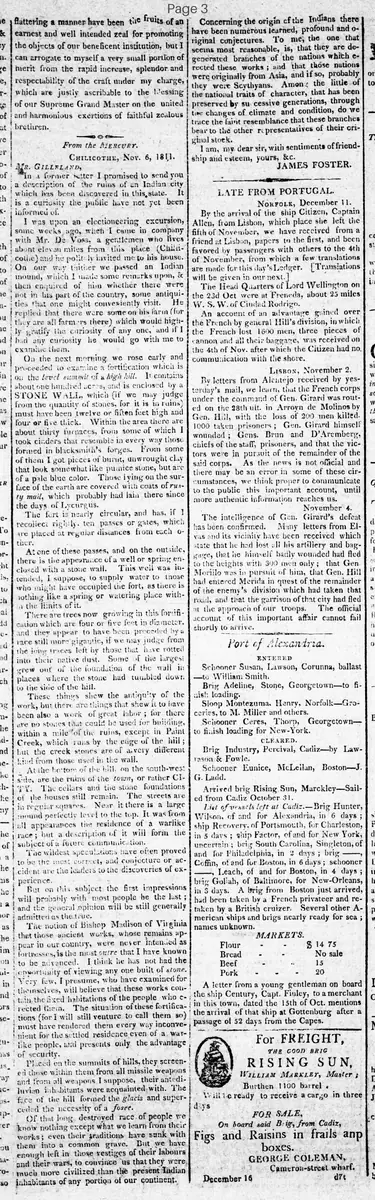
Chillicothe, Nov. 6, 1811.
MR. GILLILAND,
In a former letter I promised to send you a description of the ruins of an Indian city which has been discovered in this state. It is a curiosity the public have not yet been informed of.
I was upon an electioneering excursion, some weeks ago, when I came in company with Mr. De Voss, a gentleman who lives about eleven miles from this place (Chillicothe) and he politely invited me to his house. On our way thither we passed an Indian mound, which I made some remarks upon, & then enquired of him whether there were not in his part of the country, some antiquities that one might conveniently visit. He replied that there were some on his farm (for they are all farmers there) which would highly gratify the curiosity of any one, 'and if I had any curiosity he would go with me to examine them.
On the next morning we rose early and proceeded to examine a fortification which is on the level summit of a high hill. It contains about one hundred acres, and is enclosed by a STONE WALL, which (if we may judge from the quantity of stones, for it is in ruins) must have been twelve or fifteen feet high and four or five thick. Within the area there are about thirty furnaces, from some of which I took cinders that resemble in every way those formed in blacksmith's forges. From some of them I got pieces of burnt, unwrought clay that look somewhat like pumice stone, but are of a pale blue color. Those lying on the surface of the earth are covered with coats of rusty mail, which probably had lain there since the days of Lycurgus.
The fort is nearly circular, and has, if I recollect rightly, ten passes or gates, which are placed at regular distances from each other.
At one of these passes, and on the outside, there is the appearance of a well or spring enclosed with a stone wall. This well was intended, I suppose, to supply water to those who might have occupied the fort, as there is nothing like a spring or watering place within the limits of it.
There are trees now growing in this fortification which are four or five feet in diameter, and they appear to have been preceded by a race still more gigantic, if we may judge from the long traces left by those that have rotted into their native dust. Some of the largest grew out of the foundation of the wall in places where the stone had tumbled down to the side of the hill.
These things shew the antiquity of the work, but there are things that shew it to have been also a work of great labor; for there are no stones that could be used for building within a mile of the ruins, except in Paint Creek, which runs by the edge of the hill: But the creek stones are of a very different kind from those used in the wall.
At the bottom of the hill, on the south-west side, are the ruins of the town, or rather CITY. The cellars and the stone foundations of the houses still remain. The streets are in regular squares. Near it there is a large mound perfectly level to the top. It was from all appearances the residence of a warlike race; but a description of it will form the subject of a future communication.
The wildest speculations have often proved to be the most correct, and conjecture or accident are the leaders to the discoveries of experience.
But on this subject the first impressions will probably with most people be the last; and the general opinion will be still generally admitted as the true.
The notion of Bishop Madison of Virginia that those ancient works, whose remains appear in our country, were never intended as fortresses, is the most absurd that I have known to be advanced. I think he has not had the opportunity of viewing any one built of stone. Very few, I presume, who have examined for themselves, will believe that these works contain the fixed habitations of the people who erected them. The situation of these fortifications (for I will still venture to call them so) must have rendered them every way inconvenient for the settled residence even of a warlike people, among presents only the advantage of security.
Placed on the summits of hills, they screened those within them from all missile weapons and from all weapons I suppose, their antediluvian Indian inhabitants were acquainted with. The face of the hill formed the glacis and superseded the necessity of a fosse.
Of that long destroyed race of people we know nothing except what we learn from their works; even their traditions have sank with them into a common grave. But we have enough left in those vestiges of their labours and their wars, to convince us that they were much more civilized than the present Indian inhabitants of any portion of our continent.
Concerning the origin of the Indians there have been numerous learned, profound and original conjectures. To me, the one that seems most reasonable, is, that they are degenerated branches of the nations which erected these works; and that those nations were originally from Asia, and if so, probably they were Scythians. Among the little of the national traits of character, that has been preserved by successive generations, through the changes of climate and condition, do we trace the faint resemblance that these branches bear to the other representatives of their original stock.
I am, my dear sir, with sentiments of friendship and esteem, yours, &c.
JAMES FOSTER.
What sub-type of article is it?
What keywords are associated?
What entities or persons were involved?
Where did it happen?
Domestic News Details
Primary Location
Near Chillicothe
Event Date
Some Weeks Before Nov. 6, 1811
Key Persons
Event Details
James Foster examined ruins of an ancient Indian fortification on a high hill on Mr. De Voss's farm, about 11 miles from Chillicothe. The fort covers about 100 acres, enclosed by a ruined stone wall estimated 12-15 feet high and 4-5 feet thick, nearly circular with ten gates. Inside are about 30 furnaces with cinders and burnt clay pieces. Outside one gate is a stone-enclosed well or spring. Large trees 4-5 feet in diameter grow within, indicating great age. Stones used differ from local creek stones, sourced from over a mile away. At the hill's southwest base are city ruins with stone house foundations, regular square streets, and a level-topped mound nearby, suggesting a warlike race's residence.