Thank you for visiting SNEWPapers!
Sign up free
Editorial
July 7, 1859
Yorkville Enquirer
York, York County, South Carolina
What is this article about?
Editorial praising the indispensable role of newspapers in perpetuating political triumphs, educating the public, shaping society, and acting as a powerful democratic institution, while acknowledging its potential for mischief. Quotes Philadelphia Argus and published in Quincy Herald.
Clipping
OCR Quality
95%
Excellent
Full Text
INFLUENCE OF NEWSPAPERS.
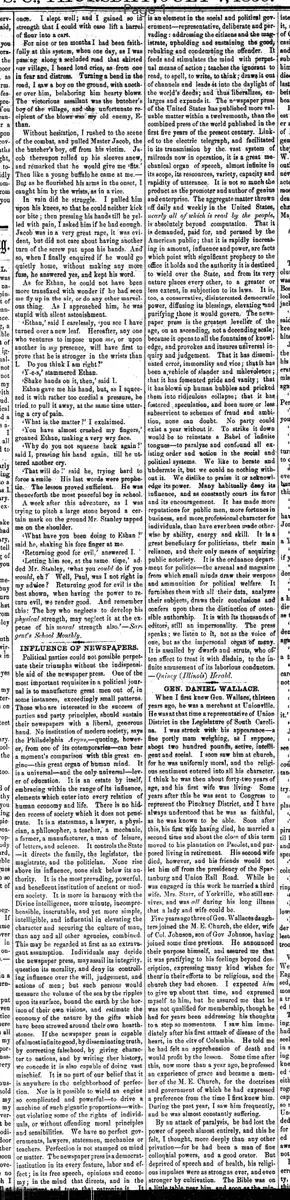
Political parties could not possibly perpetuate their triumphs without the indispensable aid of the newspaper press. One of the most important requisites in a political journal is to manufacture great men out of, in some instances, exceedingly small patterns. Those who are interested in the success of parties and party principles, should sustain their newspapers with a liberal, generous hand. No institution of modern society, says the Philadelphia Argus,—quoting, however, from one of its cotemporaries—can bear a moment's comparison with this great engine—this great organ of human mind. It is a universal—and the only universal—lever of education. It is an estate by itself, embracing within the range of its influence, elements which enter into every relation of human economy and life. There is no hidden recess of society which it does not penetrate. It is a statesman, a lawyer, a physician, a philosopher, a teacher, a mechanic, a farmer, a manufacturer, a man of leisure, of letters, and science. It controls the State—it directs the family, the legislator, the magistrate, and the politician. None rise above its influence, none sink below its authority. It is the most pervading, powerful, and beneficent institution of ancient or modern society. It is more in harmony with the Divine intelligence, more minute, incomprehensible, inscrutable, and yet more simple, intelligible, and influential in elevating the character and securing the culture of human, than any and all other agencies, combined. This may be regarded at first as an extravagant assumption. Individuals may deride the newspaper press, may assail its integrity, question its morality, and deny its controlling influence over the will, judgement, and actions of men; but such persons would measure the volume of the sea by the ripples upon its surface, bound the earth by the horizon of their own visions, and estimate the economy of the nature by the gifts which have been strewed around their own hearthstones. If the newspaper press is capable of almost infinite good, by disseminating truth, by correcting falsehood, by giving character to nations, and by writing their history, we concede it is also capable of doing vast mischief. It is no part of our belief that it is anywhere in the neighborhood of perfection. Nor is it possible to wield an engine so complicated and powerful—to drive a machine of such gigantic proportions—without violating some of the rights of individuals, or without offending moral principles and sensibilities. We have no perfect governments, lawyers, statesmen, mechanics or teachers. Perfection is not stamped on mind or matter. The newspaper press is a democratic institution in its every feature, labor and effect; in its free speech, opinions and economy; in the mind that directs, and in the is an element in the social and political government—representative, deliberate and pervading: addressing the citizens and the magistrate, upholding and sustaining the good; rebuking and condemning the offender. It feeds and stimulates the mind with perpetual means of action; teaches the ignorant to read, to spell, to write, to think; draws it out of channels and leads it into the daylight of the world's deeds; and thus liberalizes, enlarges and expands it. The newspaper press of the United States has published more valuable matter within a twelvemonth, than the combined press of the world published in the first five years of the present century. Linked to the electric telegraph, and facilitated in its transmission by the vast system of railroads now in operation, it is a great mechanical organ of speech, almost infinite in its scope, its resources, variety, capacity and rapidity of utterance. It is not so much the product as the promoter and author of genius and enterprise. The aggregate matter thrown off daily and weekly in the United States, nearly all of which is read by the people, is absolutely beyond computation. That it is demanded, paid for, and perused by the American public; that it is rapidly increasing in amount, influence and power, are facts which point with significant prophecy to the office it holds and the authority it is destined to wield over the State, and from its very nature places every other, to a greater or less extent, in subjection to its laws. It is, too, a conservative, disinterested democratic power, diffusing its blessings, elevating and purifying those it would govern. The newspaper press is the greatest leveller of the age, on an ascending, not a descending scale; because it opens to all the fountains of knowledge, and provokes and insures universal inquiry and judgement. That it has disseminated error, immorality and vice; that it has been a vehicle of slander and malevolence; that it has fomented pride and vanity; that it has blown up human bubbles and pricked them into ridiculous collapse: that it has fostered speculation, and been more or less subservient to schemes of fraud and ambition, none can doubt. No party could exist a year without it. To strike it down would be to reinstate a Babel of infinite tongues—to paralyze and confound all existing order and action in the social and political systems. We like to berate and underrate it, but we could not do without it. We dislike to praise it or acknowledge its power. Many habitually deny its influence, and as constantly court its favor and its encouragement. It has made more reputations for public men, more fortunes in business, and more professional character for individuals, than have ever been made otherwise by ability, energy and skill. It is a great beneficiary for politicians, their main reliance, and their only means of acquiring public notoriety. It is the ordnance department for politics—the arsenal and magazine from which small minds draw their weapons and ammunition for political warfare. It furnishes them with all their data, analyzes their subjects, draws their conclusions and confers upon them the distinction of ostensible authorship. It is with its thousands of editors, still an impersonality. The press speaks; we listen to it, not as the voice of one, but as the impersonal organ of many. It is assailed by dwarfs and pigmies, who often affect to treat it with disdain, to the infinite amusement of its laborious conductors.—Quincy (Illinois) Herald.
Political parties could not possibly perpetuate their triumphs without the indispensable aid of the newspaper press. One of the most important requisites in a political journal is to manufacture great men out of, in some instances, exceedingly small patterns. Those who are interested in the success of parties and party principles, should sustain their newspapers with a liberal, generous hand. No institution of modern society, says the Philadelphia Argus,—quoting, however, from one of its cotemporaries—can bear a moment's comparison with this great engine—this great organ of human mind. It is a universal—and the only universal—lever of education. It is an estate by itself, embracing within the range of its influence, elements which enter into every relation of human economy and life. There is no hidden recess of society which it does not penetrate. It is a statesman, a lawyer, a physician, a philosopher, a teacher, a mechanic, a farmer, a manufacturer, a man of leisure, of letters, and science. It controls the State—it directs the family, the legislator, the magistrate, and the politician. None rise above its influence, none sink below its authority. It is the most pervading, powerful, and beneficent institution of ancient or modern society. It is more in harmony with the Divine intelligence, more minute, incomprehensible, inscrutable, and yet more simple, intelligible, and influential in elevating the character and securing the culture of human, than any and all other agencies, combined. This may be regarded at first as an extravagant assumption. Individuals may deride the newspaper press, may assail its integrity, question its morality, and deny its controlling influence over the will, judgement, and actions of men; but such persons would measure the volume of the sea by the ripples upon its surface, bound the earth by the horizon of their own visions, and estimate the economy of the nature by the gifts which have been strewed around their own hearthstones. If the newspaper press is capable of almost infinite good, by disseminating truth, by correcting falsehood, by giving character to nations, and by writing their history, we concede it is also capable of doing vast mischief. It is no part of our belief that it is anywhere in the neighborhood of perfection. Nor is it possible to wield an engine so complicated and powerful—to drive a machine of such gigantic proportions—without violating some of the rights of individuals, or without offending moral principles and sensibilities. We have no perfect governments, lawyers, statesmen, mechanics or teachers. Perfection is not stamped on mind or matter. The newspaper press is a democratic institution in its every feature, labor and effect; in its free speech, opinions and economy; in the mind that directs, and in the is an element in the social and political government—representative, deliberate and pervading: addressing the citizens and the magistrate, upholding and sustaining the good; rebuking and condemning the offender. It feeds and stimulates the mind with perpetual means of action; teaches the ignorant to read, to spell, to write, to think; draws it out of channels and leads it into the daylight of the world's deeds; and thus liberalizes, enlarges and expands it. The newspaper press of the United States has published more valuable matter within a twelvemonth, than the combined press of the world published in the first five years of the present century. Linked to the electric telegraph, and facilitated in its transmission by the vast system of railroads now in operation, it is a great mechanical organ of speech, almost infinite in its scope, its resources, variety, capacity and rapidity of utterance. It is not so much the product as the promoter and author of genius and enterprise. The aggregate matter thrown off daily and weekly in the United States, nearly all of which is read by the people, is absolutely beyond computation. That it is demanded, paid for, and perused by the American public; that it is rapidly increasing in amount, influence and power, are facts which point with significant prophecy to the office it holds and the authority it is destined to wield over the State, and from its very nature places every other, to a greater or less extent, in subjection to its laws. It is, too, a conservative, disinterested democratic power, diffusing its blessings, elevating and purifying those it would govern. The newspaper press is the greatest leveller of the age, on an ascending, not a descending scale; because it opens to all the fountains of knowledge, and provokes and insures universal inquiry and judgement. That it has disseminated error, immorality and vice; that it has been a vehicle of slander and malevolence; that it has fomented pride and vanity; that it has blown up human bubbles and pricked them into ridiculous collapse: that it has fostered speculation, and been more or less subservient to schemes of fraud and ambition, none can doubt. No party could exist a year without it. To strike it down would be to reinstate a Babel of infinite tongues—to paralyze and confound all existing order and action in the social and political systems. We like to berate and underrate it, but we could not do without it. We dislike to praise it or acknowledge its power. Many habitually deny its influence, and as constantly court its favor and its encouragement. It has made more reputations for public men, more fortunes in business, and more professional character for individuals, than have ever been made otherwise by ability, energy and skill. It is a great beneficiary for politicians, their main reliance, and their only means of acquiring public notoriety. It is the ordnance department for politics—the arsenal and magazine from which small minds draw their weapons and ammunition for political warfare. It furnishes them with all their data, analyzes their subjects, draws their conclusions and confers upon them the distinction of ostensible authorship. It is with its thousands of editors, still an impersonality. The press speaks; we listen to it, not as the voice of one, but as the impersonal organ of many. It is assailed by dwarfs and pigmies, who often affect to treat it with disdain, to the infinite amusement of its laborious conductors.—Quincy (Illinois) Herald.
What sub-type of article is it?
Partisan Politics
Social Reform
Education
What keywords are associated?
Newspaper Influence
Political Press
Democratic Institution
Public Education
Social Leveller
Party Support
What entities or persons were involved?
Philadelphia Argus
Quincy Herald
Political Parties
Editorial Details
Primary Topic
Influence Of The Newspaper Press On Politics And Society
Stance / Tone
Strongly Laudatory And Defensive Of The Press's Power And Benefits
Key Figures
Philadelphia Argus
Quincy Herald
Political Parties
Key Arguments
Newspapers Are Essential For Political Parties To Maintain Power And Create Leaders.
The Press Serves As A Universal Educator And Influencer In All Aspects Of Society.
It Penetrates Every Part Of Human Life, Acting As Statesman, Teacher, And More.
While Capable Of Mischief, Its Overall Influence Is Beneficent And Democratic.
The U.S. Press Has Grown Immensely, Linked To Telegraph And Railroads, Promoting Genius And Enterprise.
No Party Could Survive Without It; It Shapes Reputations And Public Opinion.