Thank you for visiting SNEWPapers!
Sign up free
National Gazette
Philadelphia, Philadelphia County, Pennsylvania
What is this article about?
A.B. submits two essays by 'Algernon Sidney' from the April 1 Hartford American Mercury to Mr. Freneau, urging vigilant exercise of voting rights in Connecticut to counter aristocratic family influences, party intrigues, and preserve republican liberty through informed elections.
Merged-components note: Merged as they form a single letter to the editor from A.B. enclosing two related pieces on the importance of elections and parties.
Clipping
OCR Quality
Full Text
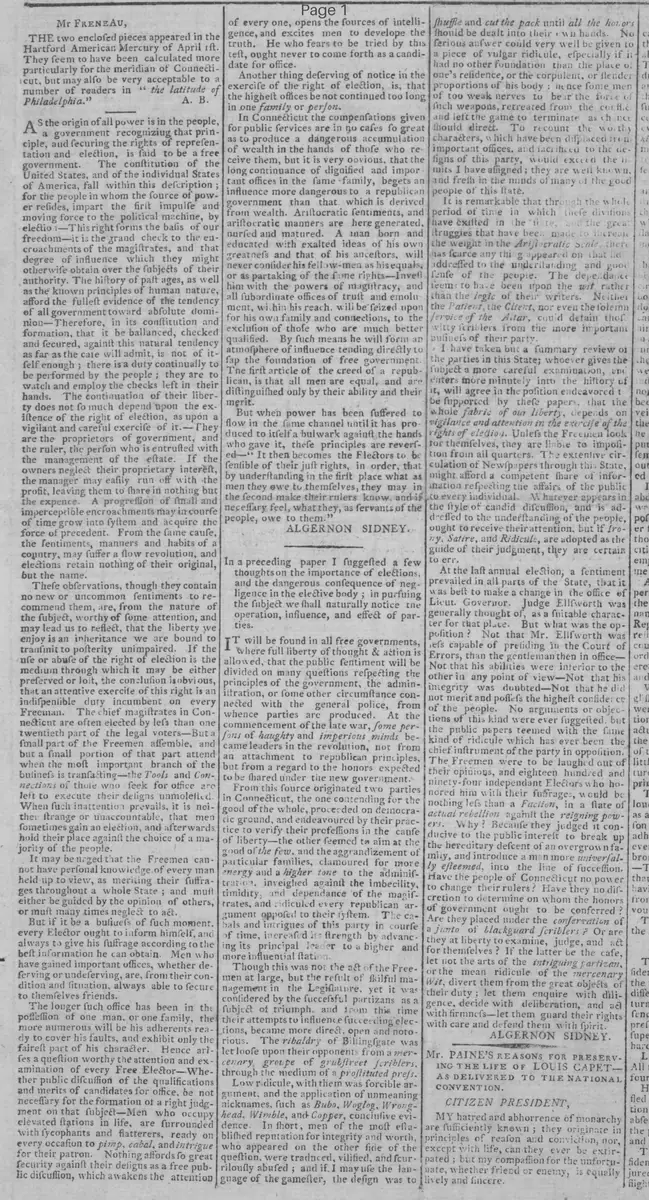
THE two enclosed pieces appeared in the Hartford American Mercury of April 1st. They seem to have been calculated more particularly for the meridian of Connecticut, but may also be very acceptable to a number of readers in "the latitude of Philadelphia."
A. B.
As the origin of all power is in the people, a government recognizing that principle, and securing the rights of representation and election, is said to be a free government. The constitution of the United States, and of the individual States of America, fall within this description; for the people in whom the source of power resides, impart the first impulse and moving force to the political machine, by election. This right forms the basis of our freedom—it is the grand check to the encroachments of the magistrates, and that degree of influence which they might otherwise obtain over the subjects of their authority. The history of past ages, as well as the known principles of human nature, afford the fullest evidence of the tendency of all government toward absolute dominion—Therefore, in its constitution and formation, that it be balanced, checked and secured, against this natural tendency as far as the case will admit, is not of itself enough; there is a duty continually to be performed by the people; they are to watch and employ the checks left in their hands. The continuation of their liberty does not so much depend upon the existence of the right of election, as upon a vigilant and careful exercise of it. They are the proprietors of government, and the ruler, the person who is entrusted with the management of the state. If the owners neglect their proprietary interest, the manager may easily run off with the profit, leaving them to share in nothing but the expense. A progression of null and imperceptible encroachments may in course of time grow into system and acquire the force of precedent. From the same cause, the sentiments, manners and habits of a country, may suffer a slow revolution, and elections retain nothing of their original, but the name.
These observations, though they contain no new or uncommon sentiments to recommend them, are, from the nature of the subject, worthy of some attention, and may lead us to reflect, that the liberty we enjoy is an inheritance we are bound to transmit to posterity unimpaired. If the use or abuse of the right of election is the medium through which it may be either preserved or lost, the conclusion is obvious, that an attentive exercise of this right is an indispensable duty incumbent on every Freeman. The chief magistrates in Connecticut are often elected by less than one twentieth part of the legal voters—But a small part of the Freemen assemble, and but a small portion of that part attend when the most important branch of the business is transacting—the Tools and Connections of those who seek for office are left to execute their designs unmolested. When such inattention prevails, it is neither strange or unaccountable, that men sometimes gain an election, and afterwards hold their place against the choice of a majority of the people.
It may be urged that the Freemen cannot have personal knowledge of every man held up to view, as meriting their suffrages throughout a whole State; and must either be guided by the opinion of others, or must many times neglect to act. But if it be a business of such moment, every Elector ought to inform himself, and always to give his suffrage according to the best information he can obtain. Men who have gained important offices, whether deserving or undeserving, are, from their condition and situation, always able to secure to themselves friends. The longer such office has been in the possession of one man or one family, the more numerous will be his adherents ready to cover his faults, and exhibit only the fairest part of his character. Hence arises a question worthy the attention and examination of every Free Elector—Whether public discussion of the qualifications and merits of candidates for office, be not necessary for the formation of a right judgment on that subject—Men who occupy elevated stations in life, are surrounded with sycophants and flatterers, ready on every occasion to pimp, cabal, and intrigue for their patron. Nothing affords so great security against their designs as a free public discussion, which awakens the attention of every one, opens the sources of intelligence, and excites men to develope the truth. He who fears to be tried by this test, ought never to come forth as a candidate for office.
Another thing deserving of notice in the exercise of the right of election, is, that the highest offices be not continued too long in one family or person. In Connecticut the compensations given for public services are in no case so great as to produce a dangerous accumulation of wealth in the hands of those who receive them, but it is very obvious, that the long continuance of dignified and important offices in the same family, begets an influence more dangerous to a republican government than that which is derived from wealth. Aristocratic sentiments, and aristocratic manners are here generated, nursed and matured. A man born and educated with exalted ideas of his own greatness and that of his ancestors, will never consider his fellow-men as his equals, or as partaking of the same rights—Invest him with the powers of magistracy, and all subordinate offices of trust and emolument, within his reach, will be seized upon for his own family and connections, to the exclusion of those who are much better qualified. By such means he will form an atmosphere of influence tending directly to sap the foundation of free government.
The first article of the creed of a republican, is that all men are equal, and are distinguished only by their ability and their merit.
But when power has been suffered to flow in the same channel until it has produced to itself a bulwark against the hands who gave it, these principles are reversed. It then becomes the Electors to be sensible of their just rights, in order, that by understanding in the first place what as men they owe to themselves, they may in the second make their rulers know, and if necessary feel, what they, as servants of the people, owe to them.
ALGERNON SIDNEY.
In a preceding paper I suggested a few thoughts on the importance of elections, and the dangerous consequence of negligence in the elective body; in pursuing the subject we shall naturally notice the operation, influence, and effect of parties.
It will be found in all free governments, where full liberty of thought & action is allowed, that the public sentiment will be divided on many questions respecting the principles of the government, the administration, or some other circumstance connected with the general police, from whence parties are produced. At the commencement of the late war, some persons of haughty and imperious minds became leaders in the revolution, not from an attachment to republican principles, but from a regard to the honors expected to be shared under the new government. From this source originated two parties in Connecticut, the one contending for the good of the whole, proceeded on democratic ground, and endeavored by their practice to verify their professions in the cause of liberty—the other seemed to aim at the good of the few, and the aggrandizement of particular families, clamoured for more energy and a higher tone to the administration, inveighed against the imbecility, timidity, and dependence of the magistrates, and ridiculed every republican argument opposed to their system. The cabals and intrigues of this party in course of time, increased its strength by advancing its principal leader to a higher and more influential station.
Though this was not the act of the Freemen at large, but the result of skilful management in the Legislature, yet it was considered by the successful partisans as a subject of triumph, and from this time their attempts to influence succeeding elections, became more direct, open and notorious. The ribaldry of Billingsgate was let loose upon their opponents from a mercenary group of Grub-street scribblers, through the medium of a prostituted press. Low ridicule, with them was forcible argument, and the application of unmeaning nicknames, such as Bubo, Woglog, Wronghead, Wimble, and Copper, conclusive evidence. In short, men of the most established reputation for integrity and worth, who appeared on the other side of the question, were traduced, vilified, and currilously abused; and if I may use the language of the gameter, the design was to shuffle and cut the pack until all the honor should be dealt into their own hands. No serious answer could very well be given to a piece of vulgar ridicule, especially if it had no other foundation than the place of one's residence, or the corpulent, or slender proportions of his body: hence some men of too weak nerves to be in the forefront of such weapons, retreated from the contest, and left the game to terminate as chance should direct. To recount the worthy characters, which have been displaced from important offices, and sacrificed to the designs of this party, would exceed the limits I have assigned; they are well known, and fresh in the minds of many of the good people of this state.
It is remarkable that through the whole period of time in which these divisions have existed in the state, and the great struggles that have been made to increase the weight in the Aristocratic Scale, there has scarce any thing appeared on that side addressed to the understanding and good sense of the people. The dependence seems to have been upon the wit rather than the logic of their writers. Neither the Patient, the Client, nor even the solemn service of the Altar, could detain those witty scribblers from the more important business of their party.
I have taken but a summary review of the parties in this State; whoever gives the subject a more careful examination, enters more minutely into the history of it, will agree in the position endeavored to be supported by these papers, that the whole fabric of our liberty, depends on vigilance and attention in the exercise of the right of election. Unless the Freemen look for themselves, they are liable to imposition from all quarters. The extensive circulation of Newspapers through this State, might afford a competent share of information respecting the affairs of the public to every individual. Whatever appears in the style of candid discussion, and is addressed to the understanding of the people, ought to receive their attention, but if Irony, Satire, and Ridicule, are adopted as the guide of their judgment, they are certain to err.
At the last annual election, a sentiment prevailed in all parts of the State, that it was best to make a change in the office of Lieut. Governor. Judge Ellsworth was generally thought of, as a suitable character for that place. But what was the opposition? Not that Mr. Ellsworth was less capable of presiding in the Court of Errors, than the gentleman then in office—Not that his abilities were inferior to the other in any point of view—Not that his integrity was doubted—Not that he did not merit and possess the highest confidence of the people. No arguments or objections of this kind were ever suggested, but the public papers teemed with the same kind of ridicule which has ever been the chief instrument of the party in opposition. The Freemen were to be laughed out of their opinions, and eighteen hundred and ninety-four independent Electors who honored him with their suffrages, would be nothing less than a Faction, in a state of actual rebellion against the reigning powers. Why? Because they judged it conducive to the public interest to break up the hereditary descent of an overgrown family, and introduce a man more universally esteemed, into the line of succession.
Have the people of Connecticut no power to change their rulers? Have they no discretion to determine on whom the honors of government ought to be conferred? Are they placed under the confederation of a junto of blackguard scribblers? Or are they at liberty to examine, judge, and act for themselves? If the latter be the case, let not the arts of the intriguing partisan, or the mean ridicule of the mercenary Wit, divert them from the great objects of their duty; let them enquire with diligence, decide with deliberation, and act with firmness—let them guard their rights with care and defend them with spirit.
ALGERNON SIDNEY.
What sub-type of article is it?
What themes does it cover?
What keywords are associated?
What entities or persons were involved?
Letter to Editor Details
Author
Algernon Sidney
Recipient
Mr. Freneau
Main Argument
vigilant and informed exercise of the right to election is essential to preserve liberty, prevent aristocratic family influences in government, and ensure rulers serve the people rather than entrench power.
Notable Details