Thank you for visiting SNEWPapers!
Sign up free
Story
August 6, 1930
Imperial Valley Press
El Centro, Imperial County, California
What is this article about?
The U.S. Navy General Board considers requesting Congress for a five-year program to build 1,000 airplanes costing $85 million to meet London naval treaty limits, despite President Hoover's economy policy.
Clipping
OCR Quality
100%
Excellent
Full Text
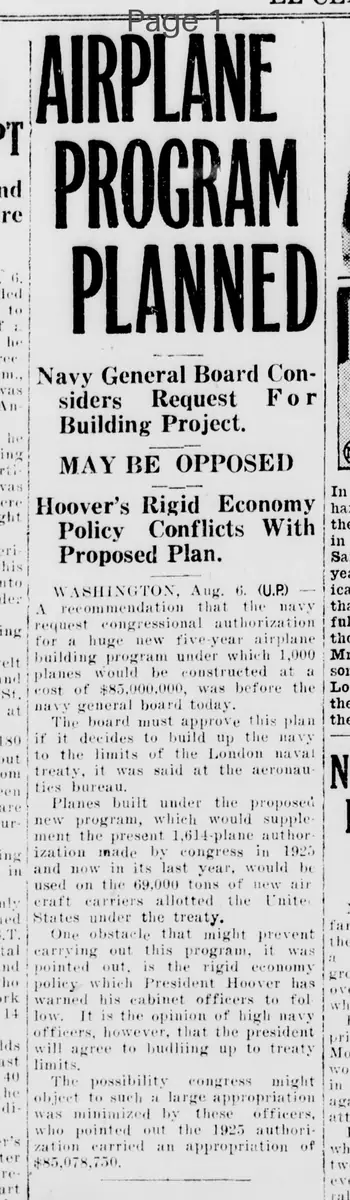
AIRPLANE PROGRAM PLANNED
Navy General Board Considers Request For Building Project.
MAY BE OPPOSED
Hoover's Rigid Economy Policy Conflicts With Proposed Plan.
WASHINGTON, Aug. 6. (U.P.)
A recommendation that the navy request congressional authorization for a huge new five-year airplane building program under which 1,000 planes would be constructed at a cost of $85,000,000, was before the navy general board today.
The board must approve this plan if it decides to build up the navy to the limits of the London naval treaty, it was said at the aeronautics bureau.
Planes built under the proposed new program, which would supplement the present 1,614-plane authorization made by congress in 1925 and now in its last year, would be used on the 69,000 tons of new aircraft carriers allotted the United States under the treaty.
One obstacle that might prevent carrying out this program, it was pointed out, is the rigid economy policy which President Hoover has warned his cabinet officers to follow. It is the opinion of high navy officers, however, that the president will agree to building up to treaty limits.
The possibility congress might object to such a large appropriation was minimized by these officers, who pointed out the 1925 authorization carried an appropriation of $85,078,750.
Navy General Board Considers Request For Building Project.
MAY BE OPPOSED
Hoover's Rigid Economy Policy Conflicts With Proposed Plan.
WASHINGTON, Aug. 6. (U.P.)
A recommendation that the navy request congressional authorization for a huge new five-year airplane building program under which 1,000 planes would be constructed at a cost of $85,000,000, was before the navy general board today.
The board must approve this plan if it decides to build up the navy to the limits of the London naval treaty, it was said at the aeronautics bureau.
Planes built under the proposed new program, which would supplement the present 1,614-plane authorization made by congress in 1925 and now in its last year, would be used on the 69,000 tons of new aircraft carriers allotted the United States under the treaty.
One obstacle that might prevent carrying out this program, it was pointed out, is the rigid economy policy which President Hoover has warned his cabinet officers to follow. It is the opinion of high navy officers, however, that the president will agree to building up to treaty limits.
The possibility congress might object to such a large appropriation was minimized by these officers, who pointed out the 1925 authorization carried an appropriation of $85,078,750.
What sub-type of article is it?
Historical Event
What keywords are associated?
Navy Airplane Program
London Naval Treaty
Congressional Authorization
Hoover Economy Policy
Aircraft Carriers
What entities or persons were involved?
Navy General Board
President Hoover
Where did it happen?
Washington
Story Details
Key Persons
Navy General Board
President Hoover
Location
Washington
Event Date
Aug. 6
Story Details
Navy General Board reviews recommendation for congressional authorization of a five-year program to build 1,000 airplanes for $85 million to reach London naval treaty limits, supplementing 1925 authorization, potentially conflicting with Hoover's economy policy but expected to be approved.