Thank you for visiting SNEWPapers!
Sign up free
Pine Bluff Daily Graphic
Pine Bluff, Jefferson County, Arkansas
What is this article about?
Description of the nearing completion of Boston's new Union terminal station, authorized in 1896, featuring extensive facilities for passengers, trains, and baggage, covering 35 acres at a cost of $13 million, compared to other major U.S. stations.
Merged-components note: These components form a single article on the new Union terminal station in Boston, including the comparison table, split due to parsing but with sequential reading order and related content; table merged as it provides supporting data.
Clipping
OCR Quality
Full Text
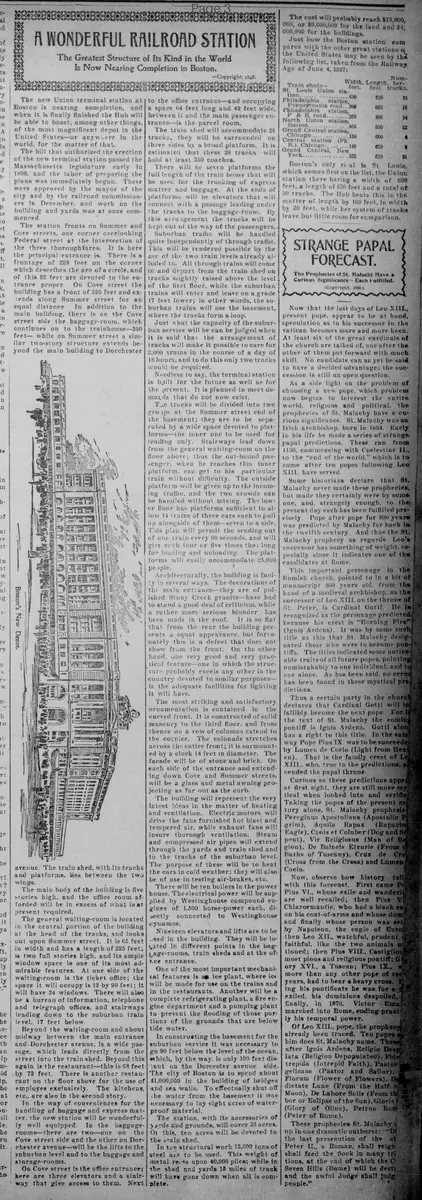
The bill that authorized the erection of the new terminal station passed the Massachusetts legislature early in 1896, and the labor of preparing the plans was immediately begun. These were approved by the mayor of the city and by the railroad commissioners in December, and work on the building and yards was at once commenced.
The station fronts on Summer and Cove streets, one corner overlooking Federal street at the intersection of the three thoroughfares. It is here the principal entrance is. There is a frontage of 228 feet on the corner which describes the arc of a circle, and of this 92 feet are devoted to the entrance proper. On Cove street the building has a front of 320 feet and extends along Summer street for an equal distance. In addition to the main building, there is on the Cove street side the baggage-room, which continues on to the train-house—350 feet—while on Summer street a similar two-story structure extends beyond the main building to Dorchester avenue. The train shed, with its tracks and platforms, lies between the two wings.
The main body of the building is five stories high, and the office room afforded will be in excess of what is at present required.
The general waiting-room is located in the central portion of the building at the head of the tracks, and looks out upon Summer street. It is 65 feet in width and has a length of 225 feet; is two full stories high, and its ample window space is one of its most admirable features. At one side of the waiting-room is the ticket office; the space it will occupy is 12 by 90 feet; it will have 24 windows. There will also be a bureau of information, telephone and telegraph offices, and stairways leading down to the suburban train level, 17 feet below.
Beyond the waiting-room and about midway between the main entrance and Dorchester avenue, is a wide passage, which leads directly from the street into the train shed. Beyond this again is the restaurant—this is 68 feet by 73 feet. There is another restaurant on the floor above for the use of employees exclusively. The kitchens, etc., are also in the second story.
In the way of conveniences for the handling of baggage and express matter, the new station will be wonderfully well equipped. In the baggage-rooms—there are two—one on the Cove street side and the other on Dorchester avenue—will be the lifts to the suburban level and to the baggage and storage-rooms.
On Cove street is the office entrance; here are three elevators and a stairway that give access to them. Next
-Copyright, 1898.
to the office entrance—and occupying a space 64 feet long and 42 feet wide, between it and the main passenger entrance—is the parcel room.
The train shed will accommodate 25 tracks, they will be surrounded on three sides by a broad platform. It is estimated that these 25 tracks will hold at least 350 coaches.
There will be seven platforms the full length of the train house that will be used for the trucking of express matter and baggage. At the ends of platforms will be elevators that will connect with a passage leading under the tracks to the baggage-room. By this arrangement the trucks will be kept out of the way of the passengers.
Suburban traffic will be handled quite independently of through traffic. This will be rendered possible by the use of the two train levels already alluded to. All through trains will come in and depart from the train shed on tracks slightly raised above the level of the first floor, while the suburban trains will enter and leave on a grade 17 feet lower; in other words, the suburban trains will use the basement, where the tracks form a loop.
Just what the capacity of the suburban service will be can be judged when it is said that the arrangement of tracks will make it possible to care for 2,000 trains in the course of a day of 18 hours, and to do this only two tracks would be required.
Needless to say, the terminal station is built for the future as well as for the present. It is planned to meet demands that do not now exist.
The tracks will be divided into two groups at the Summer street end of the basement; they are to be separated by a wide space devoted to platforms—the inner one to be used for loading only. Stairways lead down from the general waiting-room on the floor above; thus the out-bound passenger, when he reaches this inner platform, can get to his particular train without difficulty. The outside platform will be given up to the incoming traffic, and the two crowds can be handled without mixing. The lower floor has platforms sufficient to allow 14 trains of three cars each to pull up alongside of them—seven to a side.
This plan will permit the sending out of one train every 60 seconds, and will give each four or five times that long for loading and unloading. The platforms will easily accommodate 25,000 people.
Architecturally, the building is faulty in several ways. The decorations of the main entrance—they are of polished Stony Creek granite—have had to stand a good deal of criticism, while a rather more serious blunder has been made in the roof. It is so flat that from the rear the building presents a squat appearance, but fortunately this is a defect that does not show from the front. On the other hand, one very good and very practical feature—one in which the structure probably excels any other in the country devoted to similar purposes—is the adequate facilities for lighting it will have.
The most striking and satisfactory ornamentation is contained in the curved front. It is constructed of solid masonry to the third floor, and from thence on a row of columns extend to the cornice. The colonnade stretches across the entire front; it is surmounted by a clock 14 feet in diameter. The facade will be of stone and brick. On each side of the entrance and extending down Cove and Summer streets, will be a glass and metal awning projecting as far out as the curb.
The building will represent the very latest ideas in the matter of heating and ventilation. Electric motors will drive the fans furnishing hot blast and tempered air, while exhaust fans will insure thorough ventilation. Steam and compressed air pipes will extend through the yards and train shed and to the tracks of the suburban level.
The purpose of these will be to heat the cars in cold weather; they will also be of use in testing air-brakes, etc.
There will be ten boilers in the power house. The electrical power will be supplied by Westinghouse compound engines of 1,500 horse-power each, directly connected to Westinghouse dynamos.
Nineteen elevators and lifts are to be used in the building. They will be located in different points in the baggage-rooms, train sheds and at the office entrance.
One of the most important mechanical features is an ice plant, where ice will be made for use on the trains and in the restaurants. Another will be a complete refrigerating plant, a fire engine department and a pumping plant to prevent the flooding of those portions of the grounds that are below tide water.
In constructing the basement for the suburban service it was necessary to go 90 feet below the level of the ocean, which, by the way, is only 100 feet distant on the Dorchester avenue side.
The city of Boston is to spend about $1,000,000 in the building of bridges and sea walls. To effectually shut off the water from the basement it was necessary to lay eight acres of waterproof material.
The station, with its accessories of yards and grounds, will cover 35 acres. Of this, ten acres will be devoted to the train shed.
In the structural work 15,000 tons of steel are to be used. This weight of metal rests upon 40,000 piles; while in the shed and yards 15 miles of track will have gone down when all is complete.
The cost will probably reach $13,000,000, or $9,000,000 for the land and $4,000,000 for the buildings.
Just how the Boston station compares with the other great stations of the United States may be seen by the following list, taken from the Railway Age of June 4, 1897:
Num-
Boston's only rival is St. Louis, which comes first on the list, the Union station there having a width of 600 feet, a length of 630 feet and a total of 30 tracks. The Hub beats this in the matter of length by 100 feet, in width by 20 feet, while her system of tracks leave but little room for comparison.
| Train sheds- | width, | Length, | ber- |
| St. Louis Union sta- | feet. | feet | tracks. |
| tion | 600 | 630 | 30 |
| Philadelphia station, | |||
| Pennsylvania road | 300 | 592 | 10 |
| Philadelphia station, | |||
| P & R. road | 260 | 800 | 14 |
| North Union station, | |||
| Boston | 460 | 500 | 22 |
| Grand Central station, | |||
| Chicago | 150 | 600 | 6 |
| Central station (Pk. | |||
| R.), Chicago | 140 | 650 | 8 |
| Grand Central, New York | 332 | 620 | 21 |
What sub-type of article is it?
What themes does it cover?
What keywords are associated?
Where did it happen?
Story Details
Location
Boston, Summer And Cove Streets
Event Date
1896 1898
Story Details
The new Union terminal station in Boston, authorized in 1896, is nearing completion in 1898. It features a five-story main building, extensive waiting rooms, ticket offices, restaurants, baggage handling, a train shed for 25 tracks, separate levels for suburban and through traffic, advanced heating, ventilation, and power systems, covering 35 acres at a cost of $13 million.