Thank you for visiting SNEWPapers!
Sign up free
The New Hampshire Gazette
Portsmouth, Rockingham County, New Hampshire
What is this article about?
Criticism of Mr. Holmes for his decision as US commissioner conceding Passamaquoddy islands to Great Britain after the war, despite no prior British claim; his defensive responses in the press are attacked as evasive and ungentlemanly, amid public scrutiny by writer Sulpicius.
Clipping
OCR Quality
Full Text
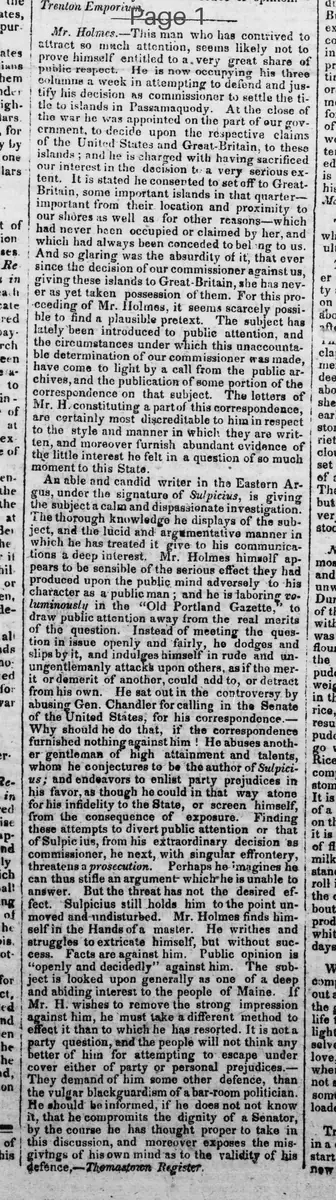
An able and candid writer in the Eastern Argus, under the signature of Sulpicius, is giving the subject a calm and dispassionate investigation. The thorough knowledge he displays of the subject, and the lucid and argumentative manner in which he has treated it give to his communications a deep interest. Mr. Holmes himself appears to be sensible of the serious effect they had produced upon the public mind adversely to his character as a public man; and he is laboring colossally in the "Old Portland Gazette," to draw public attention away from the real merits of the question. Instead of meeting the question in issue openly and fairly, he dodges and slips by it, and indulges himself in rude and ungentlemanly attacks upon others, as if the merit or demerit of another, could add to, or detract from his own. He set out in the controversy by abusing Gen. Chandler for calling in the Senate of the United States, for his correspondence.--Why should he do that, if the correspondence furnished nothing against him! He abuses another gentleman of high attainment and talents, whom he conjectures to be the author of Sulpicius; and endeavors to enlist party prejudices in his favor, as though he could in that way atone for his infidelity to the State, or screen himself from the consequence of exposure. Finding these attempts to divert public attention or that of Sulpicius, from his extraordinary decision as commissioner, he next, with singular effrontery, threatens a prosecution. Perhaps he imagines he can thus stifle an argument--which he is unable to answer. But the threat has not the desired effect. Sulpicius still holds him to the point unmoved and undisturbed. Mr. Holmes finds himself in the hands of a master. He writhes and struggles to extricate himself, but without success. Facts are against him. Public opinion is "openly and decidedly" against him. The subject is looked upon generally as one of a deep and abiding interest to the people of Maine. If Mr. H. wishes to remove the strong impression against him, he must take a different method to effect it than to which he has resorted. It is not a party question, and the people will not think any better of him for attempting to escape under cover either of party or personal prejudices.--They demand of him some other defence, than the vulgar blackguardism of a bar-room politician. He should be informed, if he does not know it, that he compromises the dignity of a Senator, by the course he has thought proper to take in this discussion, and moreover exposes the misgivings of his own mind as to the validity of his defence,--Thomaston Register.
What sub-type of article is it?
What themes does it cover?
What keywords are associated?
What entities or persons were involved?
Where did it happen?
Story Details
Key Persons
Location
Islands In Passamaquoddy, Maine
Event Date
At The Close Of The War
Story Details
Mr. Holmes, as US commissioner, conceded important Passamaquoddy islands to Great Britain despite no prior claim by her; his correspondence reveals disinterest; he defends evasively in press against Sulpicius' investigations, using attacks and threats, but public opinion turns against him.