Thank you for visiting SNEWPapers!
Sign up free
Story
March 29, 1866
The Daily Empire
Dayton, Montgomery County, Ohio
What is this article about?
In 1866, New Hampshire's Union Club sought 1.5% salary contributions from federal officers for election costs. Clerk E.B. Johnson refused, calling it ballot corruption in a letter to Rep. E.I. Rollins. President Andrew Johnson praised his independence and recommended promotion on March 15.
Clipping
OCR Quality
95%
Excellent
Full Text
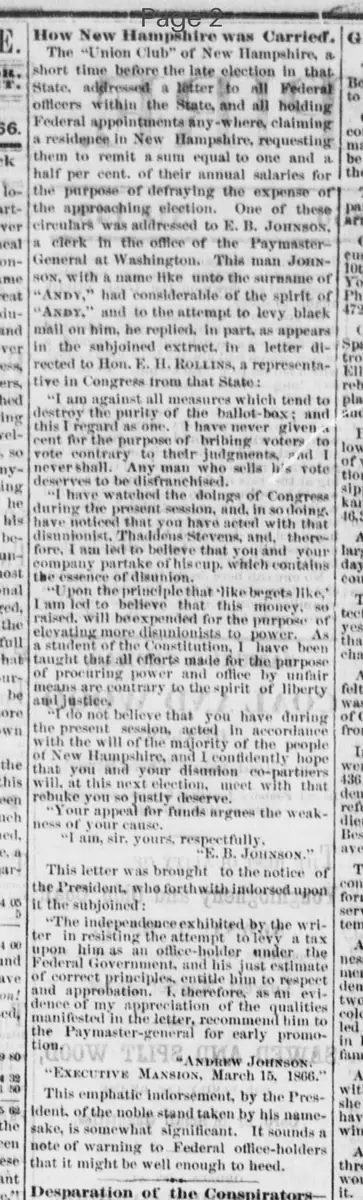
How New Hampshire was Carried.
The "Union Club" of New Hampshire, a short time before the late election in that State, addressed a letter to all Federal officers within the State, and all holding Federal appointments anywhere, claiming a residence in New Hampshire, requesting them to remit a sum equal to one and a half per cent. of their annual salaries for the purpose of defraying the expense of the approaching election. One of these circulars was addressed to E. B. JOHNSON, a clerk in the office of the Paymaster-General at Washington. This man Johnson, with a name like unto the surname of "Andy," had considerable of the spirit of "Andy," and to the attempt to levy black mail on him, he replied, in part, as appears in the subjoined extract. In a letter directed to Hon. E. I. ROLLINS, a representative in Congress from that State:
"I am against all measures which tend to destroy the purity of the ballot-box; and this I regard as one. I have never given a cent for the purpose of bribing voters to vote contrary to their judgments, and I never shall. Any man who sells his vote deserves to be disfranchised.
"I have watched the doings of Congress during the present session, and, in so doing, have noticed that you have acted with that disunionist, Thaddeus Stevens, and, therefore, I am led to believe that you and your company partake of his cup, which contains the essence of disunion.
"Upon the principle that like begets like, I am led to believe that this money, so raised, will be expended for the purpose of elevating more disunionists to power. As a student of the Constitution, I have been taught that all efforts made for the purpose of procuring power and office by unfair means are contrary to the spirit of liberty and justice.
"I do not believe that you have during the present session, acted in accordance with the will of the majority of the people of New Hampshire, and I confidently hope that you and your disunion co-partners will, at this next election, meet with that rebuke you so justly deserve.
"Your appeal for funds argues the weakness of your cause.
"I am, sir, yours, respectfully,
"E. B. JOHNSON."
This letter was brought to the notice of the President, who forthwith indorsed upon it the subjoined:
"The independence exhibited by the writer in resisting the attempt to levy a tax upon him as an office-holder under the Federal Government, and his just estimate of correct principles, entitle him to respect and approbation. I, therefore, as an evidence of my appreciation of the qualities manifested in the letter, recommend him to the Paymaster-general for early promotion.
"ANDREW JOHNSON.
"EXECUTIVE MANSION, March 15, 1866."
This emphatic indorsement, by the President, of the noble stand taken by his namesake, is somewhat significant. It sounds a note of warning to Federal office-holders that it might be well enough to heed.
The "Union Club" of New Hampshire, a short time before the late election in that State, addressed a letter to all Federal officers within the State, and all holding Federal appointments anywhere, claiming a residence in New Hampshire, requesting them to remit a sum equal to one and a half per cent. of their annual salaries for the purpose of defraying the expense of the approaching election. One of these circulars was addressed to E. B. JOHNSON, a clerk in the office of the Paymaster-General at Washington. This man Johnson, with a name like unto the surname of "Andy," had considerable of the spirit of "Andy," and to the attempt to levy black mail on him, he replied, in part, as appears in the subjoined extract. In a letter directed to Hon. E. I. ROLLINS, a representative in Congress from that State:
"I am against all measures which tend to destroy the purity of the ballot-box; and this I regard as one. I have never given a cent for the purpose of bribing voters to vote contrary to their judgments, and I never shall. Any man who sells his vote deserves to be disfranchised.
"I have watched the doings of Congress during the present session, and, in so doing, have noticed that you have acted with that disunionist, Thaddeus Stevens, and, therefore, I am led to believe that you and your company partake of his cup, which contains the essence of disunion.
"Upon the principle that like begets like, I am led to believe that this money, so raised, will be expended for the purpose of elevating more disunionists to power. As a student of the Constitution, I have been taught that all efforts made for the purpose of procuring power and office by unfair means are contrary to the spirit of liberty and justice.
"I do not believe that you have during the present session, acted in accordance with the will of the majority of the people of New Hampshire, and I confidently hope that you and your disunion co-partners will, at this next election, meet with that rebuke you so justly deserve.
"Your appeal for funds argues the weakness of your cause.
"I am, sir, yours, respectfully,
"E. B. JOHNSON."
This letter was brought to the notice of the President, who forthwith indorsed upon it the subjoined:
"The independence exhibited by the writer in resisting the attempt to levy a tax upon him as an office-holder under the Federal Government, and his just estimate of correct principles, entitle him to respect and approbation. I, therefore, as an evidence of my appreciation of the qualities manifested in the letter, recommend him to the Paymaster-general for early promotion.
"ANDREW JOHNSON.
"EXECUTIVE MANSION, March 15, 1866."
This emphatic indorsement, by the President, of the noble stand taken by his namesake, is somewhat significant. It sounds a note of warning to Federal office-holders that it might be well enough to heed.
What sub-type of article is it?
Historical Event
Deception Fraud
Personal Triumph
What themes does it cover?
Deception
Moral Virtue
Justice
What keywords are associated?
Election Funding
Political Coercion
Federal Officers
Andrew Johnson Endorsement
New Hampshire Election
What entities or persons were involved?
E. B. Johnson
E. I. Rollins
Andrew Johnson
Thaddeus Stevens
Where did it happen?
New Hampshire And Washington
Story Details
Key Persons
E. B. Johnson
E. I. Rollins
Andrew Johnson
Thaddeus Stevens
Location
New Hampshire And Washington
Event Date
March 15, 1866
Story Details
The Union Club requests funds from federal officers for New Hampshire election expenses; E. B. Johnson refuses, denounces it as bribery in a letter to Rep. E. I. Rollins, criticizing disunionist actions; President Andrew Johnson endorses the letter and recommends Johnson's promotion.