Thank you for visiting SNEWPapers!
Sign up free
Editorial
November 8, 1834
Republican Herald
Providence, Providence County, Rhode Island
What is this article about?
This 1834 editorial from the Republican Herald critiques the ambiguous term 'respectability,' linking it to wealth and social class in Providence, Rhode Island. It argues that artificial class distinctions corrupt justice in courts and the state legislature, where poor prisoners face harsher treatment than the wealthy, calling for definite punishment laws and equitable application regardless of status.
Clipping
OCR Quality
95%
Excellent
Full Text
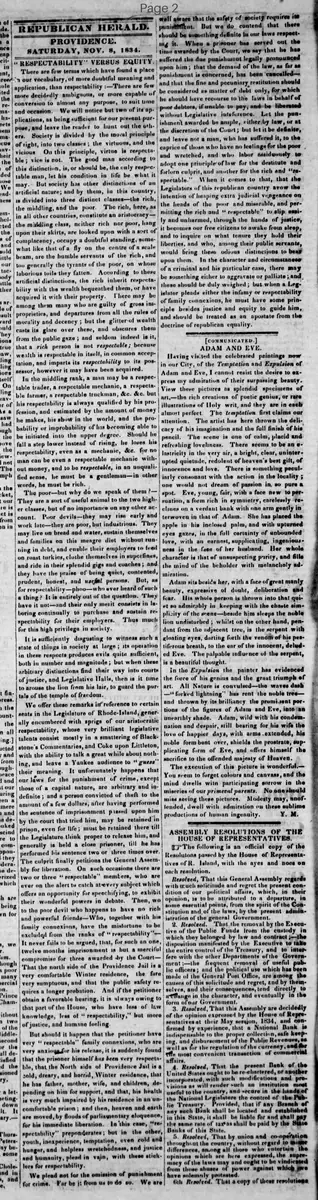
REPUBLICAN HERALD.
PROVIDENCE.
SATURDAY,
NOV.
8,
1834.
"RESPECTABILITY"
VERSUS
EQUITY
There are few terms which have found a place in our vocabulary, of more doubtful meaning and application, than respectability:—There are few more decidedly ambiguous, or more capable of conversion to almost any purpose, to suit time and occasion. We will notice but two of its applications, as being sufficient for our present purpose, and leave the reader to hunt out the others. Society is divided by the moral principle of right, into two classes; the virtuous, and the vicious. On this principle, virtue is respectable; vice is not. The good man according to this distinction, is, or should be, the only respectable man, let his condition in life be what it may.—But society has other distinctions of an artificial nature; and by them, in this country, is divided into three distinct classes—the rich, the middling, and the poor. The rich, here, as in all other countries, constitute an aristocracy—the middling class, neither rich nor poor, hang upon their skirts, are looked upon with a sort of complacency, occupy a doubtful standing, somewhat like that of a fly on the centre of a scale beam, are the humble servants of the rich, and too generally the tyrants of the poor, on whose laborious toils they fatten. According to these artificial distinctions, the rich inherit respectability with the wealth bequeathed them, or have acquired it with their property. There may be among them many who are guilty of gross improprieties, and departures from all the rules of morality and decency; but the glitter of wealth casts its glare over these, and obscures them from the public gaze; and seldom indeed is it, that a rich person is not respectable; because wealth is respectable in itself, in common acceptation, and imparts its respectability to its possessor, however it may have been acquired.
In the middling rank, a man may be a respectable trader, a respectable mechanic, a respectable farmer, a respectable truckman, &c. &c. but his respectability is always qualified by his profession, and estimated by the amount of money he makes, his show in the world, and the probability or improbability of his becoming able to be initiated into the upper degree. Should he fall a step lower instead of rising, he loses his respectability, even as a mechanic, &c. for no man can be even a respectable mechanic without money, and to be respectable, in an unqualified sense, he must be a gentleman—in other words, he must be rich.
The poor—but why do we speak of them?—They are a sort of useful animal to the two higher classes, but of no importance on any other account. Poor devils—they may rise early and work late—they are poor, but industrious. They may live on bread and water, sustain themselves and families on this meagre diet without running in debt, and enable their employers to feed on roast turkeys, clothe themselves in superfines, and ride in their splendid gigs and coaches; and they have the praise of being quiet, contented, prudent, honest, and useful persons. But, as for respectability—phoo—who ever heard of such a thing? It is entirely out of the question. They have it not—and their only merit consists in laboring continually to purchase and sustain respectability for their employers. Thus much for this high privilege in society.
It is sufficiently disgusting to witness such a state of things in society at large; its operation in these respects produces evils quite sufficient, both in number and magnitude; but when these arbitrary distinctions find their way into courts of justice, and Legislative Halls, then is it time to arouse the lion from his lair, to guard the portals of the temple of freedom.
We offer these remarks in reference to certain seats in the Legislature of Rhode-Island, generally encumbered with sprigs of our aristocratic respectability, whose very brilliant legislative talents consist mostly in a smattering of Blackstone's Commentaries, and Coke upon Littleton, with the ability to talk a great while about nothing, and leave a Yankee audience to "guess" their meaning. It unfortunately happens that our laws for the punishment of crime, except those of a capital nature, are arbitrary and indefinite; and a person convicted of theft to the amount of a few dollars, after having performed the sentence of imprisonment passed upon him by the court that tried him, may be retained in prison, even for life; must be retained there till the Legislature think proper to release him, and generally is held a close prisoner, till he has performed his sentence two or three times over. The culprit finally petitions the General Assembly for liberation. On such occasions there are two or three "respectable" members, who are ever on the alert to catch at every subject which offers an opportunity for speechifying, to exhibit their wonderful powers in debate. Then, woe to the poor devil who happens to have no rich and powerful friends—Who, together with his family connexions, have the misfortune to be excluded from the ranks of "respectability"—It never fails to be argued, that, for such an one, twelve months imprisonment is but a merciful compromise for three awarded—by the Court—That the north side of the Providence Jail is a very comfortable Winter residence, the fare very sumptuous, and that the public safety requires a longer probation. And if the petitioner obtain a favorable hearing, it is always owing to that part of the House, who have less of law knowledge, less of "respectability," but more of justice, and humane feeling.
But should it happen that the petitioner have very "respectable" family connexions, who are very anxious for his release, it is suddenly found that the prisoner himself has been very respectable, that the North side of Providence Jail is a cold, dreary, and horrid Winter residence, that he has father, mother, wife, and children, depending on him for support, and that, his health is very much impaired by his residence in an uncomfortable prison; and then, heaven and earth are moved, by floods of parliamentary eloquence, for his immediate liberation. In this case, "respectability" preponderates; but in the other, youth, inexperience, temptation, even cold and hunger, and helpless wretchedness, and justice and humanity, plead in vain, with these sticklers for respectability.
We plead not for the omission or punishment for crime.—Far be it from us to do so. We are well aware that the safety of society requires its punishment. But we do contend that there should be something definite in our laws respecting it. When a prisoner has served out the time awarded by the Court, we say that he has suffered the due punishment legally pronounced upon him; that the demand of the law, as far as punishment is concerned, has been cancelled—and that the fine and pecuniary restitution should be considered as matter of debt only, or which he should have recourse to the laws in behalf of poor debtors, if unable to pay, and be liberated without Legislative interference. Let the punishment awarded be ample, either by law, or at the discretion of the Court; but let it be definite, and leave not a man, who has suffered it, to the caprice of those who have no feelings for the poor and wretched, and who labor assiduously to adopt one principle of law for the destitute and forlorn culprit, and another for the rich and "respectable." When it comes to that, that the Legislators of this republican country avow the intention of heaping extra judicial vengeance on the heads of the poor and miserable, and permitting the rich and "respectable" to slip easily and unharmed, through the hands of justice, it becomes our free citizens to awake from sleep, and to inquire on what tenure they hold their liberties, and who, among their public servants, would bring these odious distinctions to be borne upon them. In the character and circumstances of a criminal and his particular case, there may be something either to aggravate or palliate; and these should be duly weighed; but when a Legislator pleads either the infamy or respectability of family connexions, he must have some principle besides justice and equity to guide him, and should be treated as an apostate from the doctrine of republican equality.
PROVIDENCE.
SATURDAY,
NOV.
8,
1834.
"RESPECTABILITY"
VERSUS
EQUITY
There are few terms which have found a place in our vocabulary, of more doubtful meaning and application, than respectability:—There are few more decidedly ambiguous, or more capable of conversion to almost any purpose, to suit time and occasion. We will notice but two of its applications, as being sufficient for our present purpose, and leave the reader to hunt out the others. Society is divided by the moral principle of right, into two classes; the virtuous, and the vicious. On this principle, virtue is respectable; vice is not. The good man according to this distinction, is, or should be, the only respectable man, let his condition in life be what it may.—But society has other distinctions of an artificial nature; and by them, in this country, is divided into three distinct classes—the rich, the middling, and the poor. The rich, here, as in all other countries, constitute an aristocracy—the middling class, neither rich nor poor, hang upon their skirts, are looked upon with a sort of complacency, occupy a doubtful standing, somewhat like that of a fly on the centre of a scale beam, are the humble servants of the rich, and too generally the tyrants of the poor, on whose laborious toils they fatten. According to these artificial distinctions, the rich inherit respectability with the wealth bequeathed them, or have acquired it with their property. There may be among them many who are guilty of gross improprieties, and departures from all the rules of morality and decency; but the glitter of wealth casts its glare over these, and obscures them from the public gaze; and seldom indeed is it, that a rich person is not respectable; because wealth is respectable in itself, in common acceptation, and imparts its respectability to its possessor, however it may have been acquired.
In the middling rank, a man may be a respectable trader, a respectable mechanic, a respectable farmer, a respectable truckman, &c. &c. but his respectability is always qualified by his profession, and estimated by the amount of money he makes, his show in the world, and the probability or improbability of his becoming able to be initiated into the upper degree. Should he fall a step lower instead of rising, he loses his respectability, even as a mechanic, &c. for no man can be even a respectable mechanic without money, and to be respectable, in an unqualified sense, he must be a gentleman—in other words, he must be rich.
The poor—but why do we speak of them?—They are a sort of useful animal to the two higher classes, but of no importance on any other account. Poor devils—they may rise early and work late—they are poor, but industrious. They may live on bread and water, sustain themselves and families on this meagre diet without running in debt, and enable their employers to feed on roast turkeys, clothe themselves in superfines, and ride in their splendid gigs and coaches; and they have the praise of being quiet, contented, prudent, honest, and useful persons. But, as for respectability—phoo—who ever heard of such a thing? It is entirely out of the question. They have it not—and their only merit consists in laboring continually to purchase and sustain respectability for their employers. Thus much for this high privilege in society.
It is sufficiently disgusting to witness such a state of things in society at large; its operation in these respects produces evils quite sufficient, both in number and magnitude; but when these arbitrary distinctions find their way into courts of justice, and Legislative Halls, then is it time to arouse the lion from his lair, to guard the portals of the temple of freedom.
We offer these remarks in reference to certain seats in the Legislature of Rhode-Island, generally encumbered with sprigs of our aristocratic respectability, whose very brilliant legislative talents consist mostly in a smattering of Blackstone's Commentaries, and Coke upon Littleton, with the ability to talk a great while about nothing, and leave a Yankee audience to "guess" their meaning. It unfortunately happens that our laws for the punishment of crime, except those of a capital nature, are arbitrary and indefinite; and a person convicted of theft to the amount of a few dollars, after having performed the sentence of imprisonment passed upon him by the court that tried him, may be retained in prison, even for life; must be retained there till the Legislature think proper to release him, and generally is held a close prisoner, till he has performed his sentence two or three times over. The culprit finally petitions the General Assembly for liberation. On such occasions there are two or three "respectable" members, who are ever on the alert to catch at every subject which offers an opportunity for speechifying, to exhibit their wonderful powers in debate. Then, woe to the poor devil who happens to have no rich and powerful friends—Who, together with his family connexions, have the misfortune to be excluded from the ranks of "respectability"—It never fails to be argued, that, for such an one, twelve months imprisonment is but a merciful compromise for three awarded—by the Court—That the north side of the Providence Jail is a very comfortable Winter residence, the fare very sumptuous, and that the public safety requires a longer probation. And if the petitioner obtain a favorable hearing, it is always owing to that part of the House, who have less of law knowledge, less of "respectability," but more of justice, and humane feeling.
But should it happen that the petitioner have very "respectable" family connexions, who are very anxious for his release, it is suddenly found that the prisoner himself has been very respectable, that the North side of Providence Jail is a cold, dreary, and horrid Winter residence, that he has father, mother, wife, and children, depending on him for support, and that, his health is very much impaired by his residence in an uncomfortable prison; and then, heaven and earth are moved, by floods of parliamentary eloquence, for his immediate liberation. In this case, "respectability" preponderates; but in the other, youth, inexperience, temptation, even cold and hunger, and helpless wretchedness, and justice and humanity, plead in vain, with these sticklers for respectability.
We plead not for the omission or punishment for crime.—Far be it from us to do so. We are well aware that the safety of society requires its punishment. But we do contend that there should be something definite in our laws respecting it. When a prisoner has served out the time awarded by the Court, we say that he has suffered the due punishment legally pronounced upon him; that the demand of the law, as far as punishment is concerned, has been cancelled—and that the fine and pecuniary restitution should be considered as matter of debt only, or which he should have recourse to the laws in behalf of poor debtors, if unable to pay, and be liberated without Legislative interference. Let the punishment awarded be ample, either by law, or at the discretion of the Court; but let it be definite, and leave not a man, who has suffered it, to the caprice of those who have no feelings for the poor and wretched, and who labor assiduously to adopt one principle of law for the destitute and forlorn culprit, and another for the rich and "respectable." When it comes to that, that the Legislators of this republican country avow the intention of heaping extra judicial vengeance on the heads of the poor and miserable, and permitting the rich and "respectable" to slip easily and unharmed, through the hands of justice, it becomes our free citizens to awake from sleep, and to inquire on what tenure they hold their liberties, and who, among their public servants, would bring these odious distinctions to be borne upon them. In the character and circumstances of a criminal and his particular case, there may be something either to aggravate or palliate; and these should be duly weighed; but when a Legislator pleads either the infamy or respectability of family connexions, he must have some principle besides justice and equity to guide him, and should be treated as an apostate from the doctrine of republican equality.
What sub-type of article is it?
Social Reform
Legal Reform
What keywords are associated?
Respectability
Social Classes
Wealth Aristocracy
Justice Equity
Rhode Island Legislature
Prison Reform
Punishment Laws
Republican Equality
What entities or persons were involved?
Legislature Of Rhode Island
General Assembly
Aristocratic Respectability
Blackstone's Commentaries
Coke Upon Littleton
Providence Jail
Editorial Details
Primary Topic
Class Based Respectability Versus Equitable Justice In Rhode Island Legislature
Stance / Tone
Critical Of Wealth Based Biases In Law And Punishment, Advocating For Definite Laws And Republican Equality
Key Figures
Legislature Of Rhode Island
General Assembly
Aristocratic Respectability
Blackstone's Commentaries
Coke Upon Littleton
Providence Jail
Key Arguments
Society's Artificial Class Distinctions Tie Respectability To Wealth, Not Virtue.
Rich Inherit Respectability Regardless Of Moral Failings.
Middling Class's Respectability Depends On Financial Success And Proximity To Wealth.
Poor Are Denied Respectability Despite Honest Labor Benefiting The Rich.
Class Biases Infiltrate Courts And Legislature, Leading To Unequal Treatment Of Prisoners.
Laws On Non Capital Crimes Are Arbitrary, Allowing Indefinite Imprisonment Beyond Court Sentences.
Poor Petitioners Face Extended Incarceration Without Influential Connections, While Respectable Ones Are Quickly Released.
Punishment Should Be Definite; After Serving Sentence, Prisoners Should Be Freed Without Legislative Caprice.
Legislators Must Apply Justice Equally, Without Favoring The Rich Over The Poor.
Citizens Should Question Public Servants Who Impose Class Distinctions On Republican Liberties.