Thank you for visiting SNEWPapers!
Sign up free
Richmond Enquirer
Richmond, Richmond County, Virginia
What is this article about?
Report on the formation and first proceedings of the Virginia Historical and Philosophical Society in 1831-1833, including officer elections, manuscript donations on Indian wars and a 1705 witchcraft trial, and Professor Jonathan P. Cushing's anniversary address advocating for historical preservation and public improvement in Virginia.
Clipping
OCR Quality
Full Text
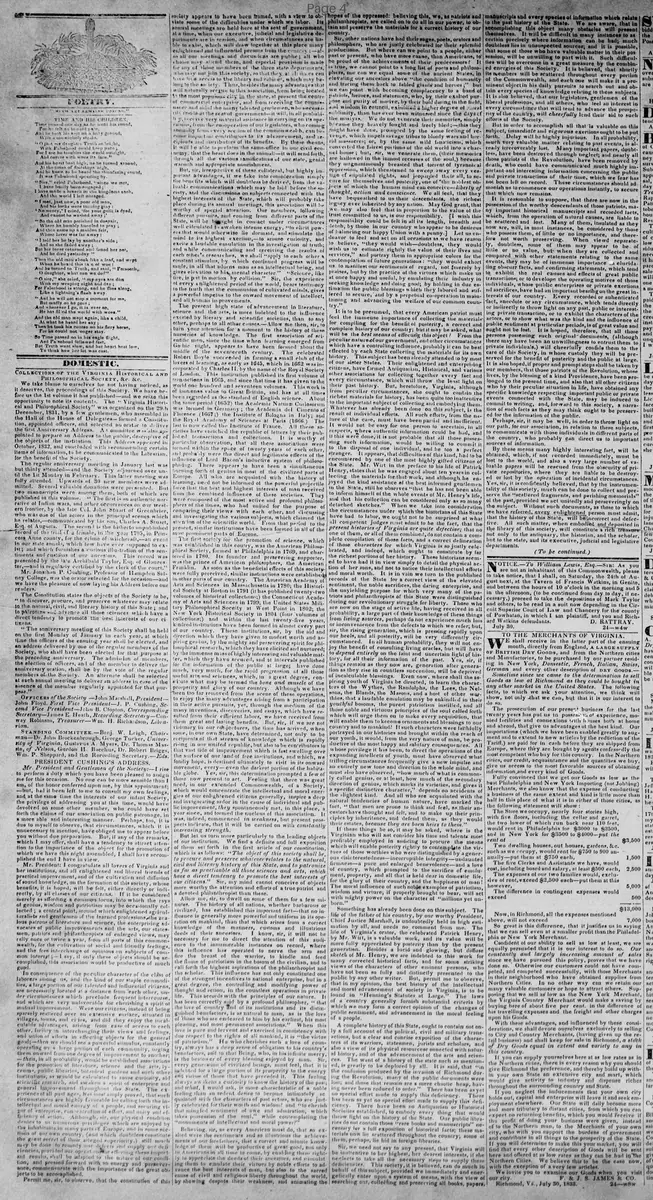
Collections of The Virginia Historical And Philosophical Society, &c. &c.
We take blame to ourselves for not having noticed, as it deserves, the proceedings of this Society. We have before us the 1st volume it has published—and we seize this opportunity to note its content. The "Virginia Historical and Philosophical Society" was organized on the 29th December, 1831, by a few gentlemen, who assembled in the Hall of the House of Delegates—formed a Constitution, appointed officers, and selected an orator to deliver the first Anniversary Address. A committee was also appointed to prepare an Address to the public, descriptive of the objects of the institution. This Address appeared in October, 1832, and concluded with recommending certain items of information, to be communicated to the Librarian, for the benefit of the Society.
The regular anniversary meeting in January last was but thinly attended—and the Society adjourned over until the 1st Monday in February. This latter meeting was fully attended. Upwards of 30 new members were admitted. Several valuable donations were presented. But two manuscripts were among them, both of which are published in this volume. "The first is an authentic narrative of Indian wars, and other occurrences on our western frontier, by the late Col. John Stuart of Greenbrier, who was one of the actors in the principal scenes which he relates,—communicated by his son, Charles A. Stuart, Esq. of Augusta. The second is the hitherto unpublished record of the trial of a female, in the year 1705, in Princess Anne county, for the crime of witchcraft,—an event in our state annals, which few have ever supposed to exist; and which furnishes a curious illustration of the sentiments and customs of our ancestors. This record was presented by the late Archibald Taylor, Esq. of Gloucester,—and is regularly certified by the clerk of the court."
Mr. Jonathan P. Cushing, Professor of Hampden Sidney College, was the orator selected for the occasion—and we have the pleasure of now laying his Address before our readers.
The Constitution states the objects of the Society to be, "to discover, procure, and preserve whatever may relate to the natural, civil, and literary history of this State; and to patronize and advance all those sciences which have a direct tendency to promote the best interests of our citizens."
"The anniversary meeting of this Society shall be held on the first Monday of January in each year, at which time the officers of the ensuing year shall be elected, and an address delivered by one of the regular members of the Society, who shall have been elected for that purpose at the preceding anniversary. The admission of members, the election of officers, and of the member to deliver the anniversary oration, shall be by the vote of the regular members of the Society. An alternate shall be selected at each annual meeting to deliver an address in case of the absence of the member regularly appointed for that purpose."
Officers of the Society—John Marshall, President—John Floyd, First Vice President—J. P. Cushing, Second Vice President—John B. Clopton, Corresponding Secretary—James E. Heath, Recording Secretary—Conway Robinson, Treasurer—Wm. H. Richardson, Librarian.
Standing Committee.—Benj. W. Leigh, Chairman—Dr. John Brockenbrough, George Tucker, University of Virginia, Gustavus A. Myers, Dr. Thomas Massie, of Nelson, Gurdon H. Bacchus, Dr. Robert Briggs, Wm. P. Sheppard, and the Recording Secretary.
PRESIDENT CUSHING'S ADDRESS.
Mr. President and Gentlemen of the Society:—I rise to perform a duty which you have been pleased to assign me for this occasion. No one can be more sensible than I am, of the honor conferred upon me, by this appointment;—but, had it been left to me to consult my own feelings, and at the same time the interests of our infant Society, the privilege of addressing you at this time, would have devolved on some other member, who could have set forth the claims of our association on public patronage, in more able and interesting manner. Perhaps, too, it is due to myself to observe, that circumstances, which it is unnecessary to mention, have obliged me to appear before you without due preparation. But, if any of the remarks, which I may offer, shall have a tendency to attract attention to the importance of the object for the promotion of which we have this night assembled, I shall have accomplished the end I have in view.
Mr. President: I congratulate all lovers of Virginia and her institutions, and all enlightened and liberal friends of practical improvement, and of the cultivation and diffusion of sound knowledge, on the formation of this society, whose benefits, it is hoped, will be felt, either directly or indirectly, by all classes of our citizens. If it be considered merely as affording a common focus, into which the rays of genius, wisdom and patriotism may be occasionally collected; a central point, around which enlightened agriculturalists and gentlemen of the learned professions the zealous patrons of literature and science, the enterprising advocates of public improvements and the arts, our statesmen, patriots and philanthropists of enlarged views, may rally once or twice a year, from all parts of this commonwealth, for the cultivation of social and friendly feelings, and the free interchange of opinions on subjects of common interest;—I say, if only these objects should be accomplished, this association would be productive of much good.
In consequence of the peculiar character of the class of laborers among us, and the kind of our staple commodities, a large portion of our talented and influential citizens, are necessarily located at a distance from each other, under circumstances which preclude frequent intercourse, and which are very unfavorable for cherishing a spirit of mutual improvement. Were our citizens, instead of being sparsely scattered over an extensive surface, situated in villages, towns, and cities, and did they enjoy the incalculable advantages, arising from ease of access to each other, facility in interchanging their views and feelings, and union of efforts in effecting objects for the general good;—then we should see a powerful stimulus, constantly operating on a large portion of each community, urging them onward from one degree of improvement to another;—then, in all probability, would be established associations for the promotion of literature, science and the arts, lyceums, public libraries, botanical gardens and such other institutions, as would be calculated to rouse curiosity, aid scientific research, and awaken a spirit of enterprise and general improvement throughout the State. The experience of all past ages, has most amply proved, that such circumstances are highly favorable for calling forth the intellectual and moral energy of a people, and securing vigor of enterprise, concentration of effort, and unity and efficiency of action. Although, sir, our physical condition denies to us numerous privileges which are enjoyed by the inhabitants in many parts of Europe, and in some sections of our own country, (and which doubtless constitute the great secret of their alleged superiority,) still much may be done to remedy our defects and supply our deficiencies, provided our operations for effecting these important results, shall be adapted to the nature of our condition, and pressed forward with an energy and perseverance, commensurate with the importance of the great objects to be accomplished.
Permit me, sir, to observe, that the constitution of this society appears to have been framed, with a view to obviate some of the difficulties under which we labor. Its annual meetings are held here at the seat of government, at a time, when our executive, judicial and legislative departments are in session, and when circumstances are liable to exist, which will draw together at this place many enlightened and influential persons from the country;—also all our meetings and discussions are public; all who choose may attend them, and especial provisions made for any of those members of the three state departments, who may not join this society, so that they at all times can have free access to the library and cabinet, which may belong to the society. Thus, besides the many advantages that will naturally accrue to this association, from being located at the most populous city in the state, at present the centre of commercial enterprise, and from receiving the countenance and aid of the many talented gentlemen, whose necessary residence is at the seat of government—it will, in all probability, receive very material assistance in carrying on its operations, from the co-operation of our legislators, who coming annually from every section of the commonwealth, can be made important contributors to its advancement, and recipients and distributors of its benefits. By these means, it will be able to perform the same office in our civil economy, that the heart does in the animal: it will send forth, through all the various ramifications of our state, genial warmth and appropriate nourishment.
But, sir, irrespective of these collateral, but highly important advantages, if we take into consideration simply the benefits which will doubtless be derived, from the valuable communications which may be laid before the society, and the discussions on subjects connected with the highest interests of the State, which will probably take place during its annual meetings, this association will be worthy of special attention. Our members, following different pursuits, and coming from different parts of the State, will be brought in contact under circumstances well calculated to awaken intense energy, "to elicit powers that would otherwise lie dormant, and stimulate the mind to its highest exertion,—to arouse curiosity, and excite a laudable emulation in the investigation of truth; and while communicating and receiving the results of each other's researches, we shall "apply to each other constant stimulus, by which continued progress will be made, in all that adorns man as an intellectual being, and gives elevation to his mental character." "Science, like fire, is put in motion by collision." Sir, the experience of every enlightened period of the world, bears testimony to the truth that the communion of cultivated minds, gives a powerful impulse to the onward movement of intellect, and all human improvements.
The present high state of advancement in literature, science and the arts, is more indebted to the influence exerted by literary and scientific societies, than to any other, perhaps to all other causes.—Allow me then, sir, to turn your attention for a moment to the history of these nurseries of knowledge. The first association of scientific men, since the time when learning emerged from Gothic night, appears to have been formed about the middle of the seventeenth century. The celebrated Robert Boyle succeeded in forming a small club of the lovers of learning, as early as 1645, which in 1662 was incorporated by Charles II. by the name of the Royal Society of London. This institution published its first volume of transactions in 1665, and since that time it has given to the world one hundred and seventeen volumes. This work is of immense value to Great Britain, and has at all times been regarded as the standard of English science. About the same period (1652) the Academia Naturae Curiosorum was formed in Germany; the Academia del Cimento of Florence (1667;) the Institute of Bologna in Italy; and the Royal Academy of Sciences at Paris (1666.) The last is now called the Institute of France. All these societies have enriched the republic of letters by their published transactions and collections. It is worthy of particular observation, that all these associations were formed within the space of twenty years of each other, and probably were the direct and legitimate effects of the influence of Lord Bacon's inductive system of philosophising. There appears to have been a simultaneous bursting forth of genius in most of the civilized parts of Europe. All who are acquainted with the history of learning, need not be informed of the powerful projectile force that the best and highest interests of man received from the combined influence of these societies. They were composed of the most active and profound philosophers of the times, who had united for the purpose of comparing their views with each other, and discussing and investigating the various subjects, which claimed the attention of the scientific world. From that period to the present, similar institutions have been formed in all of the most prominent parts of Europe.
The first society for the promotion of science, which was established in this country, was the American Philosophical Society, formed at Philadelphia in 1769, and chartered in 1780. Its founder and persevering supporter, was the prince of American philosophers, the American Franklin. As soon as the beneficial effects of this society were fully perceived, similar institutions were established in other parts of our country. The American Academy of Arts and Sciences in Massachusetts in 1780; the Historical Society at Boston in 1791 (it has published twenty-two volumes of historical collections;) the Connecticut Academy of Arts and Sciences in 1799; the United States Military Philosophical Society at West Point in 1802; the New York Historical Society in 1804 (four volumes of collections;) and within the last twenty-five years, kindred institutions have been formed in almost every part of our country. These institutions, sir, by the aid and direction which they have given to modest worth and aspiring genius, by the mighty and persevering spirit for philosophical research, which they have elicited and nurtured; by the immense mass of highly interesting and valuable matter, which they have secured, and at intervals published for the information of the public at large; have done much, very much, for the rapid progression of all those useful arts and sciences, which, in a great degree, constitute what may be termed the bone and muscle of the prosperity and glory of our country. Although we have been too far removed from the scene of these operations, to enjoy the many advantages arising from a participation in their active pursuits, yet, through the medium of the many inventions, discoveries, and essays, which have resulted from their efficient labors, we have received from them great and lasting benefits. But, sir, if we are not visionary in our conjectures, the time has arrived, when some, in our own State, have determined, not only to be recipients of that stream of knowledge which is rapidly rising in our united republic, but also to be contributors to that vast tide of improvement which is fast swelling over the surface of our land of free institutions, and which, we fondly hope, is destined ultimately to visit in its onward movement, every—even the darkest portion of the habitable globe. Yes, sir, this determination prompted a few of those now present to act. Feeling that there was great need, in our extended Commonwealth, of a Society, which would concentrate the intellectual and moral energies of our enlightened citizens generally, inspire a deep and invigorating ardor in the cause of individual and public improvement, they spontaneously met, in this place, a year since, and formed the nucleus of this association. It was, indeed, commenced in weakness, but present prospects indicate, that it will be carried on with constantly increasing strength.
But let us turn more particularly to the leading objects of our institution. We find a definite and full exposition of them set forth in the first article of our constitution, which is as follows: "The object of this society shall be, to procure and preserve whatever relates to the natural, civil and literary history of this State, and to patronize as far as practicable all those sciences and arts, which have a direct tendency to promote the best interests of our citizens." Sir, my mind cannot conceive of objects more worthy the attention and efforts of a true patriot and a devoted philanthropist than these.
Allow me, sir, to dwell on some of them for a few minutes. The history of all nations, whether barbarous or civilized, has established this important fact—that no influence is generally more powerful and uniform in its operation on mankind, than that which arises from a correct knowledge of the manners, customs and illustrious deeds of their ancestors.
I know, sir, it will not be necessary for me to direct the attention of this audience to the innumerable instances on record, where this influence has operated to nerve the arm and fire the breast of the warrior, to kindle and feed the flame of patriotism in the bosom of the civilian, and to call forth the highest aspirations of the philanthropist and the scholar. This influence has not only constituted one of the strongest incentives to national enterprise, but in a great degree, the controlling and modifying power of thought and action, in the countless operations in private life. This accords with the principles of our nature. It has been correctly said by a profound philosopher, "that the love of country and of its institutions and its distinguished benefactors, is as natural to man, as is the love of those who are endeared to him by his earliest, his most pleasing, and most permanent associations." When this love is pure and fervent and exercised in consistency with due respect to the rights of all mankind, it is "the virtue of patriotism." He who cherishes such a love of country, always has a deep sense of obligation to his country's benefactors, and to that Being, who, in his infinite mercy, is the bestower of every blessing enjoyed by man. Sir, every generation of civilized beings, must feel, that it is indebted for a large portion of its prosperity to the energy and virtue of those that have preceded it. This feeling always awakens a curiosity to know the history of the past; and what, I would ask, is more characteristic of a noble feeling than an ardent desire to become intimately acquainted with the characters of past actors, who are justly celebrated for their worth and wisdom? and "to cherish that mingled sentiment of awe and admiration, which takes possession of the soul," while contemplating the "monuments of intellectual and moral power?"
Believing, sir, as every American must do, that so exalted were the sentiments and so illustrious the achievements of our forefathers, that a correct and minute knowledge of them will be productive of great good, not only to Americans in all time to come, by enabling them rightly to appreciate the deeds of their ancestors, and stimulating them to emulate their virtues by noble efforts to advance the best interests of man, but also to the sacred cause of civil and religious liberty throughout the world, by showing despots their weakness, and animating the hopes of the oppressed: believing this, we, as patriots and philanthropists, are called on to do all in our power, to obtain and preserve the materials for a correct history of our country.
Sir, other nations have had their sages, poets, orators and philosophers, who are justly celebrated for their splendid productions. But where can we point to a people, either past or present, who have more cause, than Americans, to be proud of the achievements of their predecessors? It is true, we cannot point to a long list of poets and philosophers, nor can we equal some of the ancient States, in elevating our ancestors above "the condition of humanity and tracing them back to fabled giants and heroes;" but we can point with becoming complacency to a band of patriots, heroes, and statesmen, who, by their exalted purpose and purity of motive, by their bold daring in the field, and wisdom in council, exhibited a higher degree of moral sublimity, than has ever been witnessed since the days of the Muses. We do not venerate their memories, simply because they bravely fought and freely bled;—this they might have done, prompted by the same feeling of revenge, which impels savage tribes to bloody wars and horrid massacres; or, by the same wild fanaticism, which converted the fairest portions of the old world into a charnel house; but, sir, we venerate them, (their memories are hallowed in the inmost recesses of the soul,) because they magnanimously breasted that torrent of tyrannical oppression, which threatened to sweep away every vestige of stipulated rights, and jeoparded their all, to secure for themselves and posterity, one of "the noblest objects of which the human mind can conceive—liberty of thought, action and conscience. We all feel, that they have bequeathed to us their descendants, the richest legacy ever inherited by any nation. May God grant, that we may also feel that in proportion to the value of the trust committed to us, is our responsibility. [I wish this responsibility could be felt in all its length, breadth and depth, by those in our country who appear to be desirous of balancing our happy Union with a penny.] Let us endeavor to feel and act on all occasions as we have reason to believe, they would wish—doubtless, they would wish us to estimate rightly the value of their lives and services," and portray them in appropriate colors for the contemplation of future generations: "they would exhort us to manifest our sentiments of regard, not merely by praises, but by the practice of the virtues which make us at once happy and useful, by emulating their industry in seeking knowledge and doing good; by holding in due estimation the public blessings which they labored and suffered to secure, "and by a perpetual co-operation in maintaining and advancing the welfare of our common country.'
It is to be presumed, that every American patriot must feel the immense importance of collecting the materials for compiling for the benefit of posterity, a correct and complete history of our country; but it may be asked, what will be the best means of effecting this object? From the peculiar nature of our government, and other circumstances which have a controlling influence, probably it can be best effected by each State collecting the materials for its own history. This subject has been already attended to by most of our sister States. Their enlightened and enterprising citizens, have formed Antiquarian, Historical, and various other associations for collecting together every fact and every circumstance, which will throw the least light on their past history. But, heretofore, Virginia, although from peculiar circumstances, she ought to contain the richest materials for history, has been quite too inattentive to the important subject of collecting and embodying them. Whatever has already been done on this subject, is the result of individual efforts. All such efforts, from the nature of the case, must have been partial and inefficient. It would not be easy for one person to ascertain, in all respects, where authentic information could be had, and in this were done, it is not probable that all those possessing such information, would be willing to commit it to the disposal of one individual, and he too a perfect stranger. It appears, that difficulties of this kind, had to be encountered by one of the most highly gifted citizens of the State. Mr. Wirt in the preface to his life of Patrick Henry, states that he was engaged about ten years in collecting the materials for that work, and although he enjoyed the kind assistance of the best informed gentlemen in the State, still he observes "that he has not been able to inform himself of the whole events of Mr. Henry's life, and that his collection can be considered only as so many detached sketches." When we take into consideration the circumstances under which the historians of this State have had to labor, we ought not to be surprised at what all competent judges must admit to be the fact, that the present histories of Virginia are quite defective; that no one of them, or all of them combined, do not contain a complete compilation of those facts, and a correct delineation of those characters for which Virginia is so justly celebrated, and indeed, which ought to constitute by far the richest portions of her history. These historians seemed to have had it in view simply to detail the physical action of her sons, and not to notice their intellectual efforts and moral worth. It is in vain we turn to the published records of the State for a correct view of the elevated sentiment, the noble sacrifices, the daring enterprise, and the unyielding purpose for which very many of the patriots and philanthropists of this State were distinguished during our revolutionary struggle for liberty. Those who are now on the stage of active life, having received in all probability, a large part of their knowledge of these things from living sources, perhaps do not experience much loss or inconvenience from the defects to which we refer; but, sir, the rising generation, which is pressing rapidly upon our heels, and all posterity, will be very differently circumstanced. In all human probability, they will not enjoy the benefit of consulting living oracles, but will have to depend entirely on the faint and uncertain light of history, for all their information of the past. Yes, sir, if things remain as they now are, generation after generation as they rise in countless succession, will be deprived of incalculable blessings. Even now, where shall the aspiring youth of Virginia be directed, to learn the characters of the Wythes, the Randolphs, the Lees, the Nelsons, the Blands, the Masons, and a host of other worthies, that a laudable emulation may be enkindled in their youthful bosoms, the purest patriotism instilled, and all those noble and virtuous principles of the soul called forth which will urge them on to make every acquisition, that will enable them to become ornaments and blessings to our country and to mankind? If such characters were faithfully portrayed in our histories and brought within the reach of our youth, it would, from the very nature of man, be productive of the most happy and salutary consequences. "All whose privilege it has been, to direct the operations of the expanding intellects of youth, must have observed what trifling circumstances frequently give a new impulse and an entirely new tone and direction to the whole mind, and must also have observed, "how much of what is commonly called genius, or at least, how much of the secondary direction of genius, which marks its varieties, and gives it a specific distinctive character," depends on accidents of the slightest kind. And all who are acquainted with the natural tendencies of human nature, have marked the fact, "that men are prone to think and feel, as their ancestors have thought and felt, and to make up their principles by inheritance, and defend them, as they would their estates, because they are born heirs to them."
If these things be so, it may be asked, where is the Virginian who will not consider his time and talents most profitably employed in assisting to procure the means which will enable posterity rightly to contemplate the virtues of those worthies who were distinguished by a generous disinterestedness—incorruptible integrity—undaunted firmness—a pure and enlarged benevolence—and a love of country, which prompted to the sacrifice of emolument, property, and all that is held dear in domestic life, for the glory of their country, and the happiness of man! The moral influence of such noble examples of patriotism, wisdom and virtue, if properly brought to bear, will act with mighty power on the character of "millions yet unborn."
Something has already been done on this subject. The life of the father of his country, by our worthy President, Chief Justice Marshall, is undoubtedly held in high estimation by all, and needs no comment from me. The life of Virginia's orator, the celebrated Patrick Henry, by Mr. Wirt, is a valuable work, and its value will be more fully appreciated by posterity than by the present generation. Besides a lucid and glowing, but diffuse sketch of Mr. Henry, we are indebted to this work for many corrected historical facts, and for some striking views of the characters of other eminent persons, who have not been so fully and distinctly presented to the public by any other writer. But, permit me to observe, that in my opinion, the best history of the intellectual and moral advancement of society in Virginia, is to be found in "Henning's Statutes at Large." The laws of a country generally furnish substantial criteria by which we may form a correct opinion of the changes of public sentiment, and advancement in the moral feeling of a people.
A complete history of this State, ought to contain not only a full account of the political, civil and military transactions, but a clear and concise exposition of the characters of its warriors, statesmen, jurists and scholars, and also a view of its physical resources connected with natural history, and of the advancement of the arts and sciences. The want of a history of the state such as mentioned, is greatly to be deplored by all. It is said, that "in the confusion produced by the invasion of Richmond during the Revolution, many of the public documents were lost; and those that remain are a mere chaotic heap, having never been reduced to order."
There has been as yet no special effort made to supply this deficiency. There have been no Antiquarian or Historical Societies established, to embody every thing that would throw light on the history of the State. Our public libraries do not contain those "rare books and manuscripts" necessary for a full exposition of historical facts; these materials now lie scattered throughout the country; some of them, perhaps, lie hid in foreign libraries.
Sir, we need not say to any present, that Virginia will be inattentive to her highest, her dearest interests, if she neglects to take all the necessary steps to supply these deficiencies. This society, it is believed, can do much in behalf of this subject, provided we immediately and energetically enter upon a system of means, with the view of searching out, collecting and preserving all books, papers, manuscripts and every species of information which relate to the past history of the State. We are aware, that in accomplishing this object many obstacles will present themselves. It will be difficult in many instances to ascertain precisely where information can be had; much doubtless lies in unsuspected sources; and it is possible, that some of those who have valuable matter in their possession, will be unwilling to part with it. Such difficulties will be overcome in a great measure by the combined energies of this Society. It is believed, that shortly its members will be scattered throughout every portion of the Commonwealth, and each one will make it a prominent object in his daily pursuits to search out and obtain every species of knowledge relating to these subjects. It is also believed, that our legislators, gentlemen of the liberal professions, and all others, who feel an interest in every circumstance that will tend to advance the prosperity of the country, will cheerfully lend their aid to such efforts of the Society.
But in order to accomplish all that is valuable on this subject, immediate and vigorous exertions ought to be put forth. Delay will be highly injurious. In all probability, much very valuable matter relating to past events, is already irrecoverably lost. Many important papers, doubtless, have been destroyed through neglect; and nearly all those patriots of the Revolution, have been removed by death, who could have communicated much highly important—and interesting information concerning the public and private transactions of their time, which we fear has not been left on record. These circumstances should admonish us to commence our operations instantly, to secure that which now remains.
It is reasonable to suppose, that there are now in the possession of the worthy descendants of those patriots, many important historical manuscripts and recorded facts, which, from the operation of natural causes, are liable to be scattered and lost. Many of them, insulated as they now are, will, in most instances, be considered by those who possess them, of little or no importance, and therefore not worth preserving. When viewed separately, doubtless, some of them may appear to be of little or no value, but when they are collected and compared with other statements relating to the same events, they may be of immense importance elucidating obscure facts, and confirming statements, which tend to exhibit the real causes and effects of great public transactions; or to develope the operating motives of those individuals, whose public enterprises or private exertions and sacrifices, have had an important bearing on the great interests of our country. Every recorded or authenticated fact, anecdote or any circumstance, which tends directly or indirectly to throw light on any past, public or interesting private transaction, or to exhibit the characters of the actors, or to show what was the kind and the influence of public sentiment at particular periods, is of great value and ought not be lost. It is hoped, therefore, that all those persons possessing such original documents, (although there may have been an unwillingness to entrust them to private individuals,) will cheerfully confide them to the care of this Society, in whose custody they will be preserved for the benefit of posterity and the public at large. It is also hoped, if proper and prompt steps shall be taken by our members, that those patriots of the Revolution, whose lives, by the blessing of a kind Providence, have been prolonged to the present time, and also that all other citizens who by their peculiar situation in life, have obtained any specific knowledge respecting important public or private events connected with the State, may be induced to commit to writing, and, forward to this society, a narration of such facts as they may think ought to be preserved for the information of the public.
Perhaps, sir, it may be well, in order to throw light on our path, for our association, in relation to these subjects, to communicate with those individuals in different parts of the country, who probably can direct us to important sources of information. By these means many highly interesting facts, will be obtained, which, if not recorded immediately, must be lost to the world, and also a very large number of valuable papers will be rescued from the obscurity of private repositories, where they are liable to be destroyed or lost by the operation of incidental circumstances. Yes, sir, it is confidently believed, that by the instrumentality of this society, much can be done to collect and preserve the "scattered fragments, and perishing memorials" of the past, provided we act unitedly and perseveringly on the subject. Without such documents, as those to which we have referred, every enlightened person must admit, that the history of this State, will be incorrect and defective. All such matter, when embodied and deposited in the library of this society, will constitute a rich treasure not only to the antiquary, the historian, and the scholar, but to the state, and its executive, judicial and legislative departments.
(To be continued.)
What sub-type of article is it?
What themes does it cover?
What keywords are associated?
What entities or persons were involved?
Where did it happen?
Story Details
Key Persons
Location
Richmond, Virginia; Princess Anne County
Event Date
29th December, 1831; October, 1832; January 1833; 1st Monday In February 1833; 1705
Story Details
The Virginia Historical and Philosophical Society was organized in 1831 to preserve state history and promote sciences. At its 1833 meeting, new members joined, donations including manuscripts on Indian wars by Col. John Stuart and a 1705 witchcraft trial were received. Prof. Cushing delivered an address urging collection of historical materials to honor ancestors' virtues and inspire future generations.