Thank you for visiting SNEWPapers!
Sign up free
Literary
December 11, 1823
The Wilmingtonian
Wilmington, New Castle County, Delaware
What is this article about?
Biographical essay on Lieutenant General John Burgoyne, covering his uncertain origins, military career including promotion in 1759 and defeat at Saratoga, parliamentary involvement, marriage to Lady Charlotte Stanley, and dramatic works like The Maid of the Oaks, The Lord of the Manor, and The Heiress. Includes a poetic lament for his wife who died in 1776. Interspersed with unrelated fragments on mine descent and dissipation.
Clipping
OCR Quality
75%
Good
Full Text
MENTAL MUSEUM.
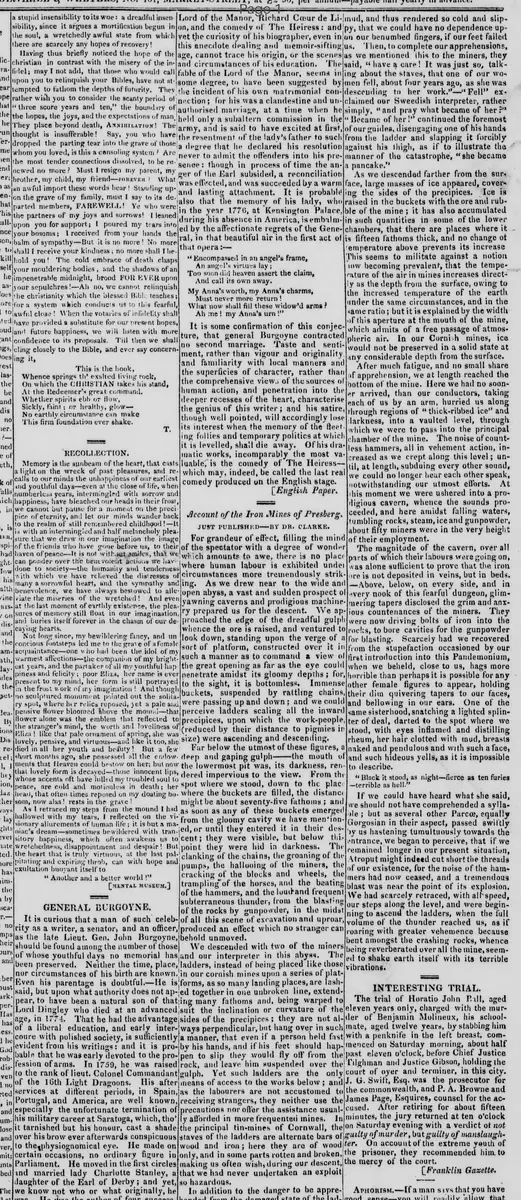
GENERAL BURGOYNE.
It is curious that a man of such celebrity as a writer, a senator, and an officer, as the late Lieut. Gen. John Burgoyne, should be found among the number of those of whose youthful days no memorial has been preserved. Neither the time, place, nor circumstances of his birth are known. Even his parentage is doubtful.—He is said, but upon what authority does not appear, to have been a natural son of that Lord Dingley who died at an advanced age, in 1774. That he had the advantage of a liberal education, and early intercourse with polished society, is sufficiently evident from his writings: and it is probable that he was early devoted to the profession of arms. In 1759, he was raised to the rank of Lieut. Colonel Commandant of the 16th Light Dragoons. His after services at different periods, in Spain, Portugal, and America, are well known, especially the unfortunate termination of his military career at Saratoga, which, tho' it tarnished not his honour, cast a shade over his brow ever afterwards conspicuous to the physiognomical eye. He made on certain occasions, no ordinary figure in Parliament. He moved in the first circles and married Lady Charlotte Stanley, a daughter of the Earl of Derby; and yet, daughter
Lord of the Manor, Richard Coeur de Lion, and thus rendered so cold and slippery, that we could have no dependence upon our benumbed fingers, if our feet failed us. 'Then, to complete our apprehensions, as we mentioned this to the miners, they said, "have a care! It was just so, talking about the staves, that one of our women fell, about four years ago, as she was descending to her work." "Fell," exclaimed our Swedish interpreter, rather simply, "and pray what became of her?" "Became of her!" continued the foremost of our guides, disengaging one of his hands from the ladder and slapping it forcibly against his thigh, as if to illustrate the manner of the catastrophe, "she became a pancake."
The lingering morning at last returns. The same circle of dissipation returns with it; till at length, by the force of habit, the mind contracts a stupid insensibility to its woe: a dreadful insensibility, since it argues a mortification begun in the soul, a wretchedly awful state from which there are scarcely any hopes of recovery! We know not who or what originally he was. He was the author of four successful dramas. The Maid of the Oaks, The Lord of the Manor, and the comedy of The Heiress: and yet the curiosity of his biographer, even in this anecdote dealing and memoir-sifting age, cannot trace his origin, or the scenes and circumstances of his education. The fable of the Lord of the Manor, seems in some degree, to have been suggested by the incident of his own matrimonial connection; for his was a clandestine and unauthorised marriage, at a time when he held only a subaltern commission in the army, and is said to have excited at first, the resentment of the lady's father to such a degree that he declared his resolution never to admit the offenders into his presence: though in process of time the anger of the Earl subsided, a reconciliation was effected, and was succeeded by a warm and lasting attachment. It is probable also that the memory of his lady, who in the year 1776, at Kensington Palace, during his absence in America, is embalmed by the affectionate regrets of the General, in that beautiful air in the first act of that opera:
"Encompassed in an angel's frame,
An angel's virtues lay;
Too soon did heaven assert the claim,
And call its own away.
My Anna's worth, my Anna's charms,
Must never more return!
What now shall fill these widow'd arms?
Ah me! my Anna's urn!"
It is some confirmation of this conjecture, that General Burgoyne contracted no second marriage. Taste and sentiment, rather than vigour and originality and familiarity with local manners and the superficies of character, rather than the comprehensive views of the sources of human action, and penetration into the deeper recesses of the heart, characterise the genius of this writer; and his satire, though well pointed, will accordingly lose its interest when the memory of the fleeting follies and temporary politics at which it is levelled, shall die away. Of his dramatic works, incomparably the most valuable, is the comedy of The Heiress—which may, indeed, be called the last real comedy produced on the English stage.
[English Paper.]
GENERAL BURGOYNE.
It is curious that a man of such celebrity as a writer, a senator, and an officer, as the late Lieut. Gen. John Burgoyne, should be found among the number of those of whose youthful days no memorial has been preserved. Neither the time, place, nor circumstances of his birth are known. Even his parentage is doubtful.—He is said, but upon what authority does not appear, to have been a natural son of that Lord Dingley who died at an advanced age, in 1774. That he had the advantage of a liberal education, and early intercourse with polished society, is sufficiently evident from his writings: and it is probable that he was early devoted to the profession of arms. In 1759, he was raised to the rank of Lieut. Colonel Commandant of the 16th Light Dragoons. His after services at different periods, in Spain, Portugal, and America, are well known, especially the unfortunate termination of his military career at Saratoga, which, tho' it tarnished not his honour, cast a shade over his brow ever afterwards conspicuous to the physiognomical eye. He made on certain occasions, no ordinary figure in Parliament. He moved in the first circles and married Lady Charlotte Stanley, a daughter of the Earl of Derby; and yet, daughter
Lord of the Manor, Richard Coeur de Lion, and thus rendered so cold and slippery, that we could have no dependence upon our benumbed fingers, if our feet failed us. 'Then, to complete our apprehensions, as we mentioned this to the miners, they said, "have a care! It was just so, talking about the staves, that one of our women fell, about four years ago, as she was descending to her work." "Fell," exclaimed our Swedish interpreter, rather simply, "and pray what became of her?" "Became of her!" continued the foremost of our guides, disengaging one of his hands from the ladder and slapping it forcibly against his thigh, as if to illustrate the manner of the catastrophe, "she became a pancake."
The lingering morning at last returns. The same circle of dissipation returns with it; till at length, by the force of habit, the mind contracts a stupid insensibility to its woe: a dreadful insensibility, since it argues a mortification begun in the soul, a wretchedly awful state from which there are scarcely any hopes of recovery! We know not who or what originally he was. He was the author of four successful dramas. The Maid of the Oaks, The Lord of the Manor, and the comedy of The Heiress: and yet the curiosity of his biographer, even in this anecdote dealing and memoir-sifting age, cannot trace his origin, or the scenes and circumstances of his education. The fable of the Lord of the Manor, seems in some degree, to have been suggested by the incident of his own matrimonial connection; for his was a clandestine and unauthorised marriage, at a time when he held only a subaltern commission in the army, and is said to have excited at first, the resentment of the lady's father to such a degree that he declared his resolution never to admit the offenders into his presence: though in process of time the anger of the Earl subsided, a reconciliation was effected, and was succeeded by a warm and lasting attachment. It is probable also that the memory of his lady, who in the year 1776, at Kensington Palace, during his absence in America, is embalmed by the affectionate regrets of the General, in that beautiful air in the first act of that opera:
"Encompassed in an angel's frame,
An angel's virtues lay;
Too soon did heaven assert the claim,
And call its own away.
My Anna's worth, my Anna's charms,
Must never more return!
What now shall fill these widow'd arms?
Ah me! my Anna's urn!"
It is some confirmation of this conjecture, that General Burgoyne contracted no second marriage. Taste and sentiment, rather than vigour and originality and familiarity with local manners and the superficies of character, rather than the comprehensive views of the sources of human action, and penetration into the deeper recesses of the heart, characterise the genius of this writer; and his satire, though well pointed, will accordingly lose its interest when the memory of the fleeting follies and temporary politics at which it is levelled, shall die away. Of his dramatic works, incomparably the most valuable, is the comedy of The Heiress—which may, indeed, be called the last real comedy produced on the English stage.
[English Paper.]
What sub-type of article is it?
Essay
What themes does it cover?
Political
War Peace
Love Romance
What keywords are associated?
John Burgoyne
Saratoga
Military Career
Dramatic Works
Heiress
Maid Of The Oaks
Lord Of The Manor
Clandestine Marriage
What entities or persons were involved?
[English Paper.]
Literary Details
Title
Mental Museum. General Burgoyne.
Author
[English Paper.]
Subject
Biography Of General Burgoyne
Form / Style
Biographical Essay With Poetic Lament
Key Lines
Encompassed In An Angel's Frame,
An Angel's Virtues Lay;
Too Soon Did Heaven Assert The Claim,
And Call Its Own Away.
My Anna's Worth, My Anna's Charms,
Must Never More Return!
What Now Shall Fill These Widow'd Arms?
Ah Me! My Anna's Urn!