Thank you for visiting SNEWPapers!
Sign up free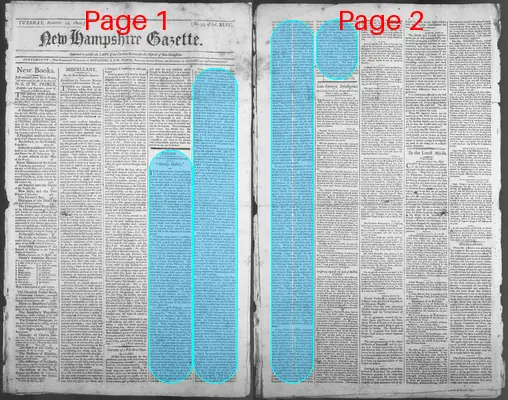
The New Hampshire Gazette
Portsmouth, Rockingham County, New Hampshire
What is this article about?
An editorial from the Independent Chronicle defends President Jefferson's economical policies, arguing they align with Connecticut's 'steady habits' of frugality and industry. It criticizes Federalists and some clergy for deceiving citizens into opposing reforms like tax reductions and judiciary restoration, portraying such opposition as hypocritical and contrary to New England principles.
Merged-components note: Continuation of the same political editorial piece across pages 1 and 2, as the text flows sequentially without interruption.
Clippings
1 of 2
OCR Quality
Full Text
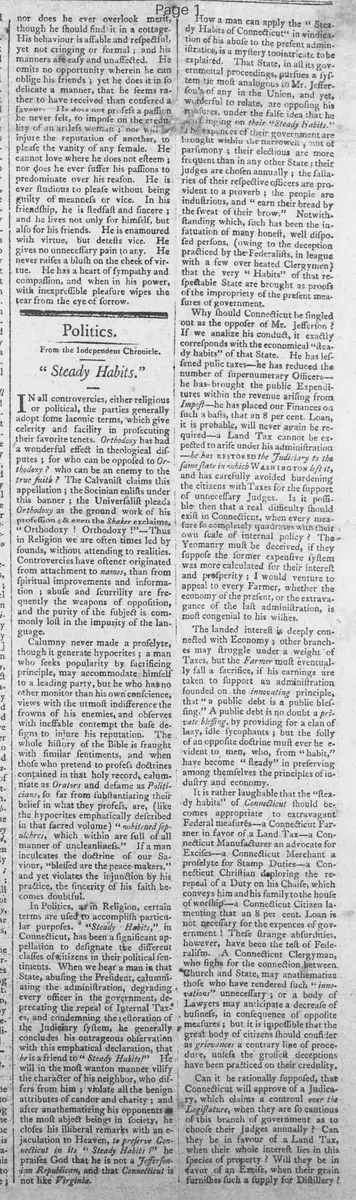
From the Independent Chronicle.
"Steady Habits."
In all controversies, either religious or political, the parties generally adopt some laconic terms, which give celerity and facility in prosecuting their favorite tenets. Orthodoxy has had a wonderful effect in theological disputes; for who can be opposed to Orthodoxy? who can be an enemy to the true faith? The Calvinist claims this appellation; the Socinian enlists under this banner; the Universalist pleads Orthodoxy as the ground work of his profession; & even the Shaker exclaims, "Orthodoxy! Orthodoxy!"--Thus in Religion we are often times led by sounds, without attending to realities. Controversies have oftener originated from attachment to names, than from spiritual improvements and information; abuse and scurrility are frequently the weapons of opposition, and the purity of the subject is commonly lost in the impurity of the language.
Calumny never made a proselyte, though it generate hypocrites; a man who seeks popularity by sacrificing principle, may accommodate himself to a leading party, but he who has no other monitor than his own conscience, views with the utmost indifference the frowns of his enemies, and observes with ineffable contempt the base designs to injure his reputation. The whole history of the Bible is fraught with similar sentiments, and when those who pretend to profess doctrines contained in that holy record, calumniate as Orators and defame as Politicians, so far from substantiating their belief in what they profess, are, (like the hypocrites emphatically described in that sacred volume) "whitened sepulchres, which within are full of all manner of uncleanness." If a man inculcates the doctrine of our Saviour, "blessed are the peace-makers," and yet violates the injunction by his practice, the sincerity of his faith becomes doubtful.
In Politics, as in Religion, certain terms are used to accomplish particular purposes. "Steady Habits," in Connecticut, has been a significant appellation to designate the different classes of citizens in their political sentiments. When we hear a man in that State, abusing the President, calumniating the administration, degrading every officer in the government, deprecating the repeal of Internal Taxes, and condemning the restoration of the Judiciary system, he generally concludes his outrageous observation with this emphatical declaration, that he is a friend to "Steady Habits!" He will in the most wanton manner vilify the character of his neighbor, who differs from him; violate all the benign attributes of candor and charity; and after anathematizing his opponents as the most abject beings in society, he closes his illiberal remarks with an ejaculation to Heaven, to preserve Connecticut in its "Steady Habits!" he praises God that he is not a Jeffersonian Republican, and that Connecticut is not like Virginia.
How a man can apply the "Steady Habits of Connecticut" in vindication of his abuse to the present administration, is a mystery too intricate to be explained. That State, in all its governmental proceedings, pursues a system the most analogous to Mr. Jefferson's of any in the Union, and yet, wonderful to relate, are opposing his measures, under the false idea that he is infringing on their "Steady Habits." In expenses of their government are brought within the narrowest point of parsimony; their elections are more frequent than in any other State; their judges are chosen annually; the salaries of their respective officers are provident to a proverb; the people are industrious, and "earn their bread by the sweat of their brow." Notwithstanding which, such has been the infatuation of many honest, well disposed persons, (owing to the deception practiced by the Federalists, in league with a few over heated Clergymen) that the very "Habits" of that respectable State are brought as proofs of the impropriety of the present measures of government.
Why should Connecticut be singled out as the opposer of Mr. Jefferson? If we analyze his conduct, it exactly corresponds with the economical "steady habits" of that State. He has lessened public taxes--he has reduced the number of supernumerary Officers-- he has brought the public Expenditures within the revenue arising from Import--he has placed our Finances on such a basis, that an 8 per cent. Loan, it is probable, will never again be required--a Land Tax cannot be expected to arise under his administration --he has Restored the Judiciary to the same state in which WASHINGTON left it, and has carefully avoided burdening the citizens with Taxes for the support of unnecessary Judges. Is it possible then that a real difficulty should exist in Connecticut, when every measure so completely quadrates with their own scale of internal policy? The Yeomanry must be deceived, if they suppose the former expensive system was more calculated for their interest and prosperity; I would venture to appeal to every Farmer, whether the economy of the present, or the extravagance of the last administration, is most congenial to his wishes.
The landed interest is deeply connected with Economy; other branches may struggle under a weight of Taxes, but the Farmer must eventually fall a sacrifice, if his earnings are taken to support an administration founded on the innovating principle, that "a public debt is a public blessing." A public debt is no doubt a private blessing, by providing for a clan of lazy, idle sycophants; but the folly of an opposite doctrine must ever be evident to men, who, from "habit," have become "steady" in preserving among themselves the principles of industry and economy.
It is rather laughable that the "steady habits" of Connecticut should become appropriate to extravagant Federal measures--a Connecticut Farmer in favor of a Land Tax--a Connecticut Manufacturer an advocate for Excise--a Connecticut Merchant a proselyte for Stamp Duties--a Connecticut Christian deploring the repeal of a Duty on his Chaise, which conveys him and his family to the house of worship--a Connecticut Citizen lamenting that an 8 per cent. Loan is not necessary for the expenses of government! These strange absurdities, however, have been the test of Federalism. A Connecticut Clergyman, who sighs for the connection between. Church and State, may anathematize those who have rendered such "innovations" unnecessary; or a body of Lawyers may anticipate a decrease of business, in consequence of opposite measures; but it is impossible that the great body of citizens should consider as grievances a contrary line of procedure, unless the grossest deceptions have been practiced on their credulity.
Can it be rationally supposed, that Connecticut will approve of a Judiciary, which claims a controul over the Legislature, when they are so cautious of this branch of government as to choose their Judges annually? Can they be in favour of a Land Tax, when their whole interest lies in this species of property? Will they be in favor of an Excise, when their grain furnishes such a supply for Distillery?
Can they approve of the innovation of an eight per cent. loan, when all their transactions are within the old established usage of six per cent? Or can the people confide in the integrity of a few federal Clergymen, when they see a Huntington sacrifice every vestage of decency, and Christian benevolence in calumniating a clerical brother, merely for political purposes? "Such things are," but common sense forbids their continuance. It may answer for "half a time," but it cannot be durable, when information dispels the clouds of error and deception. The fact is, the citizens of the most Republican States, have been led to support federal measures not from conviction, but from delusion. The honesty of the people has been practised on by an artful, intriguing Priestly Junto. Not that I do, or ever did, suppose that the Clergy in general were opposed to Republicanism, yet I believe, that the subtlety of a few have in many instances deceived the very elect. Owing to an uncommon exertion of the federal party, the good people of Connecticut have been led to adopt sentiments contrary to every "steady habit" imbibed by themselves, and predecessors. They have been deceived by some spiritual leader, to embrace political doctrines subversive of all those legitimate practices, which have raised them to their present opulence freedom and respectability. A system of administration prosecuted on the same extravagant principles with the last, would have proved ruinous to every agricultural State in the Union. A standing army—a numerous body of Excisemen—a burdensome judiciary, with all the connections attendant on a particular profession, might be advantageous to those who live by others labors, or to those who profit by litigious law suits, but in a country, whose prosperity depends on agriculture, Commerce and Manufactures all such extraneous contingencies must prove destructive to the permanent happiness of the people.
From the first settlement of America, economy was the peculiar maxim of the Northern States. In every Legislature, we find that the purse strings were held with peculiar circumspection. In Massachusetts, the treasury department, is watched with hawk-eyed attention. Rhode-Island, Connecticut and New-Hampshire, have their "steady habits" in guarding against the inroads of extravagance. All money matters are considered with the utmost accuracy; we not only weigh the gold issuing from the treasury, but also weigh the measures which draw it from the place of deposit. An extravagant system could never become popular in either of the Northern States. If any man ever took New England ground, it is Mr. Jefferson, and it only shews the folly of the Federalists to expect to raise a formidable opposition to him from this quarter. He conforms his measures to our "habits;" he pursues such a mode of conduct as must finally be universally approved; it is impossible he should fail of success, as he takes all our rules for his guidance and direction. Would a Governor in Connecticut, Massachusetts, R. Island, or New-Hampshire become unpopular by reducing Taxes? Should we have thought, if a British Governor had imposed heavy duties before the Revolution, that an American Governor, by reducing them, was an enemy to our national happiness? If under Hutchinson we had a Stamp Act, surely under Hancock we experienced the efficacy of the repeal. These reflections are consonant to our "steady habits;" they are the test of "New-England feelings, manners and principles;" under no other regimen will "New England rule" or be ruled; they are the tenets of legitimate orthodoxy: all other doctrines are heresy, "innovation," "modern philosophy," and political "atheism;" it is the newfangled creed of Hamilton propogated by missionaries under the immediate patronage of his disciples; it is promulgated by false prophets, aided by a few ignorant, superstitious priests; commissioned by a Junto, who are planning the ruin of the country an Alliance with Britain, a War with France, and the dissolution of the Union!
Fellow Citizens! This controversy is plain to every man's understanding, and nothing is wanting to restore universal harmony, but to read and judge for yourselves. Have your burdens encreased since the inauguration of Mr. Jefferson? Is not your public credit risen to an uncommon elevation since that period? Wherein then is the difficulty? I will tell you—a few men, who have anticipated the exclusive benefits of the Federal Government, by posts of honor and profit, who, under the last administration, had a prospect of aggrandizing themselves and families, at the expence of the public; such men, and their connections, are disappointed, by the lessening of the sources of their promotion, and the principal clamor arises from them. Common sense dictates to us, that no real opposition can, or ever will arise among the People, while their government is administered on principles of economy; they never will contend for a Land-Tax, a Stamp-Act, a Standing Army, or for a numerous corps of Excisemen; they will not quarrel for supernumerary Judges or for the encrease of the influence of the Bar. The advocates for such measures may cry aloud, but the People will turn a deaf ear to all their acclamations; their "steady habits" can never be deranged by such innovating projects. We may rest assured, that a New-Englandman never will exchange his plough for a musket, to enforce additional Taxes; such an absurdity has never yet been practised among us, and I trust never will.
OLD SOUTH.
What sub-type of article is it?
What keywords are associated?
What entities or persons were involved?
Editorial Details
Primary Topic
Defense Of Jefferson's Policies Aligning With Connecticut's Steady Habits
Stance / Tone
Strongly Supportive Of Jefferson And Republican Economy, Critical Of Federalist Deception And Clerical Hypocrisy
Key Figures
Key Arguments