Thank you for visiting SNEWPapers!
Sign up free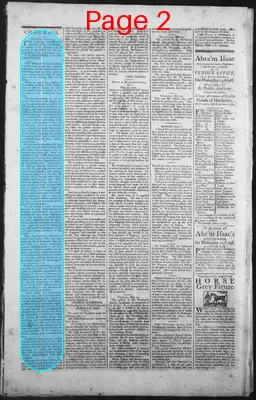
The New Hampshire Gazette
Portsmouth, Rockingham County, New Hampshire
What is this article about?
On May 24, the U.S. Senate presents an address to President John Adams, approving his speech on the state of the union, supporting negotiation with France, national defense measures, and condemning internal disloyalty. Vice President Thomas Jefferson signs it. Adams replies, expressing unity and confidence in Divine Providence.
Clipping

OCR Quality
Full Text
SENATE, MAY 24.
The following Address to the President of the United States, in answer to his Speech, at the opening of the session, was this day presented to him, at his house, viz.
To the PRESIDENT of the UNITED STATES.
SIR,
The Senate of the United States request you to accept their acknowledgements for the comprehensive & interesting detail you have given in your speech to both houses of Congress on the existing state of the union.
While we regret the necessity of the present meeting of the Legislature, we wish to express our entire approbation of your conduct in convening it, on this momentous occasion.
The superintendence of our national faith, honor and dignity, being, in a great measure, constitutionally deposited with the Executive, we observe, with singular satisfaction, the vigilance, firmness, and promptitude, exhibited by you, in this critical state of our public affairs, and from thence derive an evidence and pledge of the rectitude and integrity of your administration. And we are sensible, it is an object of primary importance, that each branch of the government should adopt a language and system of conduct, which shall be cool, just, and dispassionate, but firm, explicit, and decided.
We are equally desirous, with you, to preserve peace and friendship with all nations, and are happy to be informed, that neither the honor nor interests of the United States forbid advances for securing these desirable objects, by amicable negotiation with the French Republic. This method of adjusting national differences, is not only the most mild, but the most rational and humane, and, with governments disposed to be just, can seldom fail of success, when fairly, candidly and sincerely used. If we have committed errors, and can be made sensible of them, we agree with you, in opinion, that we ought to correct them, and compensate the injuries which may have been consequent thereon; and we trust the French Republic will be actuated by the same just and benevolent principles of national policy.
We do therefore most sincerely approve of your determination to promote and accelerate an accommodation of our existing differences with that Republic by negotiation, on terms compatible with the rights, duties, interests and honor of our nation. And you may rest assured of our most cordial co-operation, so far as it may become necessary, in this pursuit.
Peace and harmony with all nations is our sincere wish; but such being the lot of humanity that nations will not always reciprocate peaceful dispositions--it is our firm belief that effectual measures of defence will tend to inspire that national self-respect and confidence at home, which is the unfailing source of respectability abroad, to check aggression and prevent war.
While we are endeavoring to adjust our differences with the French Republic by amicable negotiation, the progress of the war in Europe, the depredations on our commerce, the personal injuries to our citizens, and the general complexion of affairs, prove to us your vigilant care, in recommending to our attention effectual measures of defence.
Those which you recommend whether they relate to external defence, by permitting our citizens to arm, for the purpose of repelling aggressions on their commercial rights, and by providing sea convoys, or to internal defence, by increasing the establishments of artillery and cavalry, by forming a provisional army, by revising the militia Laws, and fortifying, more completely, our ports and harbours; will meet our consideration under the influence of the same just regard for the security, interest, and honor of our country-- which dictated your recommendation.
Practices so unnatural and iniquitous as those you state, of our own citizens, converting their property & personal exertions into the means of annoying our trade, and injuring their fellow-citizens, deserve legal severity commensurate with their turpitude.
Although the Senate believe, that the prosperity and happiness of our country does not depend on general and extensive political connections with European nations, yet we can never lose sight of the propriety as well as necessity of enabling the Executive, by sufficient and liberal supplies, to maintain, and even extend our foreign intercourse, as exigencies may require, reposing full confidence in the Executive, in whom the constitution has placed the powers of negotiation.
We learn with sincere concern, that attempts are in operation to alienate the affections of our fellow-citizens from their government. Attempts so wicked, wherever they exist, cannot fail to excite our utmost abhorrence. A government chosen by the people for their own safety and happiness, and calculated to secure both, cannot lose their affections, so long as its administration pursues the principles upon which it was erected. And your resolution to observe a conduct just and impartial to all nations, a sacred regard to our national engagements, and not to impair the rights of our government, contains principles which cannot fail to secure to your administration the support of the national Legislature, to render abortive every attempt to excite dangerous jealousies among us, and to convince the world that our government and your administration of it cannot be separated from the affectionate support of every good citizen. And the Senate cannot suffer the present occasion to pass, without thus publicly and solemnly expressing their attachment to the Constitution and Government of their country, and as they hold themselves responsible to their Constituents, their Consciences, and their God, it is their determination by all their exertions to repel every attempt to alienate the affections of the people from the government, so highly injurious to the honor, safety and independence of the United States.
We are happy since our sentiments on the subject are in perfect union with yours, in this public manner to declare, that we believe the conduct of the government has been just & impartial towards foreign nations, and that those internal regulations which have been established for the preservation of peace, are, in their nature proper, and have been fairly executed.
And we are equally happy, in possessing an entire confidence in your abilities and exertions in your station, to maintain untarnished the honor, preserve the peace, and support the independence of our country; to acquire and establish which in connection with your fellow citizens, has been the virtuous effort of a principal part of your life.
To aid you, in the honorable and arduous exertions, as it is our duty so it shall be our faithful endeavour. And we flatter ourselves, Sir, that the proceedings of the present session of Congress will manifest to the world, that although the United States love peace, they will be independent.--That they are sincere in their declarations to be just to the French and all other nations, and expect the same in return.
If a sense of justice, a love of moderation and peace, shall influence their councils, which we sincerely hope, we shall have just grounds to expect, peace and amity between the United States and all nations will be preserved.
But if we are so unfortunate, as to experience injuries from any foreign power, and the ordinary methods by which differences are amicably adjusted between nations shall be rejected; the determination "not to surrender in any manner the rights of the government," being so inseparably connected with the dignity, interest and independence of our country, shall, by us, be steadily and inviolably supported.
THOMAS JEFFERSON,
Vice-President of the United States, and President of the Senate.
To which the President made the following reply:
Mr. Vice-President, and Gentlemen of the Senate,
It would be an affectation in me, to dissemble the pleasure I feel in receiving this kind address. My long experience of the wisdom, fortitude and patriotism of the Senate of the United States, enhances in my estimation, the value of those obliging expressions of your approbation of my conduct, which are a generous reward for the past, and an affecting encouragement to constancy and perseverance in future.
Our sentiments appear so entirely in union, that I cannot but believe them to be, the rational results of the understandings, and the natural feelings of the hearts of Americans in general, in contemplating the present state of the nation. While such principles and affections prevail, they will form an indissoluble bond of union, and a sure pledge, that our country has no essential injury, to apprehend from any portentious appearances abroad. In a humble reliance on Divine Providence, we may rest assured, that while we reiterate, with sincerity, our endeavors to accommodate all our differences with France, the Independence of our country cannot be diminished, its dignity degraded, or its glory tarnished, by any nation, or combination of nations, whether friends or enemies.
JOHN ADAMS.
What sub-type of article is it?
What themes does it cover?
What keywords are associated?
What entities or persons were involved?
Where did it happen?
Story Details
Key Persons
Location
The President's House
Event Date
May 24
Story Details
The U.S. Senate, led by Vice President Thomas Jefferson, presents an address to President John Adams approving his convening of Congress, his vigilance in public affairs, support for negotiation with the French Republic, measures of national defense, and condemnation of internal disloyalty, pledging full cooperation. Adams replies, expressing pleasure and unity in sentiments, relying on Divine Providence for the nation's independence.