Thank you for visiting SNEWPapers!
Sign up free
Story
October 19, 1822
Edwardsville Spectator
Edwardsville, Madison County, Illinois
What is this article about?
Napoleon recounts from St. Helena his experience during the 1812 burning of Moscow, where Russians set fire to the city to deny him winter quarters, leading to devastation that forced his retreat and altered the campaign against Russia.
Merged-components note: Napoleon's account of the burning of Moscow continues across components.
Clipping
OCR Quality
95%
Excellent
Full Text
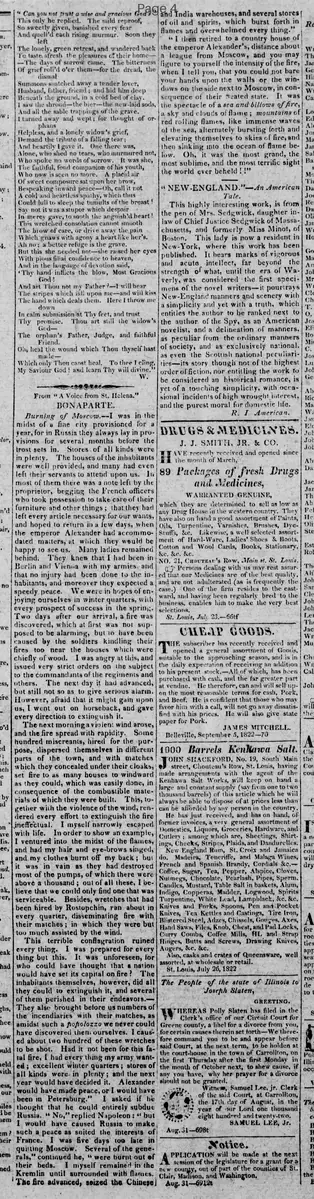
From "A Voice from St. Helena."
BONAPARTE.
Burning of Moscow.—I was in the
midst of a fine city provisioned for a
year, for in Russia they always lay in pro-
visions for several months before the
frost sets in. Stores of all kinds were
in plenty. The houses of the inhabitants
were well provided, and many had even
left their servants to attend upon us. In
most of them there was a note left by the
proprietor, begging the French officers
who took possession to take care of their
furniture and other things; that they had
left every article necessary for our wants.
and hoped to return in a few days, when
the emperor Alexander had accommo-
dated matters, at which they would be
happy to see us. Many ladies remained
behind. They knew that I had been in
Berlin and Vienna with my armies, and
that no injury had been done to the in-
habitants, and moreover they expected a
speedy peace. We were in hopes of en-
joying ourselves in winter quarters, with
every prospect of success in the spring.
Two days after our arrival, a fire was
discovered, which at first was not sup-
posed to be alarming, but to have been
caused by the soldiers kindling their
fires too near the houses which were
chiefly of wood. I was angry at this, and
issued very strict orders on the subject
to the commandants of the regiments and
others. The next day it had advanced,
but still not so as to give serious alarm.
However, afraid that it might gain upon
us, I went out on horseback, and gave
every direction to extinguish it.
The next morning a violent wind arose,
and the fire spread with rapidity. Some
hundred miscreants, hired for the pur-
pose, dispersed themselves in different
parts of the town, and with matches
which they concealed under their cloaks,
set fire to as many houses to windward
as they could, which was easily done, in
consequence of the combustible mate-
rials of which they were built. This, to-
gether with the violence of the wind, ren-
dered every effort to extinguish the fire
ineffectual. I myself narrowly escaped
with life. In order to show an example,
I ventured into the midst of the flames,
and had my hair and eye-brows singed,
and my clothes burnt off my back; but
it was in vain as they had destroyed
most of the pumps, of which there were
above a thousand; out of all these, I be-
lieve that we could only find one that was
serviceable. Besides, wretches that had
been hired by Rostopchin, ran about in
every quarter, disseminating fire with
their matches; in which they were but
too much assisted by the wind.
This terrible conflagration ruined
every thing. I was prepared for every
thing but this. It was unforeseen, for
who could have thought that a nation
would have set its capital on fire? The
inhabitants themselves, however, did all
they could to extinguish it, and several
of them perished in their endeavors.—
They also brought before us numbers of
the incendiaries with their matches, as
amidst such a pandemonium we never could
have discovered them ourselves. I caus-
ed about two hundred of these wretches
to be shot. Had it not been for this fa-
tal fire, I had every thing my army want-
ed; excellent winter quarters; stores of
all kinds were in plenty; and the next
year would have decided it. Alexander
would have made peace, or I would have
been in Petersburg." I asked if he
thought that he could entirely subdue
Russia. "No," replied Napoleon: "but
I would have caused Russia to make
such a peace as suited the interests of
France. I was five days too late in
quitting Moscow. Several of the gene-
rals," continued he, "were burnt out of
their beds. I myself remained in the
Kremlin until surrounded with flames.
The fire advanced, seized the Chinese
and India warehouses, and several stores
of oil and spirits, which burst forth in
flames and overwhelmed every thing."
"I then retired to a country house of
the emperor Alexander's, distant about
a league from Moscow, and you may
figure to yourself the intensity of the fire,
when I tell you, that you could not bear
your hands upon the walls or the win-
dows on the side next to Moscow, in con-
sequence of their heated state. It was
the spectacle of a sea and billows of fire,
a sky and clouds of flame; mountains of
red roiling flames, like immense waves
of the sea, alternately bursting forth and
elevating themselves to skies of fire, and
then sinking into the ocean of flame be-
low. Oh, it was the most grand, the
most sublime, and the most terrific sight
the world ever beheld!!"
BONAPARTE.
Burning of Moscow.—I was in the
midst of a fine city provisioned for a
year, for in Russia they always lay in pro-
visions for several months before the
frost sets in. Stores of all kinds were
in plenty. The houses of the inhabitants
were well provided, and many had even
left their servants to attend upon us. In
most of them there was a note left by the
proprietor, begging the French officers
who took possession to take care of their
furniture and other things; that they had
left every article necessary for our wants.
and hoped to return in a few days, when
the emperor Alexander had accommo-
dated matters, at which they would be
happy to see us. Many ladies remained
behind. They knew that I had been in
Berlin and Vienna with my armies, and
that no injury had been done to the in-
habitants, and moreover they expected a
speedy peace. We were in hopes of en-
joying ourselves in winter quarters, with
every prospect of success in the spring.
Two days after our arrival, a fire was
discovered, which at first was not sup-
posed to be alarming, but to have been
caused by the soldiers kindling their
fires too near the houses which were
chiefly of wood. I was angry at this, and
issued very strict orders on the subject
to the commandants of the regiments and
others. The next day it had advanced,
but still not so as to give serious alarm.
However, afraid that it might gain upon
us, I went out on horseback, and gave
every direction to extinguish it.
The next morning a violent wind arose,
and the fire spread with rapidity. Some
hundred miscreants, hired for the pur-
pose, dispersed themselves in different
parts of the town, and with matches
which they concealed under their cloaks,
set fire to as many houses to windward
as they could, which was easily done, in
consequence of the combustible mate-
rials of which they were built. This, to-
gether with the violence of the wind, ren-
dered every effort to extinguish the fire
ineffectual. I myself narrowly escaped
with life. In order to show an example,
I ventured into the midst of the flames,
and had my hair and eye-brows singed,
and my clothes burnt off my back; but
it was in vain as they had destroyed
most of the pumps, of which there were
above a thousand; out of all these, I be-
lieve that we could only find one that was
serviceable. Besides, wretches that had
been hired by Rostopchin, ran about in
every quarter, disseminating fire with
their matches; in which they were but
too much assisted by the wind.
This terrible conflagration ruined
every thing. I was prepared for every
thing but this. It was unforeseen, for
who could have thought that a nation
would have set its capital on fire? The
inhabitants themselves, however, did all
they could to extinguish it, and several
of them perished in their endeavors.—
They also brought before us numbers of
the incendiaries with their matches, as
amidst such a pandemonium we never could
have discovered them ourselves. I caus-
ed about two hundred of these wretches
to be shot. Had it not been for this fa-
tal fire, I had every thing my army want-
ed; excellent winter quarters; stores of
all kinds were in plenty; and the next
year would have decided it. Alexander
would have made peace, or I would have
been in Petersburg." I asked if he
thought that he could entirely subdue
Russia. "No," replied Napoleon: "but
I would have caused Russia to make
such a peace as suited the interests of
France. I was five days too late in
quitting Moscow. Several of the gene-
rals," continued he, "were burnt out of
their beds. I myself remained in the
Kremlin until surrounded with flames.
The fire advanced, seized the Chinese
and India warehouses, and several stores
of oil and spirits, which burst forth in
flames and overwhelmed every thing."
"I then retired to a country house of
the emperor Alexander's, distant about
a league from Moscow, and you may
figure to yourself the intensity of the fire,
when I tell you, that you could not bear
your hands upon the walls or the win-
dows on the side next to Moscow, in con-
sequence of their heated state. It was
the spectacle of a sea and billows of fire,
a sky and clouds of flame; mountains of
red roiling flames, like immense waves
of the sea, alternately bursting forth and
elevating themselves to skies of fire, and
then sinking into the ocean of flame be-
low. Oh, it was the most grand, the
most sublime, and the most terrific sight
the world ever beheld!!"
What sub-type of article is it?
Historical Event
Biography
Disaster
What themes does it cover?
Catastrophe
Misfortune
Fate Providence
What keywords are associated?
Burning Of Moscow
Napoleon Invasion
Russian Fire
Winter Quarters
Incendiaries
Kremlin Fire
What entities or persons were involved?
Napoleon Bonaparte
Emperor Alexander
Rostopchin
Where did it happen?
Moscow
Story Details
Key Persons
Napoleon Bonaparte
Emperor Alexander
Rostopchin
Location
Moscow
Event Date
1812
Story Details
Napoleon describes arriving in Moscow expecting winter quarters, only for the city to be set ablaze by Russian incendiaries under Rostopchin, destroying provisions and forcing his retreat after five days, preventing conquest of Russia.