Thank you for visiting SNEWPapers!
Sign up free
Editorial
October 11, 1802
Jenks' Portland Gazette. Maine Advertiser
Portland, Cumberland County, Maine
What is this article about?
Editorial defending Oliver Wolcott and Timothy Pickering against a congressional committee's accusations of financial mismanagement in public accounts, criticizing the committee for suppressing evidence and bias, while highlighting Edmund Randolph's unresolved defalcation.
Clipping
OCR Quality
92%
Excellent
Full Text
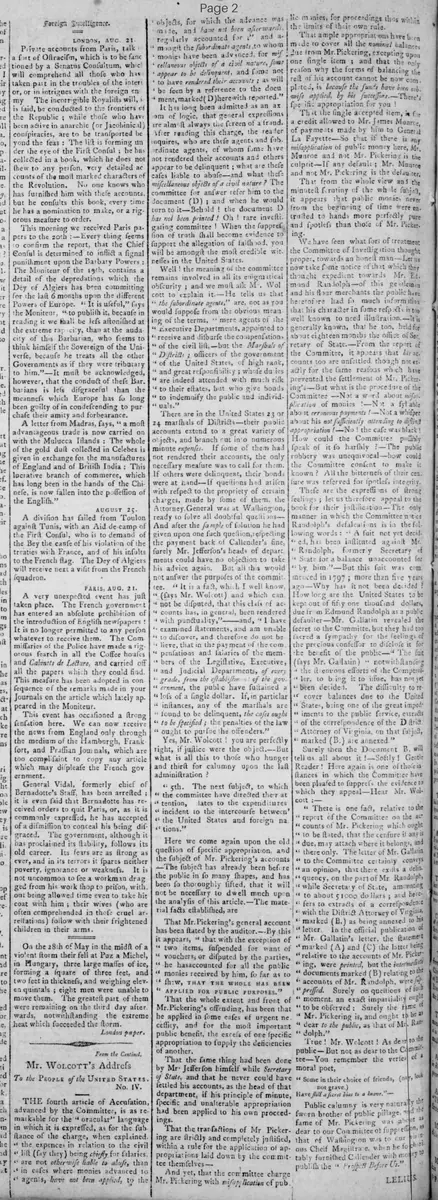
From the Centinel.
Mr. Wolcott's Address
To the People of the United States.
No. IV.
THE fourth article of Accusation, advanced by the Committee, is as remarkable for the "oracular" language in which it is expressed, as for the substance of the charge, when explained.
"the expences in relation to the civil list (say they) being chiefly for salaries, are not otherwise liable to abuse, than in cases where monies advanced to agents, have not been applied, to the objects. for which the advance was made, and have not been afterwards. regularly accounted for ;" and a-
"mongst the subordinate agents, to whom monies have been advanced, for miscellaneous objects of a civil nature, some appear to be delinquent, and some not to have rendered their accounts ; as will be seen by a reference to the docu-ment, marked (D) herewith reported."
It has long been admitted as an axiom of logic. that general expressions are almost always the screen of a fraud. After reading this charge, the reader inquires, who are these agents and subordinate agents, of whom some have not rendered their accounts and others appear to be delinquent: what are these cases liable to abuse—and what these miscellaneous objects of a civil nature? The committee for answer refer him to the document (D) ; and when he would turn to it—Behold! the document D has not been printed! Oh! rare investigating committee! When the suppression of truth shall become evidence to support the allegation of falsehood, you will be amongst the most credible witnesses in the United States.
Well! the meaning of the committee remains involved in all its enigmatical obscurity: and we must ask Mr. Wolcott to explain it.—He tells us that "the subordinate agents," are, not as you would suppose from the obvious meaning of the terms, "mere agents of the Executive Departments, appointed to receive and disburse the compensations of the civil list,—but the Marshals of Districts: officers of the government of the United States, of high rank, and great responsibility; whose duties are indeed attended with much risk to their estates. but who give bonds to indemnify the public and individuals."
There are in the United States 23 or 24 marshals of Districts—their public accounts extend to a great variety of objects, and branch out into numerous minute expenses. If some of them had not rendered their accounts, the only necessary measure was to call for them. If others were delinquent, their bonds were at hand—If questions had arisen with respect to the propriety of certain charges, made by some of them, the Attorney-General was at Washington, ready to solve all doubtful questions— And after the sample of solution he had given upon one such question, respecting the payment back of Callender's fine, surely Mr. Jefferson's heads of departments could have no objection to take his advice again. But all this would not answer the purposes of the committee. "It is a fact, which I well know. (says Mr. Wolcott) and which can-not be disputed, that this class of accounts has, in general, been rendered with punctuality,"—and, "I have examined statements, and am unable to discover, and therefore do not be-lieve, that in the payment of the com-pensations and salaries of the mem-bers of the Legislative, Executive, and Judicial Departments, of every grade, from the establishment of the gov-ernment, the public have sustained a loss of a single dollar. If, in particular instances, any of the marshals are found to be delinquent, the cases ought to be specified; the penalties of the law ought to pursue the offenders."
Yes, Mr. Wolcott! you are perfectly right, if justice were the object.—But what is all this to those who hunger and thirst for calumny upon the last administration?
"5th. The next subject, to which the committee have directed their at-tention, relates to the expenditures incident to the intercourse between the United States and foreign na-tions."
Here we come again upon the old question of specific appropriation, and the subject of Mr. Pickering's accounts -The subject has already been before the public in so many shapes, and has been so thoroughly sifted, that it will not be necessary to dwell much upon the analysis of this article.—The mate-rial facts established, are
That Mr. Pickering's general account has been stated by the auditor.—By this it appears, "that with the exception of two items, suspended for want of vouchers; or disputed by the parties, he has accounted for all the public monies received by him, so far as to SHEW, THAT THE WHOLE HAS BEEN APPLIED FOR PUBLIC PURPOSES."
That the whole extent and front of Mr. Pickering's offending, has been that he applied in some cases of urgent ne-cessity, and for the most important public benefit, the excess of one specific appropriation to supply the deficiencies of another.
That the same thing had been done by Mr Jefferson himself while Secretary of State, and that he never could have settled his accounts, as the head of that department, if his principle of minute, specific and unalterable appropriation had been applied to his own proceed-ings.
That the transactions of Mr. Picker-ing are strictly and completely justified, within a rule for the application of ap-propriations laid down by the commit-tee themselves—
And yet, that the committee charge Mr. Pickering with misapplication of pub-lic monies, for proceedings thus within the limits of their own rule.
That ample appropriations have been made to cover all the nominal balances due from Mr. Pickering, excepting upon one single item; and that the only reason why the forms of balancing the rest of his account cannot be now com-pleted, is because the funds have been otherwise applied, by his successors.—There's specific appropriation for you!
This the single accepted item, is for a credit allowed to Mr. James Munroe of payments made by him to General La Fayette—So that if there is any misapplication of public money here, Mr. Munroe and not Mr. Pickering is the culprit—If any default; Mr. Munroe and not Mr. Pickering is the defaulter.
That from the whole view and the minutest scrutiny of the whole subject, it appears that public monies never from the beginning of time were en-trusted to hands more perfectly pure and spotless than those of Mr. Picker-ing.
We have seen what sort of treatment the Committee of Investigation thought proper, towards an honest man—Let us now take some notice of that which they thought expedient towards Mr. Edmund Randolph—of this gentleman and his four merchants the public have heretofore had so much information that his character in some respects is too well known to need illustration.—It is generally known, that he too, held for about eighteen months the office of Secretary of State.—From the report of the Committee, it appears that his ac-counts too are unsettled though not ex-actly for the same reasons which have prevented the settlement of Mr. Picker-ing's—But what is the procedure of the Committee Not a word about misap-plication of monies!—Not a syllable abouterroneous payments!—Not a whisper about his not sufficiently attending to distinct appropriation!—No! the case was black! How could the Committee possibly speak of it so harshly?—The public robbery was unequivocal—how could the Committee consent to make it known? All the bitterness of their cen-sure was reserved for spotless integrity. These are the expressions of strong feelings: let us therefore appeal to the book for their justification—The only manner in which the Committee notice Randolph's defalcations is in the fol-lowing words: A suit not yet decid-ed, has been instituted against Mr. Randolph, formerly Secretary of State for a balance unaccounted for by. him.—But this suit was com-menced in 1797; more than five years ago—Why has it not been decided? How long are the United States to be kept out of fifty one thousand dollars, due from Edmund Randolph as a public defaulter—Mr. Gallatin revealed the secret to the Committee, but they had too sacred a sympathy for the feelings of the precious confessor to disclose it for the benefit of the public—"The suit (says Mr. Gallatin) "notwithstanding the strenuous efforts of the Comptroller to bring it to issue, has not yet been decided. The difficulty to re-cover balances due to the United States, being one of the great impediments to the public service, extracts of the correspondence of the District Attorney of Virginia, on that subject, marked (B.) are annexed."
Surely then the Document B, will tell us all about it!—Softly! Gentle Reader! Here again is one of those in-stances in which the Committee have been pleased to suppress the evidence to which they appeal—Hear Mr. Wol-colt:-
"There is one fact. relative to the report of the Committee on the ac-counts of Mr. Pickering which ought to be stated. that the censure it contains may attach where it belongs, and there only. The letter of Mr. Gallatin to the Committee certainly conveys an opinion, that there exists a delinquency, on the part of Mr Randolph, while Secretary of State, amounting to about 51,000 dollars: and re-fers to extracts of a correspondence with the District Attorney of Virginia, marked (B.) as being annexed to his letter. In the official publication of Mr. Gallatin's letter. the statements marked (A) and (C) the latter being relative to the accounts of Mr. Pickering, were printed, but the intermediate documents marked (B) relating to the accounts of Mr. Randolph, were sup-pressed. Surely on questions of such moment, an exact impartiality ought to be observed: Surely the fame of Mr. Pickering is, and ought to be as dear to the public, as that of Mr. Ran-dolph."
Public—But not as dear to the Commit-tee—You remember the verses of a moral poet,
"Some in their choice of friends, (nay, look not grave.)
Have still a secret bias to a knave."
—
The sympathy of the Committee for the worn brother of public pillage, and the Public calumny is very naturally the same of Mr. Pickering was about as dear to our Committee of suppression, as that of Washington was to our un-tably furnished Callender with money to publish the "Prospect Before Us." LELIUS.
Mr. Wolcott's Address
To the People of the United States.
No. IV.
THE fourth article of Accusation, advanced by the Committee, is as remarkable for the "oracular" language in which it is expressed, as for the substance of the charge, when explained.
"the expences in relation to the civil list (say they) being chiefly for salaries, are not otherwise liable to abuse, than in cases where monies advanced to agents, have not been applied, to the objects. for which the advance was made, and have not been afterwards. regularly accounted for ;" and a-
"mongst the subordinate agents, to whom monies have been advanced, for miscellaneous objects of a civil nature, some appear to be delinquent, and some not to have rendered their accounts ; as will be seen by a reference to the docu-ment, marked (D) herewith reported."
It has long been admitted as an axiom of logic. that general expressions are almost always the screen of a fraud. After reading this charge, the reader inquires, who are these agents and subordinate agents, of whom some have not rendered their accounts and others appear to be delinquent: what are these cases liable to abuse—and what these miscellaneous objects of a civil nature? The committee for answer refer him to the document (D) ; and when he would turn to it—Behold! the document D has not been printed! Oh! rare investigating committee! When the suppression of truth shall become evidence to support the allegation of falsehood, you will be amongst the most credible witnesses in the United States.
Well! the meaning of the committee remains involved in all its enigmatical obscurity: and we must ask Mr. Wolcott to explain it.—He tells us that "the subordinate agents," are, not as you would suppose from the obvious meaning of the terms, "mere agents of the Executive Departments, appointed to receive and disburse the compensations of the civil list,—but the Marshals of Districts: officers of the government of the United States, of high rank, and great responsibility; whose duties are indeed attended with much risk to their estates. but who give bonds to indemnify the public and individuals."
There are in the United States 23 or 24 marshals of Districts—their public accounts extend to a great variety of objects, and branch out into numerous minute expenses. If some of them had not rendered their accounts, the only necessary measure was to call for them. If others were delinquent, their bonds were at hand—If questions had arisen with respect to the propriety of certain charges, made by some of them, the Attorney-General was at Washington, ready to solve all doubtful questions— And after the sample of solution he had given upon one such question, respecting the payment back of Callender's fine, surely Mr. Jefferson's heads of departments could have no objection to take his advice again. But all this would not answer the purposes of the committee. "It is a fact, which I well know. (says Mr. Wolcott) and which can-not be disputed, that this class of accounts has, in general, been rendered with punctuality,"—and, "I have examined statements, and am unable to discover, and therefore do not be-lieve, that in the payment of the com-pensations and salaries of the mem-bers of the Legislative, Executive, and Judicial Departments, of every grade, from the establishment of the gov-ernment, the public have sustained a loss of a single dollar. If, in particular instances, any of the marshals are found to be delinquent, the cases ought to be specified; the penalties of the law ought to pursue the offenders."
Yes, Mr. Wolcott! you are perfectly right, if justice were the object.—But what is all this to those who hunger and thirst for calumny upon the last administration?
"5th. The next subject, to which the committee have directed their at-tention, relates to the expenditures incident to the intercourse between the United States and foreign na-tions."
Here we come again upon the old question of specific appropriation, and the subject of Mr. Pickering's accounts -The subject has already been before the public in so many shapes, and has been so thoroughly sifted, that it will not be necessary to dwell much upon the analysis of this article.—The mate-rial facts established, are
That Mr. Pickering's general account has been stated by the auditor.—By this it appears, "that with the exception of two items, suspended for want of vouchers; or disputed by the parties, he has accounted for all the public monies received by him, so far as to SHEW, THAT THE WHOLE HAS BEEN APPLIED FOR PUBLIC PURPOSES."
That the whole extent and front of Mr. Pickering's offending, has been that he applied in some cases of urgent ne-cessity, and for the most important public benefit, the excess of one specific appropriation to supply the deficiencies of another.
That the same thing had been done by Mr Jefferson himself while Secretary of State, and that he never could have settled his accounts, as the head of that department, if his principle of minute, specific and unalterable appropriation had been applied to his own proceed-ings.
That the transactions of Mr. Picker-ing are strictly and completely justified, within a rule for the application of ap-propriations laid down by the commit-tee themselves—
And yet, that the committee charge Mr. Pickering with misapplication of pub-lic monies, for proceedings thus within the limits of their own rule.
That ample appropriations have been made to cover all the nominal balances due from Mr. Pickering, excepting upon one single item; and that the only reason why the forms of balancing the rest of his account cannot be now com-pleted, is because the funds have been otherwise applied, by his successors.—There's specific appropriation for you!
This the single accepted item, is for a credit allowed to Mr. James Munroe of payments made by him to General La Fayette—So that if there is any misapplication of public money here, Mr. Munroe and not Mr. Pickering is the culprit—If any default; Mr. Munroe and not Mr. Pickering is the defaulter.
That from the whole view and the minutest scrutiny of the whole subject, it appears that public monies never from the beginning of time were en-trusted to hands more perfectly pure and spotless than those of Mr. Picker-ing.
We have seen what sort of treatment the Committee of Investigation thought proper, towards an honest man—Let us now take some notice of that which they thought expedient towards Mr. Edmund Randolph—of this gentleman and his four merchants the public have heretofore had so much information that his character in some respects is too well known to need illustration.—It is generally known, that he too, held for about eighteen months the office of Secretary of State.—From the report of the Committee, it appears that his ac-counts too are unsettled though not ex-actly for the same reasons which have prevented the settlement of Mr. Picker-ing's—But what is the procedure of the Committee Not a word about misap-plication of monies!—Not a syllable abouterroneous payments!—Not a whisper about his not sufficiently attending to distinct appropriation!—No! the case was black! How could the Committee possibly speak of it so harshly?—The public robbery was unequivocal—how could the Committee consent to make it known? All the bitterness of their cen-sure was reserved for spotless integrity. These are the expressions of strong feelings: let us therefore appeal to the book for their justification—The only manner in which the Committee notice Randolph's defalcations is in the fol-lowing words: A suit not yet decid-ed, has been instituted against Mr. Randolph, formerly Secretary of State for a balance unaccounted for by. him.—But this suit was com-menced in 1797; more than five years ago—Why has it not been decided? How long are the United States to be kept out of fifty one thousand dollars, due from Edmund Randolph as a public defaulter—Mr. Gallatin revealed the secret to the Committee, but they had too sacred a sympathy for the feelings of the precious confessor to disclose it for the benefit of the public—"The suit (says Mr. Gallatin) "notwithstanding the strenuous efforts of the Comptroller to bring it to issue, has not yet been decided. The difficulty to re-cover balances due to the United States, being one of the great impediments to the public service, extracts of the correspondence of the District Attorney of Virginia, on that subject, marked (B.) are annexed."
Surely then the Document B, will tell us all about it!—Softly! Gentle Reader! Here again is one of those in-stances in which the Committee have been pleased to suppress the evidence to which they appeal—Hear Mr. Wol-colt:-
"There is one fact. relative to the report of the Committee on the ac-counts of Mr. Pickering which ought to be stated. that the censure it contains may attach where it belongs, and there only. The letter of Mr. Gallatin to the Committee certainly conveys an opinion, that there exists a delinquency, on the part of Mr Randolph, while Secretary of State, amounting to about 51,000 dollars: and re-fers to extracts of a correspondence with the District Attorney of Virginia, marked (B.) as being annexed to his letter. In the official publication of Mr. Gallatin's letter. the statements marked (A) and (C) the latter being relative to the accounts of Mr. Pickering, were printed, but the intermediate documents marked (B) relating to the accounts of Mr. Randolph, were sup-pressed. Surely on questions of such moment, an exact impartiality ought to be observed: Surely the fame of Mr. Pickering is, and ought to be as dear to the public, as that of Mr. Ran-dolph."
Public—But not as dear to the Commit-tee—You remember the verses of a moral poet,
"Some in their choice of friends, (nay, look not grave.)
Have still a secret bias to a knave."
—
The sympathy of the Committee for the worn brother of public pillage, and the Public calumny is very naturally the same of Mr. Pickering was about as dear to our Committee of suppression, as that of Washington was to our un-tably furnished Callender with money to publish the "Prospect Before Us." LELIUS.
What sub-type of article is it?
Partisan Politics
Economic Policy
What keywords are associated?
Public Accounts
Financial Accusations
Committee Bias
Pickering Defense
Randolph Defalcation
Specific Appropriations
Marshals Accounts
Political Calumny
What entities or persons were involved?
Mr. Wolcott
Committee Of Investigation
Mr. Pickering
Mr. Jefferson
Mr. Randolph
Mr. Gallatin
Mr. Munroe
General La Fayette
Marshals Of Districts
Editorial Details
Primary Topic
Defense Against Committee Accusations On Public Accounts Mismanagement
Stance / Tone
Defensive Of Federalist Officials, Accusatory Towards Republican Committee
Key Figures
Mr. Wolcott
Committee Of Investigation
Mr. Pickering
Mr. Jefferson
Mr. Randolph
Mr. Gallatin
Mr. Munroe
General La Fayette
Marshals Of Districts
Key Arguments
Committee Uses Vague Language And Suppresses Documents To Imply Abuse In Civil List Expenses
Marshals' Accounts Are Generally Punctual With No Public Loss
Pickering Accounted For All Funds Applied To Public Purposes, With Minor Transfers Justified By Necessity And Precedent Including Jefferson's Actions
Committee's Own Rules Justify Pickering's Actions Yet They Charge Misapplication
Randolph's $51,000 Defalcation Is Downplayed By Committee Despite Ongoing Suit
Committee Shows Bias By Suppressing Evidence Unfavorable To Randolph While Attacking Pickering