Thank you for visiting SNEWPapers!
Sign up free
Editorial
February 13, 1867
The Lancaster Ledger
Lancaster, Lancaster County, South Carolina
What is this article about?
The article discusses a proposed reconstruction compromise plan, suggesting Southern states like South Carolina amend constitutions to grant qualified negro suffrage similar to Massachusetts and New York, with presidential amnesty for compliance and congressional admission of loyal representatives.
Clipping
OCR Quality
95%
Excellent
Full Text
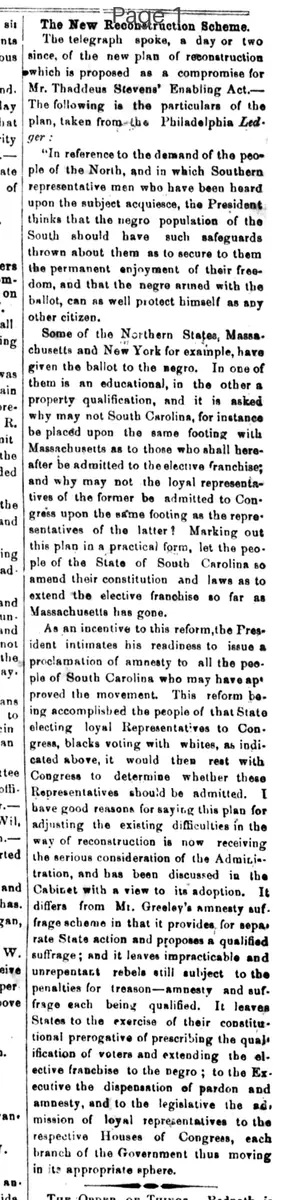
The New Reconstruction Scheme.
The telegraph spoke, a day or two since, of the new plan of reconstruction which is proposed as a compromise for Mr. Thaddeus Stevens' Enabling Act.—The following is the particulars of the plan, taken from the Philadelphia Ledger:
"In reference to the demand of the people of the North, and in which Southern representative men who have been heard upon the subject acquiesce, the President thinks that the negro population of the South should have such safeguards thrown about them as to secure to them the permanent enjoyment of their freedom, and that the negro armed with the ballot, can as well protect himself as any other citizen.
Some of the Northern States, Massachusetts and New York for example, have given the ballot to the negro. In one of them is an educational, in the other a property qualification, and it is asked why may not South Carolina, for instance be placed upon the same footing with Massachusetts as to those who shall hereafter be admitted to the elective franchise; and why may not the loyal representatives of the former be admitted to Congress upon the same footing as the representatives of the latter? Marking out this plan in a practical form, let the people of the State of South Carolina so amend their constitution and laws as to extend the elective franchise so far as Massachusetts has gone.
As an incentive to this reform, the President intimates his readiness to issue a proclamation of amnesty to all the people of South Carolina who may have approved the movement. This reform being accomplished the people of that State electing loyal Representatives to Congress, blacks voting with whites, as indicated above, it would then rest with Congress to determine whether these Representatives should be admitted. I have good reasons for saying this plan for adjusting the existing difficulties in the way of reconstruction is now receiving the serious consideration of the Administration, and has been discussed in the Cabinet with a view to its adoption. It differs from Mr. Greeley's amnesty and suffrage scheme in that it provides, for separate State action and proposes a qualified suffrage; and it leaves impracticable and unrepentant rebels still subject to the penalties for treason—amnesty and suffrage each being qualified. It leaves States to the exercise of their constitutional prerogative of prescribing the qualification of voters and extending the elective franchise to the negro; to the Executive the dispensation of pardon and amnesty, and to the legislative the admission of loyal representatives to the respective Houses of Congress, each branch of the Government thus moving in its appropriate sphere."
The telegraph spoke, a day or two since, of the new plan of reconstruction which is proposed as a compromise for Mr. Thaddeus Stevens' Enabling Act.—The following is the particulars of the plan, taken from the Philadelphia Ledger:
"In reference to the demand of the people of the North, and in which Southern representative men who have been heard upon the subject acquiesce, the President thinks that the negro population of the South should have such safeguards thrown about them as to secure to them the permanent enjoyment of their freedom, and that the negro armed with the ballot, can as well protect himself as any other citizen.
Some of the Northern States, Massachusetts and New York for example, have given the ballot to the negro. In one of them is an educational, in the other a property qualification, and it is asked why may not South Carolina, for instance be placed upon the same footing with Massachusetts as to those who shall hereafter be admitted to the elective franchise; and why may not the loyal representatives of the former be admitted to Congress upon the same footing as the representatives of the latter? Marking out this plan in a practical form, let the people of the State of South Carolina so amend their constitution and laws as to extend the elective franchise so far as Massachusetts has gone.
As an incentive to this reform, the President intimates his readiness to issue a proclamation of amnesty to all the people of South Carolina who may have approved the movement. This reform being accomplished the people of that State electing loyal Representatives to Congress, blacks voting with whites, as indicated above, it would then rest with Congress to determine whether these Representatives should be admitted. I have good reasons for saying this plan for adjusting the existing difficulties in the way of reconstruction is now receiving the serious consideration of the Administration, and has been discussed in the Cabinet with a view to its adoption. It differs from Mr. Greeley's amnesty and suffrage scheme in that it provides, for separate State action and proposes a qualified suffrage; and it leaves impracticable and unrepentant rebels still subject to the penalties for treason—amnesty and suffrage each being qualified. It leaves States to the exercise of their constitutional prerogative of prescribing the qualification of voters and extending the elective franchise to the negro; to the Executive the dispensation of pardon and amnesty, and to the legislative the admission of loyal representatives to the respective Houses of Congress, each branch of the Government thus moving in its appropriate sphere."
What sub-type of article is it?
Suffrage
Constitutional
Partisan Politics
What keywords are associated?
Reconstruction
Negro Suffrage
Qualified Franchise
Amnesty
Southern States
Presidential Plan
Congressional Admission
What entities or persons were involved?
President
Thaddeus Stevens
Horace Greeley
South Carolina
Massachusetts
New York
Congress
Administration
Cabinet
Editorial Details
Primary Topic
New Reconstruction Plan With Qualified Negro Suffrage
Stance / Tone
Supportive Of Compromise Plan
Key Figures
President
Thaddeus Stevens
Horace Greeley
South Carolina
Massachusetts
New York
Congress
Administration
Cabinet
Key Arguments
Negroes Need Safeguards For Freedom, Including Ballot For Self Protection.
Southern States Should Adopt Qualified Suffrage Like Northern States (E.G., Educational Or Property Qualifications).
President Offers Amnesty To Compliant Southerners.
Loyal Representatives From Reformed States To Be Admitted To Congress.
Plan Involves Separate State Action, Qualified Suffrage, And Leaves Unrepentant Rebels Penalized.
Differs From Greeley's Scheme By Qualifying Amnesty And Suffrage.