Thank you for visiting SNEWPapers!
Sign up free
Story
February 1, 1942
United Automobile Worker
Detroit, Wayne County, Michigan
What is this article about?
Legal battle over $2M in unemployment benefits for 23,000 Chrysler workers locked out in 1939 Detroit plants awaits Michigan Supreme Court decision. UAW-CIO argues for benefits based on state act and Appeal Board findings distinguishing the dispute.
Clipping
OCR Quality
98%
Excellent
Full Text
Decision Awaited by 23,000
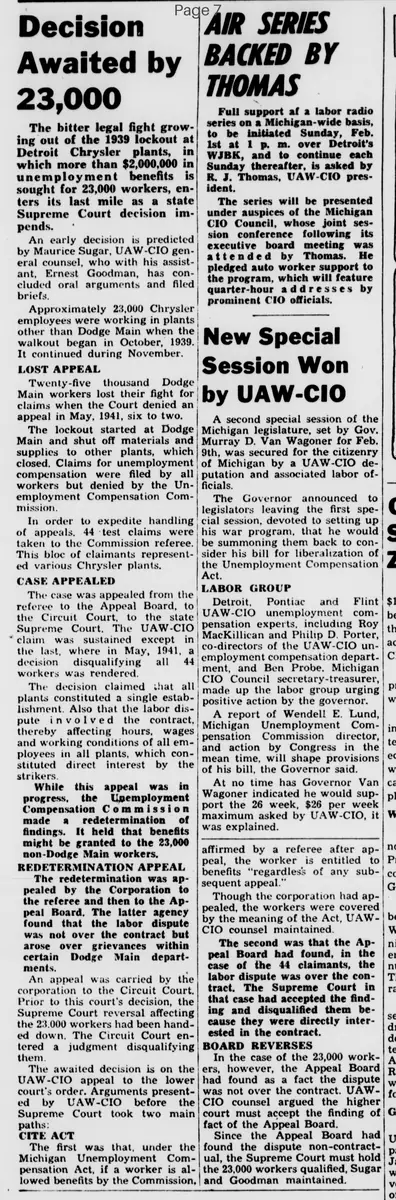
The bitter legal fight growing out of the 1939 lockout at Detroit Chrysler plants, in which more than $2,000,000 in unemployment benefits is sought for 23,000 workers, enters its last mile as a state Supreme Court decision impends.
An early decision is predicted by Maurice Sugar, UAW-CIO general counsel, who with his assistant, Ernest Goodman, has concluded oral arguments and filed briefs.
Approximately 23,000 Chrysler employees were working in plants other than Dodge Main when the walkout began in October, 1939. It continued during November.
LOST APPEAL
Twenty-five thousand Dodge Main workers lost their fight for claims when the Court denied an appeal in May, 1941, six to two.
The lockout started at Dodge Main and shut off materials and supplies to other plants, which closed. Claims for unemployment compensation were filed by all workers but denied by the Unemployment Compensation Commission.
In order to expedite handling of appeals, 44 test claims were taken to the Commission referee. This bloc of claimants represented various Chrysler plants.
CASE APPEALED
The case was appealed from the referee to the Appeal Board, to the Circuit Court, to the state Supreme Court. The UAW-CIO claim was sustained except in the last, where in May, 1941, a decision disqualifying all 44 workers was rendered.
The decision claimed that all plants constituted a single establishment. Also that the labor dispute involved the contract, thereby affecting hours, wages and working conditions of all employees in all plants, which constituted direct interest by the strikers.
While this appeal was in progress, the Unemployment Compensation Commission made a redetermination of findings. It held that benefits might be granted to the 23,000 non-Dodge Main workers.
REDETERMINATION APPEAL
The redetermination was appealed by the Corporation to the referee and then to the Appeal Board. The latter agency found that the labor dispute was not over the contract but arose over grievances within certain Dodge Main departments.
An appeal was carried by the corporation to the Circuit Court. Prior to this court's decision, the Supreme Court reversal affecting the 23,000 workers had been handed down. The Circuit Court entered a judgment disqualifying them.
The awaited decision is on the UAW-CIO appeal to the lower court's order. Arguments presented by UAW-CIO before the Supreme Court took two main paths:
CITE ACT
The first was that, under the Michigan Unemployment Compensation Act, if a worker is allowed benefits by the Commission, affirmed by a referee after appeal, the worker is entitled to benefits "regardless of any subsequent appeal."
Though the corporation had appealed, the workers were covered by the meaning of the Act. UAW-CIO counsel maintained.
The second was that the Appeal Board had found, in the case of the 44 claimants, the labor dispute was over the contract. The Supreme Court in that case had accepted the finding and disqualified them because they were directly interested in the contract.
BOARD REVERSES
In the case of the 23,000 workers, however, the Appeal Board had found as a fact the dispute was not over the contract. UAW-CIO counsel argued the higher court must accept the finding of fact of the Appeal Board.
Since the Appeal Board had found the dispute non-contractual, the Supreme Court must hold the 23,000 workers qualified, Sugar and Goodman maintained.
The bitter legal fight growing out of the 1939 lockout at Detroit Chrysler plants, in which more than $2,000,000 in unemployment benefits is sought for 23,000 workers, enters its last mile as a state Supreme Court decision impends.
An early decision is predicted by Maurice Sugar, UAW-CIO general counsel, who with his assistant, Ernest Goodman, has concluded oral arguments and filed briefs.
Approximately 23,000 Chrysler employees were working in plants other than Dodge Main when the walkout began in October, 1939. It continued during November.
LOST APPEAL
Twenty-five thousand Dodge Main workers lost their fight for claims when the Court denied an appeal in May, 1941, six to two.
The lockout started at Dodge Main and shut off materials and supplies to other plants, which closed. Claims for unemployment compensation were filed by all workers but denied by the Unemployment Compensation Commission.
In order to expedite handling of appeals, 44 test claims were taken to the Commission referee. This bloc of claimants represented various Chrysler plants.
CASE APPEALED
The case was appealed from the referee to the Appeal Board, to the Circuit Court, to the state Supreme Court. The UAW-CIO claim was sustained except in the last, where in May, 1941, a decision disqualifying all 44 workers was rendered.
The decision claimed that all plants constituted a single establishment. Also that the labor dispute involved the contract, thereby affecting hours, wages and working conditions of all employees in all plants, which constituted direct interest by the strikers.
While this appeal was in progress, the Unemployment Compensation Commission made a redetermination of findings. It held that benefits might be granted to the 23,000 non-Dodge Main workers.
REDETERMINATION APPEAL
The redetermination was appealed by the Corporation to the referee and then to the Appeal Board. The latter agency found that the labor dispute was not over the contract but arose over grievances within certain Dodge Main departments.
An appeal was carried by the corporation to the Circuit Court. Prior to this court's decision, the Supreme Court reversal affecting the 23,000 workers had been handed down. The Circuit Court entered a judgment disqualifying them.
The awaited decision is on the UAW-CIO appeal to the lower court's order. Arguments presented by UAW-CIO before the Supreme Court took two main paths:
CITE ACT
The first was that, under the Michigan Unemployment Compensation Act, if a worker is allowed benefits by the Commission, affirmed by a referee after appeal, the worker is entitled to benefits "regardless of any subsequent appeal."
Though the corporation had appealed, the workers were covered by the meaning of the Act. UAW-CIO counsel maintained.
The second was that the Appeal Board had found, in the case of the 44 claimants, the labor dispute was over the contract. The Supreme Court in that case had accepted the finding and disqualified them because they were directly interested in the contract.
BOARD REVERSES
In the case of the 23,000 workers, however, the Appeal Board had found as a fact the dispute was not over the contract. UAW-CIO counsel argued the higher court must accept the finding of fact of the Appeal Board.
Since the Appeal Board had found the dispute non-contractual, the Supreme Court must hold the 23,000 workers qualified, Sugar and Goodman maintained.
What sub-type of article is it?
Historical Event
What themes does it cover?
Justice
What keywords are associated?
Chrysler Lockout
Unemployment Benefits
Uaw Cio
Detroit
Supreme Court
Labor Dispute
Appeal Board
What entities or persons were involved?
Maurice Sugar
Ernest Goodman
Where did it happen?
Detroit Chrysler Plants, Michigan
Story Details
Key Persons
Maurice Sugar
Ernest Goodman
Location
Detroit Chrysler Plants, Michigan
Event Date
October 1939 May 1941
Story Details
UAW-CIO seeks unemployment benefits for 23,000 non-Dodge Main Chrysler workers affected by 1939 lockout; case progresses through appeals, with Supreme Court decision pending on Act interpretation and dispute nature.