Thank you for visiting SNEWPapers!
Sign up free
The Massachusetts Spy, Or, Thomas's Boston Journal
Boston, Suffolk County, Massachusetts
What is this article about?
On December 20-23, 1773, Boston tea dealers met and resolved to suspend tea sales from January 20, 1774, until the tea tax is repealed or fully boycotted, protesting British taxation as a threat to colonial liberties and economy.
Clipping
OCR Quality
Full Text
BOSTON.
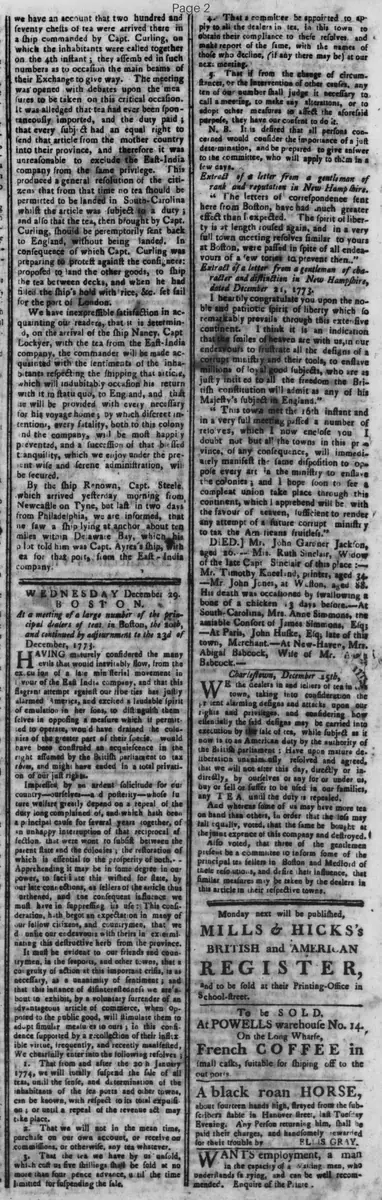
At a meeting of a large number of the principal dealers of teas in Boston, the 20th, and continued by adjournment to the 23d of December, 1773.
HAVING maturely considered the many evils that would inevitably flow from the execution of a late ministerial movement in favour of the East India company, and that this flagrant attempt against our liberties has justly alarmed America, and excited a laudable spirit of emulation in her sons, to distinguish themselves in opposing a measure which if permitted to operate, would have drained the colonies of the greater part of their specie, would have been construed an acquiescence in the right assumed by the British parliament to tax them, and might have ended in a total privation of our just rights.
Impressed by an ardent solicitude for our country, ourselves, and posterity whose future welfare greatly depend on a repeal of the duty long complained of, and which hath been a principal cause for several years together, of an unhappy interruption of that reciprocal affection that were wont to subsist between the parent state and the colonies; the restoration of which is essential to the prosperity of both.
Apprehending it may be in some degree in our power, to facilitate this wished for state, by our late connections, as sellers of the article thus burthened, and the consequent influence we must have in suppressing its use: This consideration, hath begot an expectation in many of our fellow citizens, and countrymen, that we will unite our endeavours with theirs in exterminating this destructive herb from the province.
It must be evident to our friends and countrymen, in the sea-ports, and other towns, that a congruity of action at this important crisis, is as necessary, as a unanimity of sentiment; and that this instance of disinterestedness we are about to exhibit, by a voluntary surrender of an advantageous article of commerce, when opposed to the public good, will stimulate them to adopt similar measures to ours; in this confidence supported by a recollection of their inflexible virtue, frequently, and recently manifested, We cheerfully enter into the following resolves
1. That from and after the 20th January 1774, we will totally suspend the sale of all teas, until the sense, and determination of the inhabitants of the sea-ports and other towns, can be known, with respect to its total expulsion; or until a repeal of the revenue act may take place.
2. That we will not in the mean time, purchase on our own account, or receive on commissions, or otherwise, any tea whatever.
3. That the tea we have by us unsold, which cost us five shillings may be sold at no more than four pence advance, until the time limited for suspending the sale.
4. That a committee be appointed to apply to all the dealers in tea, in this town to obtain their compliance to these resolves and make report of the same, with the names of those who decline, (if any there may be) at our next meeting.
5. That if from the change of circumstances, or the intervention of other causes any ten of our number shall judge it necessary to call a meeting to make any alterations, or to adopt other measures to effect the aforesaid purpose, they have our consent to do it.
N. B. It is desired that all persons concerned would consider the importance of a just determination, and be prepared to give answer to the committee, who will apply to them in a few days.
What sub-type of article is it?
What keywords are associated?
Where did it happen?
Domestic News Details
Primary Location
Boston
Event Date
The 20th, And Continued By Adjournment To The 23d Of December, 1773
Outcome
resolution to suspend tea sales from january 20, 1774, until repeal of the revenue act or total expulsion; committee to seek compliance from other dealers.
Event Details
Principal tea dealers in Boston met to consider the evils of the East India Company's tea importation under the ministerial movement, viewing it as a threat to liberties and economy. They resolved to unite in suppressing tea use to facilitate repeal of the duty and restore affection between Britain and colonies.