Thank you for visiting SNEWPapers!
Sign up free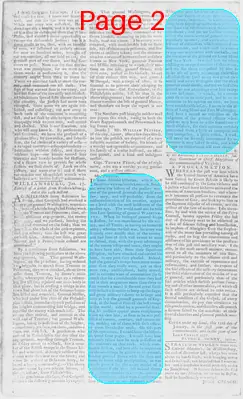
Letter to Editor
January 17, 1777
The Virginia Gazette
Williamsburg, Virginia
What is this article about?
A letter praising General Washington's military genius during the Revolutionary War, countering Tory misrepresentations of his forces and achievements in Boston, Dorchester, and New York battles, despite resource shortages.
Clipping
OCR Quality
98%
Excellent
Full Text
Mr. PURDIE,
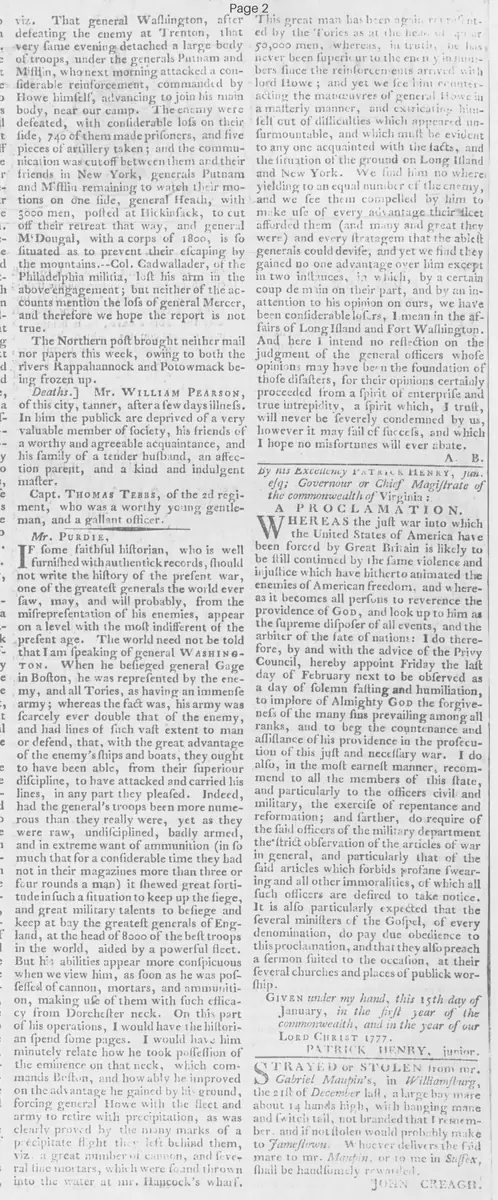
If some faithful historian, who is well furnished with authentick records, should not write the history of the present war, one of the greatest generals the world ever saw, may, and will probably, from the misrepresentation of his enemies, appear on a level with the most indifferent of the present age. The world need not be told that I am speaking of general WASHINGTON. When he besieged general Gage in Boston, he was represented by the enemy, and all Tories, as having an immense army; whereas the fact was, his army was scarcely ever double that of the enemy, and had lines of such vast extent to man or defend, that, with the great advantage of the enemy's ships and boats, they ought to have been able, from their superior discipline, to have attacked and carried his lines, in any part they pleased. Indeed, had the general's troops been more numerous than they really were, yet as they were raw, undisciplined, badly armed, and in extreme want of ammunition (in so much that for a considerable time they had not in their magazines more than three or four rounds a man) it shewed great fortitude in such a situation to keep up the siege, and great military talents to besiege and keep at bay the greatest generals of England, at the head of 8000 of the best troops in the world, aided by a powerful fleet.
But his abilities appear more conspicuous when we view him, as soon as he was possessed of cannon, mortars, and ammunition, making use of them with such efficacy from Dorchester neck. On this part of his operations, I would have the historian spend some pages. I would have him minutely relate how he took possession of the eminence on that neck, which commands Boston, and how ably he improved on the advantage he gained by high ground, forcing general Howe with the fleet and army to retire with precipitation, as was clearly proved by the many marks of a precipitate flight they left behind them, viz. a great number of cannon, and several fine mortars, which were found thrown into the water at Mr. Hancock's wharf.
This great man has been again represented by the Tories as at the head of 40 or 50,000 men, whereas, in truth, he has never been superior to the enemy in numbers since the reinforcements arrived with lord Howe; and yet we see him counteracting the manoeuvres of general Howe in a masterly manner, and extricating himself out of difficulties which appeared unsurmountable, and which must be evident to any one acquainted with the facts, and the situation of the ground on Long Island and New York. We find him no where yielding to an equal number of the enemy, and we see them compelled by him to make use of every advantage their fleet afforded them (and many and great they were) and every stratagem that the ablest generals could devise, and yet we find they gained no one advantage over him except in two instances, in which, by a certain coup de main on their part, and by an inattention to his opinion on ours, we have been considerable losers, I mean in the affairs of Long Island and Fort Washington.
And here I intend no reflection on the judgment of the general officers whose opinions may have been the foundation of those disasters, for their opinions certainly proceeded from a spirit of enterprize and true intrepidity, a spirit which, I trust, will never be severely condemned by us, however it may fail of success, and which I hope no misfortunes will ever abate.
A. B.
If some faithful historian, who is well furnished with authentick records, should not write the history of the present war, one of the greatest generals the world ever saw, may, and will probably, from the misrepresentation of his enemies, appear on a level with the most indifferent of the present age. The world need not be told that I am speaking of general WASHINGTON. When he besieged general Gage in Boston, he was represented by the enemy, and all Tories, as having an immense army; whereas the fact was, his army was scarcely ever double that of the enemy, and had lines of such vast extent to man or defend, that, with the great advantage of the enemy's ships and boats, they ought to have been able, from their superior discipline, to have attacked and carried his lines, in any part they pleased. Indeed, had the general's troops been more numerous than they really were, yet as they were raw, undisciplined, badly armed, and in extreme want of ammunition (in so much that for a considerable time they had not in their magazines more than three or four rounds a man) it shewed great fortitude in such a situation to keep up the siege, and great military talents to besiege and keep at bay the greatest generals of England, at the head of 8000 of the best troops in the world, aided by a powerful fleet.
But his abilities appear more conspicuous when we view him, as soon as he was possessed of cannon, mortars, and ammunition, making use of them with such efficacy from Dorchester neck. On this part of his operations, I would have the historian spend some pages. I would have him minutely relate how he took possession of the eminence on that neck, which commands Boston, and how ably he improved on the advantage he gained by high ground, forcing general Howe with the fleet and army to retire with precipitation, as was clearly proved by the many marks of a precipitate flight they left behind them, viz. a great number of cannon, and several fine mortars, which were found thrown into the water at Mr. Hancock's wharf.
This great man has been again represented by the Tories as at the head of 40 or 50,000 men, whereas, in truth, he has never been superior to the enemy in numbers since the reinforcements arrived with lord Howe; and yet we see him counteracting the manoeuvres of general Howe in a masterly manner, and extricating himself out of difficulties which appeared unsurmountable, and which must be evident to any one acquainted with the facts, and the situation of the ground on Long Island and New York. We find him no where yielding to an equal number of the enemy, and we see them compelled by him to make use of every advantage their fleet afforded them (and many and great they were) and every stratagem that the ablest generals could devise, and yet we find they gained no one advantage over him except in two instances, in which, by a certain coup de main on their part, and by an inattention to his opinion on ours, we have been considerable losers, I mean in the affairs of Long Island and Fort Washington.
And here I intend no reflection on the judgment of the general officers whose opinions may have been the foundation of those disasters, for their opinions certainly proceeded from a spirit of enterprize and true intrepidity, a spirit which, I trust, will never be severely condemned by us, however it may fail of success, and which I hope no misfortunes will ever abate.
A. B.
What sub-type of article is it?
Persuasive
Historical
Informative
What themes does it cover?
Military War
Politics
What keywords are associated?
Washington
Boston Siege
Dorchester Neck
Long Island
Fort Washington
Tories
British Army
American Revolution
What entities or persons were involved?
A. B.
Mr. Purdie
Letter to Editor Details
Author
A. B.
Recipient
Mr. Purdie
Main Argument
the letter defends general washington's military reputation against misrepresentations by enemies and tories, emphasizing his strategic successes in the boston siege, dorchester neck, and new york campaigns despite inferior numbers, discipline, and resources.
Notable Details
Highlights Washington's Siege Of Gage In Boston With Limited Troops And Ammunition
Describes Effective Use Of Cannon From Dorchester Neck Forcing Howe's Retreat
Notes Washington's Maneuvers Against Howe On Long Island And New York
Acknowledges Losses At Long Island And Fort Washington Due To Inattention, Not Reflecting On Officers' Enterprise