Thank you for visiting SNEWPapers!
Sign up free
Editorial
April 29, 1914
Albuquerque Morning Journal
Albuquerque, Bernalillo County, New Mexico
What is this article about?
The editorial praises the efficient mobilization of the US army and navy in the Mexican crisis, contrasting it with the disorganized Spanish-American War effort. It credits reforms under Root and highlights historical insights from Kipling and Napoleon, expressing confidence in swift, humane warfare if needed amid peace talks.
Clipping
OCR Quality
95%
Excellent
Full Text
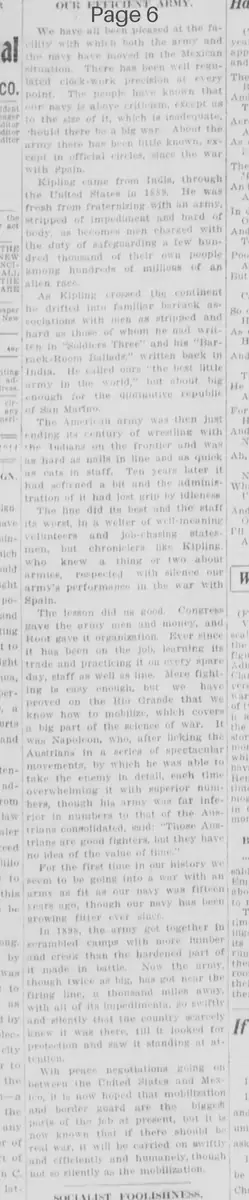
We have all been pleased at the facility with which both the army and the navy have moved in the Mexican situation. There has been well regulated clock work precision at every point. The people have known that our navy is above criticism, except as to the size of it, which is inadequate. Should there be a big war about the army there has been little known, except in official circles, since the War with Spain.
Kipling came from India, through the United States in 1889. He was fresh from fraternizing with an army, stripped of impedimenta and hard of body, as becomes men charged with the duty of guarding a few hundred thousand of their own people among hundreds of millions of an alien race.
As Kipling crossed the continent he drifted into familiar barrack associations with men as stripped and hard as those of whom he had written in 'Soldiers Three' and his 'Barrack-Room Ballads,' written back in India. He called ours the best little army in the world, but about big enough for the diminutive republic of San Marino.
The American army was then just ending its century of wrestling with the Indians on the frontier and was hard as nails in line and as quick as cats in staff. Ten years later it had softened a bit and the administration of McKinley had lost grip by idleness. The line did its best and the staff its worst, in a welter of well-meaning volunteers and job-chasing state militiamen, but chroniclers like Kipling who knew a thing or two about armies, respected with silence our army's performance in the war with Spain.
The lesson did us good. Congress gave the army men and money, and Root gave it organization. Ever since it has been on the job, learning its trade and practicing it on every spare day, staff as well as line. Mere fighting is easy enough, but we have proved on the Rio Grande that we know how to mobilize, which covers a big part of the science of war. It was Napoleon, who, after licking the Austrians in a series of spectacular movements, by which he was able to take the enemy in detail, each time overwhelming it with superior numbers, though his army was far inferior in numbers to that of the Austrians consolidated, said those Austrians are good fighters, but they have no idea of the value of time.
For the first time in our history we seem to be going into a war with an army as fit as our navy was fifteen years ago, though our navy has been growing fitter ever since. In 1898, the army got together in ramshackle camps with more lumber and canvas than the hardened jaunt of it made in battle. Now the army though twice as big, has got near the firing line, a thousand miles away with all of its impedimenta, so swiftly and silently that the country scarcely knew it was there, till it looked for protection and saw it standing at attention.
With peace negotiations going on between the United States and Mexico, it is now hoped that mobilization and border guard are the biggest parts of the job at present, but it is now known that if there should be real war, it will be carried on swiftly and efficiently and humanely, though not so silently as the mobilization.
Kipling came from India, through the United States in 1889. He was fresh from fraternizing with an army, stripped of impedimenta and hard of body, as becomes men charged with the duty of guarding a few hundred thousand of their own people among hundreds of millions of an alien race.
As Kipling crossed the continent he drifted into familiar barrack associations with men as stripped and hard as those of whom he had written in 'Soldiers Three' and his 'Barrack-Room Ballads,' written back in India. He called ours the best little army in the world, but about big enough for the diminutive republic of San Marino.
The American army was then just ending its century of wrestling with the Indians on the frontier and was hard as nails in line and as quick as cats in staff. Ten years later it had softened a bit and the administration of McKinley had lost grip by idleness. The line did its best and the staff its worst, in a welter of well-meaning volunteers and job-chasing state militiamen, but chroniclers like Kipling who knew a thing or two about armies, respected with silence our army's performance in the war with Spain.
The lesson did us good. Congress gave the army men and money, and Root gave it organization. Ever since it has been on the job, learning its trade and practicing it on every spare day, staff as well as line. Mere fighting is easy enough, but we have proved on the Rio Grande that we know how to mobilize, which covers a big part of the science of war. It was Napoleon, who, after licking the Austrians in a series of spectacular movements, by which he was able to take the enemy in detail, each time overwhelming it with superior numbers, though his army was far inferior in numbers to that of the Austrians consolidated, said those Austrians are good fighters, but they have no idea of the value of time.
For the first time in our history we seem to be going into a war with an army as fit as our navy was fifteen years ago, though our navy has been growing fitter ever since. In 1898, the army got together in ramshackle camps with more lumber and canvas than the hardened jaunt of it made in battle. Now the army though twice as big, has got near the firing line, a thousand miles away with all of its impedimenta, so swiftly and silently that the country scarcely knew it was there, till it looked for protection and saw it standing at attention.
With peace negotiations going on between the United States and Mexico, it is now hoped that mobilization and border guard are the biggest parts of the job at present, but it is now known that if there should be real war, it will be carried on swiftly and efficiently and humanely, though not so silently as the mobilization.
What sub-type of article is it?
Military Affairs
War Or Peace
What keywords are associated?
Military Mobilization
Mexican Crisis
Us Army Reform
Spanish American War
Kipling Observations
Napoleon Tactics
Peace Negotiations
What entities or persons were involved?
Kipling
Mckinley
Root
Napoleon
Us Army
Us Navy
Mexico
Editorial Details
Primary Topic
Efficiency Of Us Military Mobilization In Mexican Crisis
Stance / Tone
Praiseworthy And Confident
Key Figures
Kipling
Mckinley
Root
Napoleon
Us Army
Us Navy
Mexico
Key Arguments
Us Army And Navy Have Shown Clockwork Precision In Mexican Situation
Navy Is Excellent But Undersized
Kipling Praised Us Army As Small But Effective In 1889
Spanish American War Exposed Army Weaknesses Due To Idleness
Post War Reforms By Congress And Root Improved Organization And Readiness
Mobilization On Rio Grande Demonstrates Mastery Of War Science
Current Army Is Fitter Than In 1898, Reaching Front Lines Swiftly
Peace Talks Ongoing, But War Would Be Swift, Efficient, And Humane