Thank you for visiting SNEWPapers!
Sign up free
Story
July 12, 1806
Virginia Argus
Richmond, Virginia
What is this article about?
Joseph Parkinson describes experiments testing the poisonous effects of worms from Lombardy poplar trees on cats and puppies, conducted in Southwark and at Pennsylvania Hospital with medical observers, concluding no fatal results despite public fears.
Clipping
OCR Quality
95%
Excellent
Full Text
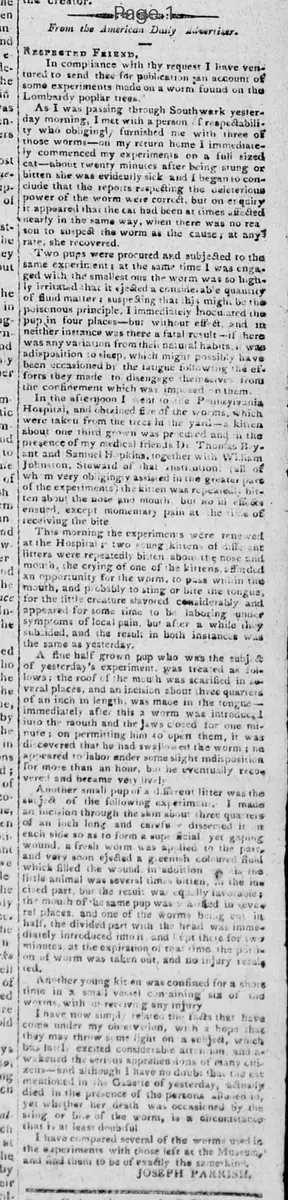
From the American Daily Advertiser.
Respected Friend,
In compliance with thy request I have ventured to send thee for publication an account of some experiments made on a worm found on the Lombardy poplar trees.
As I was passing through Southwark yesterday morning, I met with a person of respectability who obligingly furnished me with three of those worms—on my return home I immediately commenced my experiments on a full sized cat—about twenty minutes after being stung or bitten she was evidently sick and I began to conclude that the reports respecting the deleterious power of the worm were correct, but on enquiry it appeared that the cat had been at times affected nearly in the same way, when there was no reason to suspect the worm as the cause; at any rate, she recovered.
Two pups were procured and subjected to the same experiment; at the same time I was engaged with the smallest one the worm was so highly irritated that it ejected a considerable quantity of fluid matter; suspecting that this might be the poisonous principle, I immediately inoculated the pup in four places—but without effect, and in neither instance was there a fatal result—if there was any variation from the natural habits it was a disposition to sleep, which might possibly have been occasioned by the fatigue following the efforts they made to disengage themselves from the confinement which was imposed on them.
In the afternoon I went to the Pennsylvania Hospital, and obtained five of the worms, which were taken from the trees in the yard—a kitten about one third grown was procured and in the presence of my medical friends Dr. Thomas Bryan and Samuel Hopkins, together with William Johnston, Steward of that institution, (all of whom very obligingly assisted in the greater part of the experiments) the kitten was repeatedly bitten about the nose and mouth but no ill effects ensued, except momentary pain at the time of receiving the bite.
This morning the experiments were renewed at the Hospital; two young kittens of different litters were repeatedly bitten about the nose and mouth. the crying of one of the kittens afforded an opportunity for the worm, to pass within the mouth, and probably to sting or bite the tongue, for the little creature suffered considerably and appeared for some time to be laboring under symptoms of local pain, but after a while they subsided, and the result in both instances was the same as yesterday.
A fine half grown pup who was the subject of yesterday's experiment. was treated as follows; the roof of the mouth was scarified in several places, and an incision about three quarters of an inch in length, was made in the tongue—immediately after this a worm was introduced into the mouth and the jaws closed for one minute; on permitting him to open them, it was discovered that he had swallowed the worm; he appeared to labor under some slight indisposition for more than an hour, but he eventually recovered and became very lively.
Another small pup of a different litter was the subject of the following experiment. I made an incision through the skin about three quarters of an inch long and carefully dissected it in each side so as to form a superficial yet gaping wound, a fresh worm was applied to the part. and very soon ejected a greenish coloured fluid which filled the wound. in addition the little animal was several times bitten, the incised part, but the result was equally favorable; the mouth of the same pup was scarified in several places. and one of the worms being cut in half, the divided part with the head was immediately introduced into it and kept there for two minutes at the expiration of that time the part of worm was taken out, and no injury resulted.
Another young kitten was confined for a short time in a small vessel containing six of the worms, without receiving any injury
I have now simply related the facts that have come under my observation, with a hope that they may throw some light on a subject, which has lately, excited considerable attention and awakened the serious apprehensions of many citizens—and although I have no doubt that the cat mentioned in the Gazette of yesterday, actually died in the presence of the persons alluded to, yet whether her death was occasioned by the sting or bite of the worm, is a circumstance that is at least doubtful.
I have compared several of the worms used in the experiments with those left at the Museum and find them to be of exactly the same kind.
JOSEPH PARKINSON,
Respected Friend,
In compliance with thy request I have ventured to send thee for publication an account of some experiments made on a worm found on the Lombardy poplar trees.
As I was passing through Southwark yesterday morning, I met with a person of respectability who obligingly furnished me with three of those worms—on my return home I immediately commenced my experiments on a full sized cat—about twenty minutes after being stung or bitten she was evidently sick and I began to conclude that the reports respecting the deleterious power of the worm were correct, but on enquiry it appeared that the cat had been at times affected nearly in the same way, when there was no reason to suspect the worm as the cause; at any rate, she recovered.
Two pups were procured and subjected to the same experiment; at the same time I was engaged with the smallest one the worm was so highly irritated that it ejected a considerable quantity of fluid matter; suspecting that this might be the poisonous principle, I immediately inoculated the pup in four places—but without effect, and in neither instance was there a fatal result—if there was any variation from the natural habits it was a disposition to sleep, which might possibly have been occasioned by the fatigue following the efforts they made to disengage themselves from the confinement which was imposed on them.
In the afternoon I went to the Pennsylvania Hospital, and obtained five of the worms, which were taken from the trees in the yard—a kitten about one third grown was procured and in the presence of my medical friends Dr. Thomas Bryan and Samuel Hopkins, together with William Johnston, Steward of that institution, (all of whom very obligingly assisted in the greater part of the experiments) the kitten was repeatedly bitten about the nose and mouth but no ill effects ensued, except momentary pain at the time of receiving the bite.
This morning the experiments were renewed at the Hospital; two young kittens of different litters were repeatedly bitten about the nose and mouth. the crying of one of the kittens afforded an opportunity for the worm, to pass within the mouth, and probably to sting or bite the tongue, for the little creature suffered considerably and appeared for some time to be laboring under symptoms of local pain, but after a while they subsided, and the result in both instances was the same as yesterday.
A fine half grown pup who was the subject of yesterday's experiment. was treated as follows; the roof of the mouth was scarified in several places, and an incision about three quarters of an inch in length, was made in the tongue—immediately after this a worm was introduced into the mouth and the jaws closed for one minute; on permitting him to open them, it was discovered that he had swallowed the worm; he appeared to labor under some slight indisposition for more than an hour, but he eventually recovered and became very lively.
Another small pup of a different litter was the subject of the following experiment. I made an incision through the skin about three quarters of an inch long and carefully dissected it in each side so as to form a superficial yet gaping wound, a fresh worm was applied to the part. and very soon ejected a greenish coloured fluid which filled the wound. in addition the little animal was several times bitten, the incised part, but the result was equally favorable; the mouth of the same pup was scarified in several places. and one of the worms being cut in half, the divided part with the head was immediately introduced into it and kept there for two minutes at the expiration of that time the part of worm was taken out, and no injury resulted.
Another young kitten was confined for a short time in a small vessel containing six of the worms, without receiving any injury
I have now simply related the facts that have come under my observation, with a hope that they may throw some light on a subject, which has lately, excited considerable attention and awakened the serious apprehensions of many citizens—and although I have no doubt that the cat mentioned in the Gazette of yesterday, actually died in the presence of the persons alluded to, yet whether her death was occasioned by the sting or bite of the worm, is a circumstance that is at least doubtful.
I have compared several of the worms used in the experiments with those left at the Museum and find them to be of exactly the same kind.
JOSEPH PARKINSON,
What sub-type of article is it?
Curiosity
Medical Curiosity
What themes does it cover?
Recovery
Survival
What keywords are associated?
Worm Experiments
Poplar Trees
Animal Testing
Poison Test
Pennsylvania Hospital
What entities or persons were involved?
Joseph Parkinson
Dr. Thomas Bryan
Samuel Hopkins
William Johnston
Where did it happen?
Southwark, Pennsylvania Hospital
Story Details
Key Persons
Joseph Parkinson
Dr. Thomas Bryan
Samuel Hopkins
William Johnston
Location
Southwark, Pennsylvania Hospital
Event Date
Yesterday Morning, This Morning
Story Details
Experiments on animals using worms from Lombardy poplar trees to test for poison, involving bites, incisions, and ingestion, with no fatal outcomes observed despite temporary discomfort.