Thank you for visiting SNEWPapers!
Sign up free
Gazette Of The United States And Daily Evening Advertiser
Philadelphia, Philadelphia County, Pennsylvania
What is this article about?
Justificatory memorial by Barrère, Collot d'Herbois, Vadier, and Billaud Varennes defending the Committee of Public Safety against accusations of enabling Robespierre's tyranny, the law of 22 Prairial, Vendée war prolongation, and other revolutionary crimes, arguing the Convention's collective responsibility.
Clipping
OCR Quality
Full Text
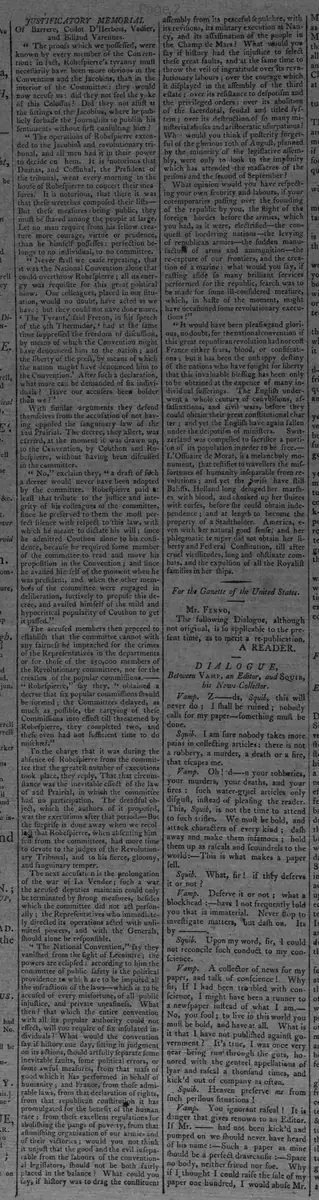
Of Barrere, Collot D'Herbois, Vadier,
and Billaud Varennes.
"The proofs which we produced, were
known by every member of the Conven-
tion: in fact, Robespierre's tyranny must
necessarily have been more obvious in the
Convention and the Jacobins, than in the
interior of the Committee: they would
now accuse us: did they not feel the yoke
of this Colossus? Did they not assist at
the sittings of the Jacobins, where he pub-
licly forbade the Journalists to publish his
sentiments without first consulting him?
"The operations of Robespierre exten-
ded to the Jacobins and revolutionary tri-
bunal, and all men had it in their power
to decide on them. It is notorious that
Dumas, and Coffinhal, the President of
the tribunal, went every morning to the
house of Robespierre to concert their mea-
sures. It is notorious, that there it was
that these wretches composed their lists—
But these measures being public, they
must be shared among the people at large.
Let no man require from his fellow crea-
ture more courage, virtue or prudence,
than he himself possesses: perfection be-
longs to no individual, to no committee.
"Never shall we cease repeating, that
it was the National Convention alone that
could overthrow Robespierre; all its ener-
gy was requisite for this great political
blow. Our colleagues, placed in our situ-
ation, would no doubt, have acted as we
have; but they could not have done more.
The Tyrant,' said Freron, in his speech
of the 9th Thermidor, had at the same
time suppressed the freedom of discussion,
by means of which the Convention might
have denounced him to the nation; and
the liberty of the press, by means of which
the nation might have denounced him to
the Convention.' After such a declaration,
what more can be demanded of six indivi-
duals? Have our accusers been bolder
than we?"
With similar arguments they defend
themselves from the accusation of not hav-
ing opposed the sanguinary law of the
22d Prairial. The decree, they assert, was
carried, at the moment it was drawn up,
to the Convention, by Couthon and Ro-
bespierre, without having been discussed
in the committee.
"No," exclaim they, "a draft of such
a decree would never have been adopted
by the committee. Robespierre paid at
least that tribute to the justice and inte-
grity of his colleagues of the committee,
since he preserved to them the most per-
fect silence with respect to this law, with
which he meant to dictate his will; since
he admitted Couthon alone to his confi-
dence, because he required some member
of the committee to read and move his
proposition in the Convention; and since
he availed himself of the moment when he
was president, and when the other mem-
bers of the committee were engaged in
deliberation, furtively to propose this de-
cree, and availed himself of the mild and
hypocritical popularity of Couthon to get
it passed."
The accused members then proceed to
establish that the committee cannot with
any fairness be impeached for the crimes
of the Representatives in the departments
or for those of the 250,000 members of
the Revolutionary committees, nor for the
creation of the popular commissions.
"Robespierre," say they, "obtained a
decree that six popular commissions should
be formed; the Committees delayed, as
much as possible, the carrying of these
Commissions into effect till threatened by
Robespierre, they completed two, and
these even had not sufficient time to do
mischief."
To the charge that it was during the
absence of Robespierre from the commit-
tee that the greatest number of executions
took place, they reply, That that circum-
stance was the inevitable effect of the law
of 22d Prairial, in which the committee
had no participation. The dreadful ob-
ject, which the authors of it proposed,
was the executions after that period.-But
the surprise is done away when we recol-
lect that Robespierre, when absenting him-
self from the committees, had more time
to devote to the judges of the Revolution-
ary Tribunal, and to his fierce, gloomy,
and sanguinary temper.
The next accusation is the prolongation
of the war of La Vendee; such a war
the accused deputies maintain could only
be terminated by strong measures, besides
which the committee did not act person-
ally; the Representatives who immediate-
ly directed its operations acted with unli-
mited powers, and with the Generals,
should alone be responsible.
"The National Convention," say they
vanished from the sight of Lecointre; the
powers are eclipsed : according to him the
committee of public safety is the political
providence to which are to be imputed all
the infractions of the laws which is to be
accused of every misfortune, of all public
injustice, and private uneasiness. What
then? that which the entire convention
with all its popular authority could not
effect, will you require of six insulated in-
dividuals? What would the convention
say if history one day, sitting in judgment
on its actions, should artfully separate some
inevitable faults, some political errors, or
some awful measures, from that mass of
good which it has performed in behalf of
humanity; and France, from those admi-
rable laws, from that declaration of rights,
from that republican constitution it has
promulgated for the benefit of the human
race; from these excellent regulations for
abolishing the pangs of poverty, from that
astonishing organization of our armies and
of their victories; would you not think
it unjust that the good and the evil insepa-
rable from the labours of the convention-
al legislators, should not be both fairly
placed in the balance ? What could you
say, if history was to drag the constituent
assembly from its peaceful sepulchre, with
What sub-type of article is it?
What keywords are associated?
What entities or persons were involved?
Where did it happen?
Foreign News Details
Primary Location
France
Event Date
9th Thermidor And 22d Prairial
Key Persons
Outcome
executions under law of 22d prairial; overthrow of robespierre by national convention; defense against accusations of complicity in tyranny and revolutionary excesses
Event Details
Accused Committee of Public Safety members defend themselves in memorial, arguing Robespierre's tyranny was known to Convention, they lacked power to act alone, law of 22 Prairial passed without committee discussion, executions resulted from that law during Robespierre's absences, Vendée war handled by representatives with unlimited powers, and blame shared collectively with Convention.