Thank you for visiting SNEWPapers!
Sign up free
The Salt Lake Herald
Salt Lake City, Salt Lake County, Utah
What is this article about?
In 1881, Senators Roscoe Conkling and Thomas C. Platt resign from the U.S. Senate in response to President Garfield's nomination of William H. Robertson to a key New York post, seen as a betrayal. They aim for re-election to challenge the administration, splitting New York Republicans. (187 chars)
Merged-components note: Merged consecutive reading order components detailing the Conkling and Platt resignation event into a single coherent political story.
Clipping
OCR Quality
Full Text
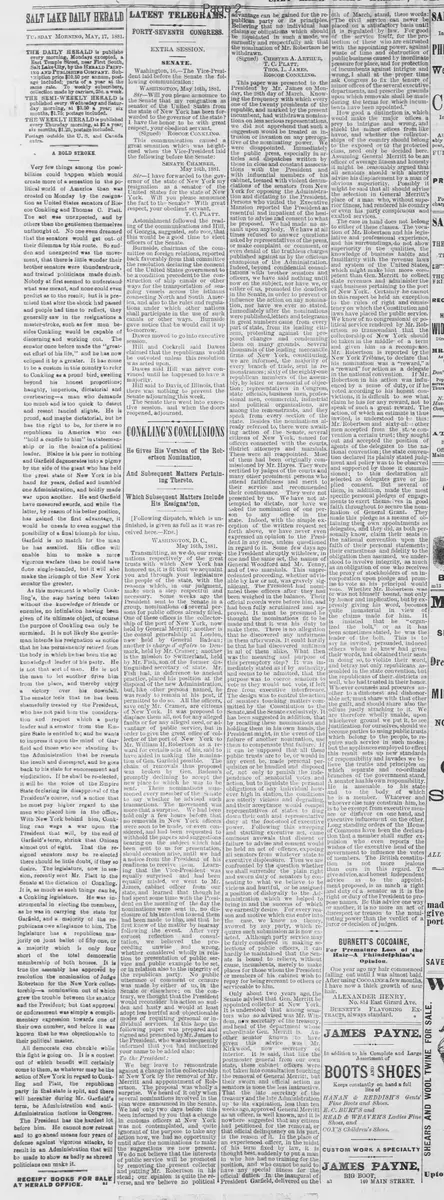
Very few things among the possibilities could happen which would create more of a sensation in the political world of America than was created on Monday by the resignation as United States senators of Roscoe Conkling and Thomas C. Platt. The act was unexpected, and by others than the gentlemen themselves unthought of. No one even dreamed that the senators would get out of their dilemma by this route. So sudden and unexpected was the movement that there is little wonder their brother senators were thunderstruck and trained politicians made dumb. Nobody at first seemed to understand what was meant, and none could even predict as to the result; but it is presumed that after the shock had passed and people had time to reflect, they generally saw in the resignations a master-stroke, such as few men besides Conkling would be capable of discerning and working out. The senator once before made the "greatest effort of his life," and he has now eclipsed it by a greater. It has come to be a custom in this country to refer to Conkling as a proud bird, swelling beyond his honest proportions; haughty, imperious, dictatorial and overbearing—a man who demands too much and is too quick to detect and resent fancied slights. He is proud, and maybe dictatorial, but he has the right to be, for there is no republican in America who can "hold a candle to him" in statesmanship or in the brains of a political leader. Blaine is his peer in nothing and Garfield degenerates into a pigmy by the side of the giant who has held the great state of New York in his hand for years, defied and humbled one Administration, and boldly made war upon another. He and Garfield have measured swords, and while the latter, by reason of his better position, has gained the first advantages, it would be unsafe to even suggest the possibility of a final triumph for him. Garfield is no match for the man he has assailed. His office will enable him to make a more vigorous warfare than he could have done single-handed, but it will also make the triumph of the New York senator the greater.
As this movement is wholly Conkling's, the step having been taken without the knowledge of friends or enemies, no intimation having been given of its ultimate object, of course the purpose of Conkling can only be surmised. It is not likely the gentlemen intend his resignation as notice that he has permanently retired from the body in which he has been the acknowledged leader of his party. He is not that sort of man. He is not the man to let another drive him from the place, and thereby enjoy a victory over his downfall. The senator feels that he has been shamefully treated by the President, who has not paid him the consideration and respect which a party leader and a senator from the Empire State is entitled to; and he wants to impress it upon the mind of Garfield and those who are standing by the Administration that he resents the insult and disrespect, and he goes back to his state for endorsement and vindication. If he shall be re-elected, it will be the voice of the Empire State declaring its disapproval of the President's course, and a notice that he must pay higher regard to the men who placed him in the office. With New York behind him, Conkling can wage a war upon the President that will, by the end of Garfield's term, shrink that Ohioan almost out of sight. That the resigned senators may be re-elected there should be little doubt, if they so desire. The legislature, now in session, recently sent Mr. Platt to the Senate at the dictation of Conkling. It is, as much as such things can be, Conkling legislature. He was instrumental in electing the members, as he was in carrying the state for Garfield, and a majority of the republicans owe allegiance to him. The legislature has a republican majority on joint ballot of fifty-one, or a majority which is only four short of the total democratic membership of both houses. It is true the assembly has approved by resolution the nomination of Judge Robertson for the New York collectorship—nomination out of which grew the trouble between the senator and the President; but that approval or endorsement was simply a complimentary expression towards one of their own number, and before it was known that he was objectionable to their political master. All democrats can chuckle while this fight is going on. It is a contest out of which benefit will certainly come to them, as whatever may be the action of New York in regard to Conkling and Platt, the republican party in that state is split, and there will hereafter during Mr. Garfield's term, be Administration and anti-Administration factions in Congress. The President has the hardest lot before him. He cannot now retreat and to go ahead means four years of defense against vigorous attacks, to result in an Administration that will be made to show as badly as shrewd politicians can make it.
RECEIPT BOOKS FOR SALE AT HERALD OFFICE.
Washington, May 16.—The Vice-President laid before the Senate the following communication:
WASHINGTON, May 16th, 1881.
Sir—Will you please announce to the Senate that my resignation as senator of the United States from the state of New York has been forwarded to the governor of the state?
I have the honor to be with great respect, your obedient servant,
(Signed) ROSCOE CONKLING.
This communication caused a great sensation which was heightened when the Vice-President laid the following before the Senate:
SENATE CHAMBER,
May 16th, 1881.
Sir—I have forwarded to the governor of the state of New York my resignation as a senator of the United States for the state of New York. Will you please announce the fact to the Senate? With great respect, your obedient servant,
T. C. PLATT.
Astonishment followed the reading of the communications and Hill, of Georgia, suggested, soto voce, that this would be a good time to elect officers of the Senate. Burnside, chairman of the committee on foreign relations, reported back favorably from that committee the resolution declaring the consent of the United States government to be a condition precedent to the construction of ship canals or other ways for the transportation of sea-going vessels across the isthmus connecting North and South America, and also to the rules and regulations under which other nations shall participate in the use of such canals or other ways. Burnside gave notice that he would call it up to-morrow. Dawes moved to go into executive session. Hill and Cockrell said Dawes claimed that the republicans would be outvoted unless this resolution was acted upon.
Dawes said Hill was never convinced until he happened to have a majority. Hill said to Davis, of Illinois, that there was nothing to prevent the Senate adjourning this week. The Senate then went into executive session, and when the doors reopened, adjourned.
CONKLING'S CONCLUSIONS
He Gives His Version of the Robertson Nomination,
And Subsequent Matters Pertaining Thereto.
Which Subsequent Matters Include His Resignation.
[Following dispatch, which is unfinished, is given as full as it was received here.—Ed.]
WASHINGTON, D. C.,
May 16th, 1881.
Transmitting, as we do, our resignations respectively of the great trusts with which New York has honored us, it is fit that we acquaint you and through your Legislature the people of the state, with the reasons which, in our judgment, make such a step respectful and necessary. Some weeks ago the President sent to the Senate in a group, nominations of several persons for public offices already filled. One of these offices is the collectorship of the port of New York, now held by General Merritt; another is the consul generalship at London, now held by General Badeau; another is charge d'affaires to Denmark, held by Mr. Cramer; another is the mission to Switzerland, held by Mr. Fish, son of the former distinguished secretary of state. Mr. Fish had, in deference to ancient practice, placed his position at the disposal of the new Administration, but, like other persons named, he was ready to remain at his post, if permitted to do so. All the officers, save only Mr. Cramer, are citizens of New York. It was proposed to displace them all, not for any alleged faults or for any alleged need, or advantage of public service, but in order to give the great office of collector of the port of New York to Mr. William H. Robertson as a reward for certain acts of his, said to have aided in making the nomination of Gen. Garfield possible. The chain of removals thus proposed was broken by Gen. Badeau's promptly declining to accept the new place to which he was to be sent. These nominations summoned every member of the Senate to say whether he advised such transactions. The movement was more than a surprise. We had been told only a few hours before that no removals in New York officers were soon to be made, or even considered, and had been requested to withhold the papers and suggestions bearing on the subject which had been sent to us for presentation, should occasion arise, until we had a notice from the President of his readiness to receive them. Learning that the Vice-President was equally surprised and had been equally misled, we went to Mr. James, cabinet officer from our state, and learned that though he had spent some time with the President on the morning of the day the nominations were sent in, no disclosure of his intention to send them had been made to him, and that he first knew of the matter by hearsay following the event. After very earnest reflection and consultation, we believed the proceeding unwise and wrong, whether considered wholly in relation to presentation of public service and public example to be set, or in relation also to the integrity of the republican party. No public utterance of comment or censure was made by either of us, in the Senate or elsewhere: on the contrary, we thought that the President would reconsider his action so sudden and hasty and would at least adopt less hurtful and objectionable modes of requiting personal or individual services. In this hope the following paper was prepared and signed and presented by Mr. James to the President, who was subsequently informed that you had authorized your name to be added also:
To the President:
We beg leave to remonstrate against a change in the collectorship at New York by the removal of Mr. Merritt and appointment of Robertson. The proposal was wholly a surprise. We heard of it only when several nominations involved in the plan were announced in the Senate. We had only two days before this been informed by you that a change in customs officers at New York was not contemplated, and quite ignorant of the purpose to take any action now, we had no opportunity until after the nominations to make the suggestions we now present. We do not believe that the interests of public service will be promoted by removing the present collector and putting Mr. Robertson in his stead; our opinion is quite the reverse, and we believe no political advantage can be gained for the republican party or its principles. Believing that no individual has claims or obligations which should be liquidated in such a mode, we earnestly and respectfully ask that the nomination of Mr. Robertson be withdrawn.
CHESTER A. ARTHUR
T. C. PLATT.
THOS. L. JAMES,
ROSCOE CONKLING.
ROSCOE CONKLING.
This paper was presented to the President by Mr. James on Monday, the 28th day of March. Knowing the frequency with which every one of the twenty presidents of the republic, and marked by the present incumbent, had withdrawn nominations on less serious representations we did not apprehend that such a suggestion would be treated as intrusion or invasion on any prerogative of the nominating power. We were disappointed. Immediately the public press, especially in articles and dispatches written by those in close and constant associations with the President and with influential members of his cabinet, teemed with violent denunciations of the senators from New York for opposing the Administration and dictating to the President. Persons who visited the Executive Mansion reported the President as resentful and impatient of the hesitation to advise and consent to what he proposed. We had made no assault upon anybody. We have at all times refused to answer questions asked by representatives of the press, or make complaint or comment, or even denial of the truthless charges published against us by the officious champions of the Administration. Indeed, beyond confidential consultation with brother senators and officers, we have said nothing until now on the subject, nor have we, or either of us, promoted the deadlock in the Senate, in order to prevent or influence the action on any nomination, nor have we ever so stated. Immediately after the nominations were published, letters and telegrams in great numbers came from every part of state, from its leading citizens, protesting against the proposed changes and condemning them on many grounds. Several thousands of the leading mercantile firms of New York, constituting, we are informed, the majority of every branch of trade, sent in remonstrances; sixty of the eighty-one republican members of the assembly, by letter or memorial of objection; representatives in Congress, state officials, business men, professional men, commercial, industrial and political organizations, are among the remonstrants, and they speak from every section of the state. Besides the nominations already referred to, there were awaiting action of the Senate, several citizens of New York, named for officers connected with the courts, district attorneys and marshals. These were all reappointed. Most of them had been originally commissioned by Mr. Hayes. They were certified by judges of the courts and many other prominent persons who attest faithfulness and merit to their service and recommended their continuance. They were not presented by us. We have not attempted to dictate, nor have we asked the nomination of one person to any office in the state. Indeed, with the simple exception of the written request set forth above, we have never even expressed an opinion to the President in any case, unless questioned in regard to it. Some few days ago the President abruptly withdrew, in one and the same act, the names of General Woodford and Mr. Tenny, and of two marshals. This unprecedented proceeding, whether advisable by law or not, was gravely significant. The President had nominated these officers after they had been weighed in the balance. Their official records were before him, and had been fully scrutinized and approved. It must be presumed he thought the nominations fit to be made and that it was his duty to make them. There is no allegation that he discovered any unfairness in them afterwards. It could hardly be that he had discovered unfitness in all of them alike. What then was the meaning and purpose of this peremptory step? It was immediately stated as if by authority, and seems to be admitted, that the purpose was to coerce senators to vote as they would not vote, if left free from executive interference. The design was to control the action of senators touching matters committed by the Constitution to the Senate, and the Senate exclusively. It has been suggested in addition, that by recalling these nominations and holding them in his own hands, the President might, in the event of the failure of another nomination, use them to compensate that failure. If it can be supposed that all these public trusts are to be, or would in any event be, made personal perquisites or be handled and disposed of, not only to punish the independence of senatorial votes and action, but to liquidate the personal obligations of any individual how high in station, the conditions are utterly vicious and degrading and their acceptance would compel representatives of states to fling down their oath and representative duty at the foot-stool of executive power. Following this sweeping and startling executive act, came ominous avowals that dissent or failure to advise and consent would be held an act of offence, exposing all senators from whatever state to executive displeasure. Thus we are confronted by the question whether we shall surrender the plain right and sworn duty of senators by consenting to what we believe to be vicious and hurtful, or be assigned a position of disloyalty to the Administration which we helped to bring in and the success of which we earnestly desire. For every reason and motive which can enter into the case, we know no theory, avowed by any party, which requires such submission as is now exacted. Although party service may be fairly considered in making selections of public officers, it can hardly be maintained that the Senate is bound to relieve, without cause, incumbents, merely to make places for those whom the President or members of his cabinet wish to repay for being recreant to others or serviceable to him.
Only about two years ago, the Senate advised that Gen. Merritt be appointed collector at New York. It is understood that among senators who so advised was Mr. Windom, now secretary of the treasury, and head of the department whose subordinate Gen. Merritt is. Another senator known to have given this advice was Mr. Kirkwood, now secretary of interior. It is said, that like the postmaster general from our own state, these cabinet officers were not taken into consultation touching the removal of General Merritt, but their sworn and official action as senators is none the less instructive. That the late secretary of the treasury and the late Administration up to its expiration, less than ten weeks ago, approved General Merritt as an officer, is well known, and it is nowhere suggested that any citizen had petitioned for the removal, or that official delinquency on his part, is the reason of it. In the place of an experienced officer, in the midst of his term fixed by law, it is thought best, suddenly to put a man in who has had no training for the position, and who cannot be said to have any special fitness for the official duties. In the inaugural of President Garfield, delivered on the 4th of March, he said:
"How good a distribution is which would make the major offices a prey to intrigue and wrong, and shield the minor offices from like havoc, and whether the collectorships of the country should belong to the exposed or to the protected class, need only be decided here. Assuming General Merritt to be an officer of average fitness and honesty it might be reasonably argued that all senators should with alacrity advise his displacement by a man of obvious superiority. Possibly it might be said that all should advise the selection in General Merritt's place of a man who, without superior fitness, had rendered his country or even his party conspicuous and exalted services. The case in hand does not belong to either of these classes. The vocation of Mr. Robertson and his legislative and professional experience, and his surroundings, do not show superiority in the qualities, the knowledge of business habits and familiarity with the revenue laws and system of the United States, which might make him more competent than Gen. Merritt to collect state revenues and administer the vast business pertaining to the port of New York. Certainly he cannot in this respect be held an exception to the rules of right and consistency on which the Constitution and laws have placed the public service. We know of no congressional or political service rendered by Mr. Robertson so transcendent that the collectorship of New York should be taken in the middle of a term and given him as a recompense. Mr. Robertson is reported by the New York Tribune, to declare that his nomination was a "reward," a "reward" for action as a delegate in the national convention. If Mr. Robertson in his action was influenced by a sense of duty, or if he voted according to his honest convictions, it is difficult to see what claim he has for any reward, not to speak of such a great reward. The action, of which an estimate is thus invited, is understood to be this: Mr. Robertson and sixty-nine other men accepted from the state convention a certain trust; they sought out and accepted the position of agents of the delegates to the national convention; the state convention declared its plainly stated judgment and policy was to be observed and supported by those it commissioned; to this declaration all selected as delegates gave or implied consent. But several of them, in addition, made the most specific personal pledges of engagements to exert themselves in good faith throughout to secure the nomination of General Grant. They made this pledge as a means of obtaining their own appointments as delegates, and they did, as both personally know, claim their seats in the national convention upon the faith of their personal statements; their earnestness and fidelity to the obligation then assumed, we understood to involve integrity, as much as an obligation of one who receives the proxy of stockholders of an incorporation upon pledge and promise to vote as his principal would vote. Whether Mr. Robertson was or was not himself bound, not only by honor and implication, but by expressly giving his word, becomes quite immaterial in view of the claims made for him. It is insisted that he "organized the bolt," or as it has been sometimes stated, he was the leader of the bolt. This is to say he invited, persuaded, induced others whom he knew had given their words, had obtained their seats in doing so, to violate their word, and betray not only republicans assembled in the state convention, but the republicans of their districts as well, who had trusted in their honor. Whoever counsels and procures another to a dishonest and dishonorable act; must share with that other the guilt, and should share also the odium justly attaching to it. We are therefore wholly unable, upon whichever ground we put it, to see justification for ourselves, should we become parties to using public trusts which belong to the people, to require such service in such modes; but the appliances employed to effect this result sets up new standards of responsibility and invades we believe the truths and principles on which separate and co-ordinate branches of the government stand. A senator has his own responsibility. He is amenable to his state and to the body of which he is a member. Whatever and whoever else may constrain him, he is to be exempt from executive menace or disfavor on one hand, and executive inducement on the other. Long standing orders of the House of Commons have been the declaration that a member shall suffer expulsion who even reports the wishes of the executive head of the government to influence the votes of members. The British constitution is not more jealous than ours in this regard. To give advice, and honest independent advice as to the appointment proposed, is as much a right and duty of a senator as it is the right or duty of the President to propose names. Be this advice one way or another, it is no more an act of disrespect or treason to the nominating power than the verdict of a juror or decision of judges.
What sub-type of article is it?
What themes does it cover?
What keywords are associated?
What entities or persons were involved?
Where did it happen?
Story Details
Key Persons
Location
Washington, New York
Event Date
May 16, 1881
Story Details
Senators Roscoe Conkling and Thomas C. Platt resign in protest against President Garfield's nomination of William H. Robertson as New York port collector, viewing it as a betrayal and reward for disloyalty. They seek re-election from the New York legislature for vindication, escalating a political feud that splits the Republican party.