Thank you for visiting SNEWPapers!
Sign up free
Harpers Ferry Free Press
Harpers Ferry, Jefferson County, West Virginia
What is this article about?
A Bostonian recounts a pre-Revolutionary incident near Dedham where Admiral Montague's coach is blocked by a defiant coal driver who refuses to yield, symbolizing American resistance to British authority. The admiral conciliates, and the tale draws parallels to colonial disputes over taxation.
Clipping
OCR Quality
Full Text
From the Boston Centinel.
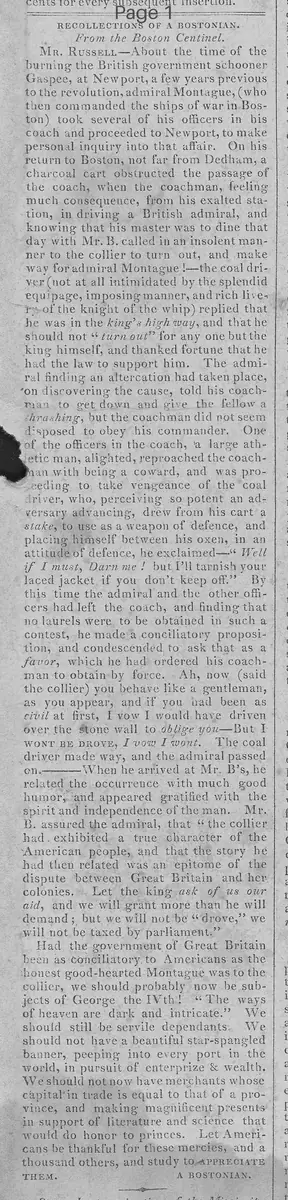
Mr. RUSSELL—About the time of the burning the British government schooner Gaspee, at Newport, a few years previous to the revolution, admiral Montague, (who then commanded the ships of war in Boston) took several of his officers in his coach and proceeded to Newport, to make personal inquiry into that affair. On his return to Boston, not far from Dedham, a charcoal cart obstructed the passage of the coach, when the coachman, feeling much consequence, from his exalted station, in driving a British admiral, and knowing that his master was to dine that day with Mr. B. called in an insolent manner to the collier to turn out, and make way for admiral Montague!—the coal driver (not at all intimidated by the splendid equipage, imposing manner, and rich livery of the knight of the whip) replied that he was in the king's high way, and that he should not "turn out" for any one but the king himself, and thanked fortune that he had the law to support him. The admiral finding an altercation had taken place, on discovering the cause, told his coachman to get down and give the fellow a thrashing, but the coachman did not seem disposed to obey his commander. One of the officers in the coach, a large athletic man, alighted, reproached the coachman with being a coward, and was proceeding to take vengeance of the coal driver, who, perceiving so potent an adversary advancing, drew from his cart a stake, to use as a weapon of defence, and placing himself between his oxen, in an attitude of defence, he exclaimed—“Well if I must, Darn me! but I'll tarnish your laced jacket if you don't keep off." By this time the admiral and the other officers had left the coach, and finding that no laurels were to be obtained in such a contest, he made a conciliatory proposition, and condescended to ask that as a favor, which he had ordered his coachman to obtain by force. Ah, now (said the collier) you behave like a gentleman, as you appear, and if you had been as civil at first, I vow I would have driven over the stone wall to oblige you—But I Wont BE Drove, I vow I wont. The coal driver made way, and the admiral passed on.—When he arrived at Mr. B's, he related the occurrence with much good humor, and appeared gratified with the spirit and independence of the man. Mr. B. assured the admiral, that "the collier had exhibited a true character of the American people, and that the story he had then related was an epitome of the dispute between Great Britain and her colonies. Let the king ask of us our aid, and we will grant more than he will demand; but we will not be "drove," we will not be taxed by parliament."
Had the government of Great Britain been as conciliatory to Americans as the honest good-hearted Montague was to the collier, we should probably now be subjects of George the IVth! "The ways of heaven are dark and intricate." We should still be servile dependants. We should not have a beautiful star-spangled banner, peeping into every port in the world, in pursuit of enterprize & wealth. We should not now have merchants whose capital in trade is equal to that of a province, and making magnificent presents in support of literature and science that would do honor to princes. Let Americans be thankful for these mercies, and a thousand others, and study to APPRECIATE THEM.
A BOSTONIAN.
What sub-type of article is it?
What themes does it cover?
What keywords are associated?
What entities or persons were involved?
Where did it happen?
Story Details
Key Persons
Location
Near Dedham, On The Road From Newport To Boston
Event Date
About The Time Of The Burning The British Government Schooner Gaspee, At Newport, A Few Years Previous To The Revolution
Story Details
Admiral Montague's coach is obstructed by a coal cart near Dedham; the coachman demands passage insolently, but the collier refuses to yield except to the king, defending his right with a stake. The admiral conciliates, and later at Mr. B.'s, the incident is seen as emblematic of American independence against British overreach.