Thank you for visiting SNEWPapers!
Sign up free
The Virginia Gazette
Williamsburg, Virginia
What is this article about?
British parliamentary debate on responding to American colonial rebellion, featuring King's speech offering pardons and mercy upon submission, and speeches by MPs advocating coercive military measures over conciliation, with Lord North outlining plans for force and conditional reconciliation.
Merged-components note: Merged introductory publication request with the King's speech excerpt and its continuation of parliamentary debate across pages, as they form a single coherent foreign news item on British proceedings.
Clippings
1 of 2
OCR Quality
Full Text
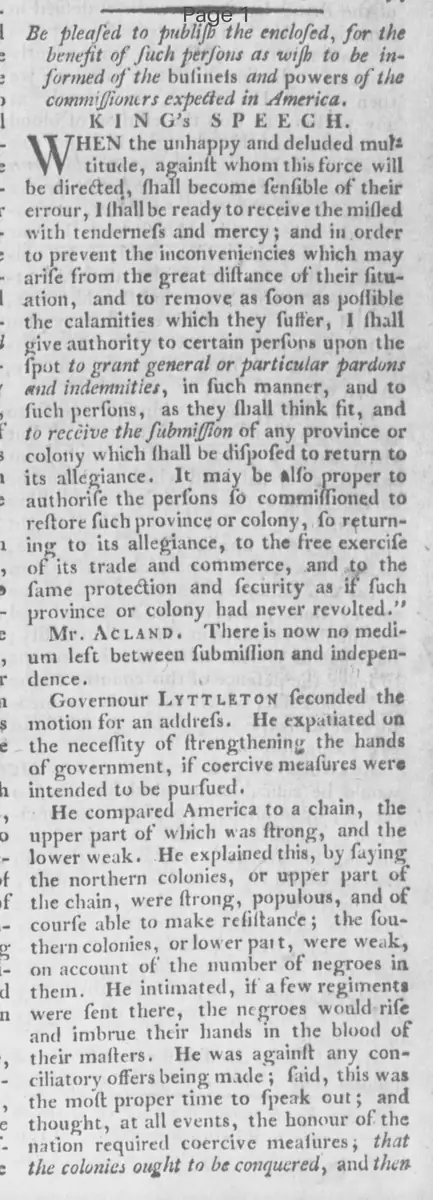
KING's SPEECH.
...titude, against whom this force will be directed, shall become sensible of their error, I shall be ready to receive the misled with tenderness and mercy; and in order to prevent the inconveniences which may arise from the great distance of their situation, and to remove as soon as possible the calamities which they suffer, I shall give authority to certain persons upon the spot to grant general or particular pardons and indemnities, in such manner, and to such persons, as they shall think fit, and to receive the submission of any province or colony which shall be disposed to return to its allegiance. It may be also proper to authorise the persons so commissioned to restore such province or colony, on returning to its allegiance, to the free exercise of its trade and commerce, and to the same protection and security as if such province or colony had never revolted."
Mr. ACKLAND. There is now no medium left between submission and independence.
Governor Lyttleton seconded the motion for an address. He expatiated on the necessity of strengthening the hands of government, if coercive measures were intended to be pursued. He compared America to a chain, the upper part of which was strong, and the lower weak. He explained this, by saying the northern colonies, or upper part of the chain, were strong, populous, and of course able to make resistance; the southern colonies, or lower part, were weak, on account of the number of negroes in them. He intimated, if a few regiments were sent there, the negroes would rise and imbrue their hands in the blood of their masters. He was against any conciliatory offers being made; said, this was the most proper time to speak out; and thought, at all events, the honour of the nation required coercive measures; that the colonies ought to be conquered, and then...
to have mercy shewn them; concluding from Virgil, with parcere subjectis et debellare superbos.
Sir ADAM FERGUSON. What remained, but that they should exert every nerve to reduce their rebellious subjects to obedience? After they had reduced them, and convinced them of their inability to resist the power of this country, then, and not till then, would be time to shew them all possible indulgence.
Lord NORTH. That if the scheme of repealing every American act passed since 1763 was adopted, there was certainly an end to the dispute; for, from that moment, America would be independent of England. That many of the acts were framed for the necessary support of the superiority of the mother country, on points in which her right of superiority had never been questioned till America was refractory; that all the acts were rather acts of justice than of cruelty. That the measures administration meant now to pursue were, to send a powerful sea and land force to America; and, at the same time, to accompany them with offers of mercy, upon a proper submission. Every exertion of force was justifiable, till such time as they should again become obedient to this government; that nothing should be wanting on his part to bring them back to a just subordination; that now it was impossible to treat with them, until once brought back to a due obedience. Their friends have said, that they only wished to be put on the same footing on which they were in 1763. He wished to God it were possible to put the colonies on the same footing they were in 1763. That before the year 1763 the authority of the British legislature was not denied in America. He said, the repealing 13 acts of parliament would not consequently place us in the same situation in which we then were. He wished, as ardently as any person, to stop the effusion of blood on both sides; but thought it could only be effected by sending over a formidable army early in the spring, and appointing proper persons on the spot to give pardons, as mentioned in the speech. These were the only methods, he said, which could, in his opinion, restore matters to that desired footing: and when that period should arrive, he did not doubt but his conciliatory plan would give permanency to the reconciliation, by our accepting a quantum annually, in lieu of taxes:
He declared, he was himself averse to the employment of foreign troops; but that where a great constitutional point was to be carried, and which could not be carried without them, he saw no objection to their being made use of. He thought they might be applied to as a resource, though it would be impolitic to use them in the first instance; that as we had more money than men, it was a natural and a justifiable resource in cases of necessity; but that at present administration meant to leave the defence of this country to the gentlemen of it, which was surely the measure most likely to prove agreeable to every Englishman.
Lord Advocate of Scotland. It would be ridiculous in administration to recede, or to listen, at present, to conciliatory measures, whilst America was making so effectual a resistance; that all Europe would say we had felt our inability to enforce our rights, and therefore were glad to accommodate matters on any terms; that when we had regained and re-established our authority there, he would be happy to join in any plan for the better and more happy government of that part of the empire.
Mr. RIGBY. He said he was firmly of opinion that America must be conquered.
What sub-type of article is it?
What keywords are associated?
What entities or persons were involved?
Where did it happen?
Foreign News Details
Primary Location
America
Key Persons
Event Details
Excerpt from King's speech offering pardons and restoration of trade to submitting American colonies; parliamentary speeches advocating conquest and coercive measures before mercy, with Lord North proposing military force accompanied by conditional offers of reconciliation and annual contributions in lieu of taxes.