Thank you for visiting SNEWPapers!
Sign up free
The Elk County Advocate
Ridgway, Elk County, Pennsylvania
What is this article about?
Interview with Col. Herbert B. Sandford, head of English Centennial commission, detailing British exhibits including East India products, security personnel, comparisons to other expositions, and the sentimental spirit of foreign exhibitors at the Philadelphia Centennial.
Clipping
OCR Quality
Full Text
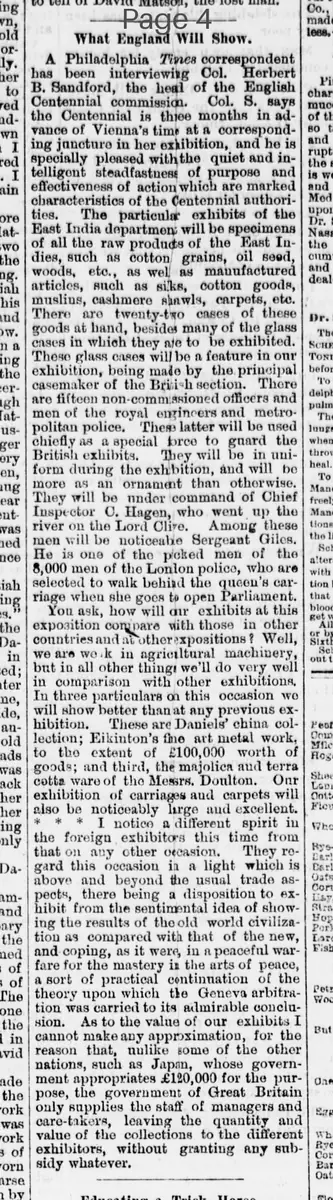
A Philadelphia Times correspondent has been interviewing Col. Herbert B. Sandford, the head of the English Centennial commission. Col. S. says the Centennial is three months in advance of Vienna's time at a corresponding juncture in her exhibition, and he is specially pleased with the quiet and intelligent steadfastness of purpose and effectiveness of action which are marked characteristics of the Centennial authorities. The particular exhibits of the East India department will be specimens of all the raw products of the East Indies, such as cotton grains, oil seed, woods, etc., as well as manufactured articles, such as silks, cotton goods, muslins, cashmere shawls, carpets, etc. There are twenty-two cases of these goods at hand, besides many of the glass cases in which they are to be exhibited. These glass cases will be a feature in our exhibition, being made by the principal casemaker of the British section. There are fifteen non-commissioned officers and men of the royal engineers and metropolitan police. These latter will be used chiefly as a special force to guard the British exhibits. They will be in uniform during the exhibition, and will be more as an ornament than otherwise. They will be under command of Chief Inspector C. Hagen, who went up the river on the Lord Clive. Among these men will be noticeable Sergeant Giles. He is one of the picked men of the 8,000 men of the London police, who are selected to walk behind the queen's carriage when she goes to open Parliament.
You ask, how will our exhibits at this exposition compare with those in other countries and at other expositions? Well, we are weak in agricultural machinery, but in all other things we'll do very well in comparison with other exhibitions. In three particulars on this occasion we will show better than at any previous exhibition. These are Daniels' china collection; Elkington's fine art metal work, to the extent of £100,000 worth of goods; and third, the majolica and terra cotta ware of the Messrs. Doulton. Our exhibition of carriages and carpets will also be noticeably large and excellent.
I notice a different spirit in the foreign exhibitors this time from that on any other occasion. They regard this occasion in a light which is above and beyond the usual trade aspects, there being a disposition to exhibit from the sentimental idea of showing the results of the old world civilization as compared with that of the new, and coping, as it were, in a peaceful warfare for the mastery in the arts of peace, a sort of practical continuation of the theory upon which the Geneva arbitration was carried to its admirable conclusion. As to the value of our exhibits I cannot make any approximation, for the reason that, unlike some of the other nations, such as Japan, whose government appropriates £120,000 for the purpose, the government of Great Britain only supplies the staff of managers and care-takers, leaving the quantity and value of the collections to the different exhibitors, without granting any subsidy whatever.
What sub-type of article is it?
What keywords are associated?
What entities or persons were involved?
Where did it happen?
Foreign News Details
Primary Location
England
Key Persons
Event Details
Col. Herbert B. Sandford discusses English preparations for the Philadelphia Centennial Exposition, including East India raw and manufactured products, special glass cases, security by royal engineers and metropolitan police under Chief Inspector C. Hagen featuring Sergeant Giles, strengths in china, metal work, majolica, carriages, and carpets, and a sentimental spirit among foreign exhibitors emphasizing cultural comparison over trade, with Britain providing no subsidies unlike Japan.