Thank you for visiting SNEWPapers!
Sign up free
The Daily Advertiser
New York, New York County, New York
What is this article about?
On October 5, the Virginia House of Delegates debated a congressional resolution to call a state convention for ratifying the new federal Constitution. Key figures like Corbin, Henry, Mason, Nicholas, and Marshall discussed the need for amendments and full deliberation powers. The House unanimously resolved to submit the Constitution to a convention of freeholders for free investigation, with elections in March and assembly in May.
Clipping
OCR Quality
Full Text
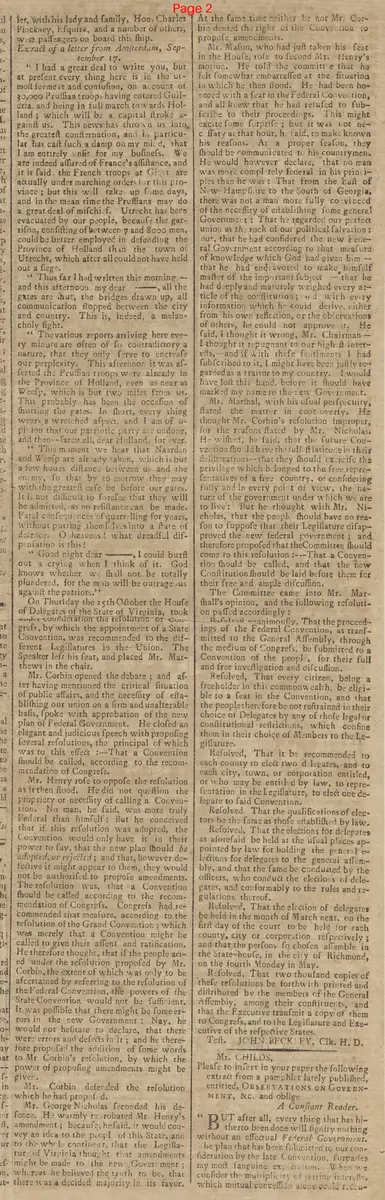
Mr. Corbin opened the debate; and after having mentioned the critical situation of public affairs, and the necessity of establishing our union on a firm and unalterable basis, spoke with approbation of the new plan of Federal Government. He closed an elegant and judicious speech with proposing several resolutions, the principal of which was to this effect :-That a Convention should be called, according to the recommendation of Congress.
Mr. Henry rose to oppose the resolution as it then stood. He did not question the propriety or necessity of calling a Convention. No man, he said, was more truly Federal than himself: But he conceived that if this resolution was adopted, the Convention would only have it in their power to say, that the new plan should be adopted, or rejected; and that, however defective it might appear to them, they would not be authorized to propose amendments. The resolution was, that a Convention should be called according to the recommendation of Congress. Congress had recommended that measure, according to the resolution of the Grand Convention; which was merely that a Convention might be called to give their assent and ratification. He therefore thought, that if the people acted under the resolution proposed by Mr. Corbin, the extent of which was only to be ascertained by referring to the resolution of the Federal Convention, the powers of the State Convention would not be sufficient. It was possible that there might be some errors in the new Government: Nay, he would not hesitate to declare, that there were errors and defects in it; and he therefore proposed the addition of some words to Mr. Corbin's resolution, by which the power of proposing amendments might be given.
Mr. Corbin defended the resolution which he had proposed.
Mr. George Nicholas seconded his defence. He warmly reprobated Mr. Henry's amendment; because, he said, it would convey an idea to the people of this State, and to the whole continent, that the Legislature of Virginia thought that amendments might be made to the new Government; whereas he believed the truth to be, that there was a decided majority in its favor.
At the same time neither he nor Mr. Corbin denied the right of the Convention to propose amendments.
Mr. Mason, who had just taken his seat in the House, rose to second Mr. Henry's motion. He told the committee that he felt somewhat embarrassed at the situation in which he then stood. He had been honored with a seat in the Federal Convention, and all knew that he had refused to subscribe to their proceedings. This might excite some surprise; but it was not necessary at that hour, he said, to make known his reasons. At a proper season, they should be communicated to his countrymen. He would however declare, that no man was more completely federal in his principles than he was: That from the East of New Hampshire to the South of Georgia, there was not a man more fully convinced of the necessity of establishing some general Government: That he regarded our perfect union as the rock of our political salvation: But, that he had considered the new Federal Government according to that measure of knowledge which God had given him - that he had endeavored to make himself master of the important subject - that he had deeply and maturely weighed every article of the constitution; and with every information which he could derive, either from his own reflection, or the observations of others, he could not approve it. He said, I thought it wrong, Mr. Chairman, I thought it repugnant to our highest interests,-and if with these sentiments I had subscribed to it, I might have been justly regarded as a traitor to my country. I would have lost this hand, before it should have marked my name to the new Government.
Mr. Marshall, with his usual perspicuity, stated the matter in controversy. He thought Mr. Corbin's resolution improper, for the reasons stated by Mr. Nicholas. He wished, he said, that the future Convention should have the full latitude in their deliberations--that they should exercise the privilege which belonged to the free representatives of a free country, of considering fully and in every point of view, the nature of the government under which we are to live: But he thought with Mr. Nicholas, that the people should have no reason to suppose that their Legislature disapproved the new federal government; and therefore proposed that the Committee should come to this resolution :---That a Convention should be called, and that the new Constitution should be laid before them for their free and ample discussion.
The Committee came into Mr. Marshall's opinion, and the following resolution passed accordingly:
Resolved unanimously, That the proceedings of the Federal Convention, as transmitted to the General Assembly, through the medium of Congress, be submitted to a Convention of the people, for their full and free investigation and discussion.
Resolved, That every citizen, being a freeholder in this commonwealth, be eligible to a seat in the Convention, and that the people therefore be not restrained in their choice of Delegates by any of those legal or constitutional restrictions, which confine them in their choice of Members to the Legislature.
Resolved, That it be recommended to each county to elect two delegates, and to each city, town, or corporation entitled, or who may be entitled by law, to representation in the Legislature, to elect one delegate to said Convention.
Resolved, That the qualifications of electors be the same as those established by law.
Resolved, That the elections for delegates as aforesaid be held at the usual places appointed by law for holding the general elections for delegates to the general assembly, and that the same be conducted by the officers, who conduct the elections of delegates, and conformably to the rules and regulations thereof.
Resolved, That the election of delegates be held in the month of March next, on the first day of the court to be held for each county, city or corporation respectively; and that the persons so chosen assemble in the State-house, in the city of Richmond, on the fourth Monday in May.
Resolved. That two thousand copies of these resolutions be forthwith printed and distributed by the members of the General Assembly, among their constituents, and that the Executive transmit a copy of them to Congress, and to the Legislature and Executive of the respective States.
Test. JOHN BECKLEY, Clk. H. D.
What sub-type of article is it?
What themes does it cover?
What keywords are associated?
What entities or persons were involved?
Where did it happen?
Story Details
Key Persons
Location
House Of Delegates Of The State Of Virginia
Event Date
Thursday The 5th October
Story Details
The Virginia House of Delegates debated calling a state convention to consider the new federal Constitution per Congress's recommendation. Corbin proposed ratification; Henry and Mason sought powers for amendments; Nicholas and Marshall opposed signaling defects. Resolution passed to submit the Constitution for full free discussion by a convention of freeholders, with elections in March and assembly in May in Richmond.