Thank you for visiting SNEWPapers!
Sign up free
Daily National Intelligencer
Washington, District Of Columbia
What is this article about?
Documents refute claims of US subserviency to Napoleon by detailing US Consul Alexander Hammett's protests against Neapolitan seizures of American vessels and cargoes in 1809-1810 under King Murat, demanding full reparation amid Napoleonic trade restrictions.
Clipping
OCR Quality
Full Text
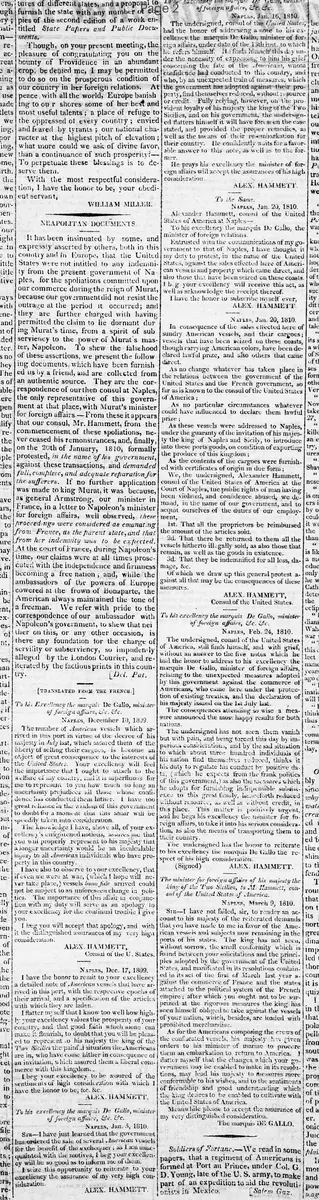
It has been insinuated by some, and expressly asserted by others, both in this country and in Europe, that the United States were not entitled to any indemnity from the present government of Naples, for the spoliations committed upon our commerce during the reign of Murat, because our government did not resist the outrage at the period it occurred; and they are further charged with having permitted the claim to lie dormant during Murat's time, from a spirit of subserviency to the power of Murat's master, Napoleon. To shew the falsehood of these assertions, we present the following documents, which have been furnished us by a friend, and are collected from an authentic source. They are the correspondence of our then consul at Naples, the only representative of this government at that place, with Murat's minister for foreign affairs.—From these it appears that our consul, Mr. Hammett, from the commencement of these spoliations, never ceased his remonstrances, and, finally, on the 20th of January, 1810, formally protested, in the name of his government, against these transactions, and demanded full, complete, and adequate reparation for the sufferers. If no further application was made to king Murat, it was because, as general Armstrong, our minister in France, in a letter to Napoleon's minister for foreign affairs, well observed, these proceedings were considered as emanating from France, as the parent state, and that from her indemnity was to be expected.
At the court of France, during Napoleon's time, our claims were at all times prosecuted with the independence and firmness becoming a free nation; and, while the ambassadors of the powers of Europe cowered at the frown of Bonaparte, the American always maintained the tone of a freeman. We refer with pride to the correspondence of our ambassador with Napoleon's government, to shew that neither on this, or any other occasion, is there any foundation for the charge of servility or subserviency, so impudently alleged by the London Courier, and reiterated by the factious prints in this country.
[TRANSLATED FROM THE FRENCH.]
To his Excellency the Marquis De Gallo, minister of foreign affairs, &c. &c.
Naples, December 10, 1809.
The number of American vessels which arrived in this port in virtue of the decree of his majesty in July last, which assured them of the liberty of selling their cargoes, is become an object of great consequence to the interests of the United States. Your excellency will feel the importance that I ought to attach to the welfare of my country, and it is superfluous for me to represent to you how much so long an uncertainty prejudices all those whose confidence has conducted them hither. I have too great reliance in the wisdom of this government to doubt for a moment that this affair will be speedily taken into consideration.
The knowledge I have, above all, of your excellency's enlightened notions, assures me that you will properly represent to his majesty that a longer uncertainty would be an incalculable injury to all American individuals who have property in this country.
I have also to observe to your excellency, that if even we were at war, (which I hope will never take place,) vessels bona fide arrived could not be subject to an unforeseen change in politics. The importance of this affair in conjunction with my duty will serve as an apology to your excellency for the continual trouble I give you.
I beg you will accept that apology, and with it the distinguished assurances of my very high consideration.
ALEX. HAMMETT,
Consul of the U. States.
Naples, Dec. 17, 1809.
I have the honor to remit to your excellency a detailed note of American vessels that have arrived in this port, with the respective epochs of their arrival, and a specification of the articles with which they are laden.
I flatter myself that I know too well how highly your excellency values the prosperity of your country, and that good faith which alone can make it flourish, to doubt that you will be pleased to represent to his majesty the king of the Two Sicilies the painful situation the Americans are in, who have come hither in consequence of an invitation, which assured them a liberal commerce with this kingdom.
I beg your excellency to be assured of the sentiments of high consideration with which I have the honor to be, &c. &c.
ALEX. HAMMETT.
To his excellency the Marquis De Gallo, minister of foreign affairs, &c. &c.
Naples, Jan. 5, 1810.
Sir—I have just learned that the government has ordered the sale of several American vessels for the benefit of the exchequer; as I am unacquainted with the motives, I beg your excellency will be so good as to inform me of them.
I seize this opportunity to reiterate to your excellency the assurance of my very high consideration.
NAPLES, Jan. 16, 1810.
The undersigned, consul of the United States, had the honor of addressing a note to his excellency the marquis De Gallo, minister of foreign affairs, under date of the 5th inst. to which he refers himself. He finds himself this day under the necessity of expressing to him his grief concerning the fate of the Americans, whom confidence had conducted to this country, and who, by an unexpected train of measures, which the government has adopted against their property, find themselves reduced, without resource or credit. Fully relying, however, on the provident loyalty of his majesty the king of the Two Sicilies, and on his government, the undersigned flatters himself it will have foreseen the case stated, and provided the proper remedies, as well as the means of their re-embarkation for their country. He confidently waits for a favorable answer to this note, as well as to the former.
He prays his excellency the minister of foreign affairs will accept the assurances of his high consideration.
ALEX. HAMMETT.
To the Same.
Naples, Jan. 20, 1810.
Alexander Hammett, consul of the United States of America at Naples—
To his excellency the marquis De Gallo, the minister of foreign relations.
Entrusted with the communications of my government to that of Naples, I have thought it my duty to protest, in the name of the United States, against the sales effected here of American vessels and property which came direct, and also those that have been seized on these coasts.
I beg your excellency will receive this act, as well as acknowledge the receipt thereof.
I have the honor to subscribe myself ever,
ALEX. HAMMETT.
Naples, Jan. 20, 1810.
In consequence of the sales effected here of sundry American vessels, and their cargoes; vessels that have been seized on these coasts, though carrying American colors, have been declared lawful prize, and also others that came direct.
As no change whatever has taken place in the relations between the government of the United States and the French government, so far as is known to the consul of the United States of America;
As no particular circumstances whatever could have influenced to declare them lawful prize;
As these vessels were addressed to Naples, under the guaranty of the invitation of his majesty the king of Naples and Sicily, to introduce into these ports goods, on condition of exporting the produce of this kingdom;
As the contents of the cargoes were furnished with certificates of origin in due form;
We, the undersigned, Alexander Hammett, consul of the United States of America at the Court of Naples, the public rights of man having been violated, and confidence abused, we demand, in the name of our government, and to acquit ourselves of the duties of our employment,
1st. That all the proprietors be reimbursed the amount of the articles sold.
2d. That there be returned to them all the vessels hitherto illegally sold, as also those that remain, as well as the goods in existence.
3d. That they be indemnified for all loss, damage, &c.
Of which we draw up this general protest against all that may be the consequences of these measures.
ALEX. HAMMETT,
Consul of the United States.
To his excellency the marquis De Gallo, minister of foreign affairs, &c. &c.
NAPLES, Feb. 24, 1810.
The undersigned, consul of the United States of America, still finds himself, and with grief, without an answer to the five notes which he had the honor to address to his excellency the marquis De Gallo, minister of foreign affairs, relating to the unexpected measures adopted by this government against the commerce of Americans, who came here under the protection of existing treaties, and the declaration of his majesty issued on the 1st July last.
The consequences attending so wise a measure announced the most happy results for both nations.
The undersigned has not seen them vanish but with pain, and being forced this day by imperious considerations, and by the sad situation to which about three hundred individuals of his nation find themselves reduced, thinks it his duty to regulate his conduct by positive data, (which he expects from the frank politics of this government,) as also the measures which he adopts for furnishing indispensable subsistence to this great family, henceforth reduced without resource, as well as without credit, in this place. This matter is positively urgent, and he begs his excellency the minister for foreign affairs, to take it into his serious consideration, as also the means of transporting them to their country.
The undersigned has the honor to reiterate to his excellency the marquis De Gallo the respect of his high consideration.
(Signed)
ALEX. HAMMETT.
The minister for foreign affairs of his majesty the king of the Two Sicilies, to M. Hammett, consul of the United States of America.
Naples, March 9, 1810.
Sir—I have not failed, sir, to render an account to his majesty of the reiterated demands that you have made to me in favor of the American vessels and subjects now remaining in the ports of his states. The king has not seen, without sorrow, the small conformity which is found between your solicitations and the principles adopted by the government of the United States, and manifested in its resolutions contained in its act of the first of March last year against the commerce of France and the states attached to the political system of the French empire; after which you ought not to be surprised at the rigorous measures the king has seen himself obliged to take against the vessels of your nation, which, besides, are loaded with prohibited merchandise.
As for the Americans composing the crews of the confiscated vessels, his majesty has given orders to his minister of marine to procure them an embarkation to return to America. I flatter myself that the changes which your government may be enabled to make in its resolutions, may lead his majesty to measures more conformable to his wishes, and to the sentiments of friendship and good understanding which the king desires to be enabled to cultivate with the United States of America.
Meanwhile please to accept the assurance of my very distinguished consideration.
The marquis DE GALLO.
What sub-type of article is it?
What keywords are associated?
What entities or persons were involved?
Where did it happen?
Foreign News Details
Primary Location
Naples
Event Date
December 1809 To March 1810
Key Persons
Outcome
american vessels and cargoes seized and sold; formal us protest demanding reimbursement, return of property, and indemnification; neapolitan response cites us non-intercourse act against france as justification and arranges return of american crews.
Event Details
US Consul Alexander Hammett repeatedly remonstrated against Neapolitan seizures of American vessels arriving under a July 1809 decree allowing trade, protesting violations of treaties and confidence, demanding reparation on January 20, 1810; Marquis De Gallo responded on March 9, 1810, justifying actions due to US policies against French-aligned states and offering crew repatriation.