Thank you for visiting SNEWPapers!
Sign up free
The National Era
Washington, District Of Columbia
What is this article about?
On April 6, 1854, during the 33rd Congress First Session, the Senate received memorials on slavery repeal and religious freedom, passed relief bills, and reviewed foreign correspondence. The House discussed mail contracts, deficiencies, and debated the Nebraska bill, with speeches on slavery extension and the Missouri Compromise.
Clipping
OCR Quality
Full Text
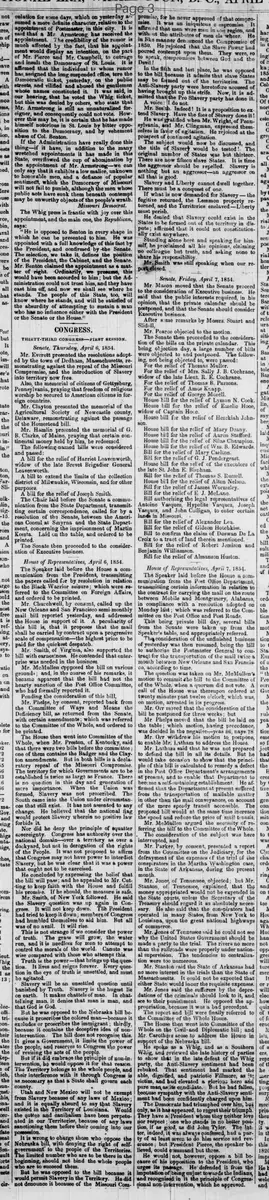
THIRTY-THIRD CONGRESS—FIRST SESSION.
Senate, Thursday, April 6, 1854.
Mr. Everett presented the resolutions adopted by the town of Dedham, Massachusetts, remonstrating against the repeal of the Missouri Compromise, and the introduction of Slavery into territory now free.
Also, the memorial of citizens of Gettysburg, Pennsylvania, praying that freedom of religious worship be secured to American citizens in foreign countries.
Mr. Clayton presented the memorial of the Agricultural Society of Newcastle county, Delaware, remonstrating against the passage of the Homestead bill.
Mr. Hamlin presented the memorial of G. B. Clarke, of Maine, praying that certain continental money held by him, be redeemed.
The following-named bills were considered and passed:
A bill for the relief of Harriet Leavenworth, widow of the late Brevet Brigadier General Leavenworth.
A bill to extend the limits of the collection district of Milwaukee, Wisconsin, and for other purposes.
A bill for the relief of Joseph Smith.
The Chair laid before the Senate a communication from the State Department, transmitting certain correspondence, called for by a resolution of the Senate, between the American Consul at Smyrna and the State Department, concerning the imprisonment of Martin Koszta. Laid on the table, and ordered to be printed.
The Senate then proceeded to the consideration of Executive business.
House of Representatives, April 6, 1854.
The Speaker laid before the House a communication from the President, transmitting the papers called for by resolution in relation to the Black Warrior seizure; which were referred to the Committee on Foreign Affairs and ordered to be printed.
Mr. Churchwell, by consent, called up the New Orleans and San Francisco semi-monthly mail bill reported yesterday, and addressed the House in support of it. A peculiarity of this bill is, that it proposes that the mail shall be carried by contract upon a progressive scale of compensation—the highest price to be paid for the quickest despatch.
Mr. Smith, of Virginia, also supported the bill with earnestness. He contended that enterprise was needed in the business.
Mr. McMullen opposed the bill on various grounds; and, in the course of his remarks, it became apparent that the bill had not the hearty sanction of the Post Office Committee who had formally reported it.
Pending the consideration of this bill, Mr. Phelps, by consent, reported back from the Committee of Ways and Means the Deficiency bill, as returned from the Senate with certain amendments; which was referred to the Committee of the Whole, and ordered to be printed.
The House then went into Committee of the Whole, when Mr. Preston, of Kentucky, said that there were two bills before the committee; one of them contains the Badger and the Clayton amendments. But in both bills is a declaratory repeal of the Missouri Compromise.
The territory for which Governments are to be established is twice as large as France. There is no question in this day and generation of more importance. When the Union was formed, Slavery was not proscribed. The South came into the Union under circumstances that still exist. It has not assented to any change. He believed that the national flag would protect Slavery wherein no positive law forbids it.
Nor did he deny the principle of squatter sovereignty. Congress has authority over the national domain—over a territory as over a dockyard, but not in derogation of the rights of the People. It was not proposed to affirm that Congress may not have power to interdict Slavery, but he was clear that it was a power that ought not to be exercised.
He concluded by expressing the belief that the bill will pass; and he appealed to Mr. Cutting to keep faith with the House and fulfill his promise. If he should, the measure is safe.
Mr. Smith, of New York followed. He said the Slavery question was up again in Congress. It will not keep down. The President had tried to keep it down; members of Congress had humbled themselves to aid him. But all was of no avail. It will rise.
This is not strange if we consider the power of truth. The grass will grow, the water run, and it is needless for men to attempt to control the morals of the world. Canute was wise compared with those who attempt this.
Truth is the power—that brings up the question. It lives and reigns forever. Every question in the eye of truth is unsettled, and must be agitated.
Slavery will be an unsettled question until banished by Truth. Slavery is the hugest lie on earth. It makes chattels of man. In chattelizing man, it denies that man is man, and that God is God.
But he was opposed to the Nebraska bill because it proscribes the colored man—because it excludes or proscribes the immigrant; thirdly, because it contains the deceptive idea of non-intervention. The bill does not recognise this. It gives a Government, it limits the power of the people, and reserves to Congress the power of revising the acts of the people.
But if it did embrace the principle of non-intervention, he would oppose it for that reason. The Territory belongs to the whole people, and their interference with it through Congress is as necessary as that a State shall govern each county.
Utah and New Mexico will not be exempt from Slavery because of any laws of Mexico; and it is equally absurd to say that Slavery existed in the Territory of Louisiana. Would the suttee and cannibalism have been perpetuated in our Territories, because of any laws sanctioning them before their coming into our possession.
It is wrong to charge those who oppose the Nebraska bill, with denying the right of self government to the people of the Territories. The limited number who are to be there in the beginning, should not bind the whole people who are to succeed them.
But he was opposed to the bill because it would permit Slavery in the Territory. He did not denounce it because of the Missouri Compromise, for he never approved of that compromise. It was an iniquitous compromise. It affirmed that men were men in one region, and without the attributes of men elsewhere. He in like manner denounced the Compromise of 1850. He rejoiced that the Slave Power had poured contempt upon them. They were, so to speak, compromises between God and the Devil!
In the fifth and last place, he was opposed to the bill because it admits that slave States may be formed out of the territories. The Anti-Slavery party were heretofore accused of having brought up this strife. Now, it is admitted that the Pro Slavery party has done it.
A voice: I do not.
Mr. Smith. Indeed! It is a proposition to extend Slavery. Have the foes of Slavery done it!
He was gratified when Mr. Wright, of Pennsylvania, and Mr. Clingman, expressed themselves in favor of agitation. He rejoiced at the prospect of continued agitation.
The subject would now be discussed, and the title of Slavery would be tested! The original number of States was but thirteen. There are now fifteen slave States. It is time the aggressor should be repelled. Slavery is nothing but an aggressor—an aggressor on all that is good.
Slavery and Liberty cannot dwell together. There must be a conquest of one.
If what is now demanded for Slavery—the fugitive returned, the Lemmon property returned, and the Territories enslaved—Liberty must perish.
He denied that Slavery could exist in the States to be formed out of the territory in dispute; affirmed that it could not constitutionally exist anywhere.
Standing alone here and speaking for himself, he proclaimed all his opinions, claiming no colleague but truth, and asking none to share his responsibility.
Mr. Smith was still speaking when our report closed.
What sub-type of article is it?
What keywords are associated?
What entities or persons were involved?
Where did it happen?
Domestic News Details
Primary Location
Washington, D.C.
Event Date
April 6, 1854
Key Persons
Outcome
bills passed in senate for relief of individuals and district extension; house debate on nebraska bill ongoing, with speeches supporting and opposing slavery extension; mail and deficiency bills discussed.
Event Details
The Senate presented memorials remonstrating against Missouri Compromise repeal, Homestead bill, and for religious freedom and money redemption; passed relief bills; received State Department communication on Martin Koszta. The House received presidential communication on Black Warrior; debated New Orleans-San Francisco mail bill; considered deficiency bill; in Committee of the Whole, debated Nebraska bill with Mr. Preston supporting and Mr. Smith opposing slavery extension.