Thank you for visiting SNEWPapers!
Sign up free
Literary
June 7, 1806
Herald Of The United States
Warren, Bristol County, Rhode Island
What is this article about?
In this Eastern moral tale, simple shepherd's daughter Fatima envies the luxurious life of the vizier's favorite Semira. A genii Nouradin grants her transformations to experience wealth and power as vizier's favorite then empress, but each brings misery. She learns the vanity of human wishes and returns content to her humble origins.
Clipping
OCR Quality
98%
Excellent
Full Text
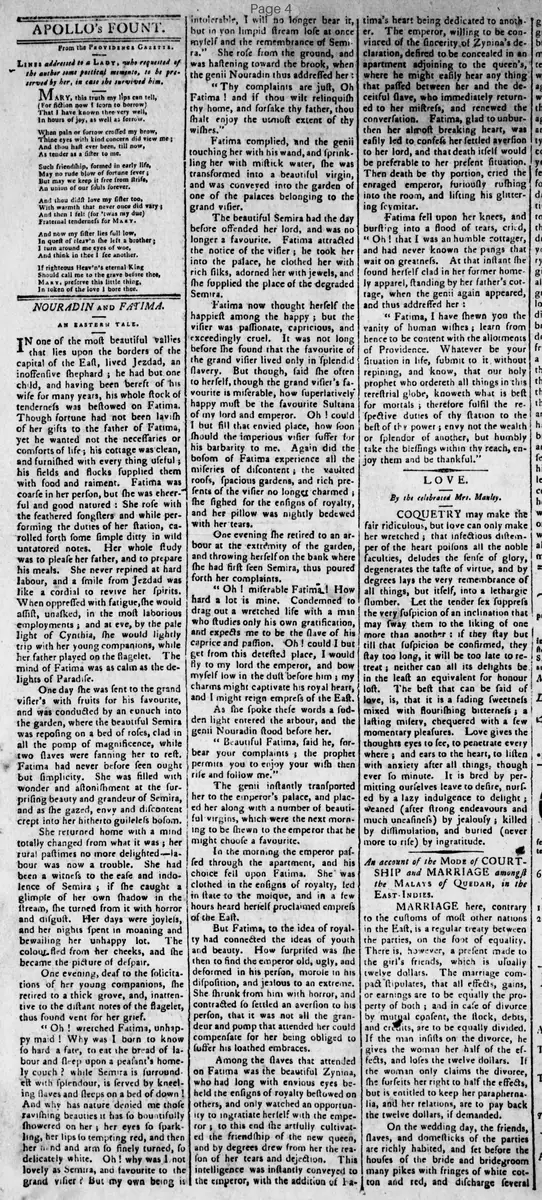
NOURADIN AND FATIMA.
AN EASTERN TALE.
In one of the most beautiful valleys that lies upon the borders of the capital of the East, lived Jezdad, an inoffensive shepherd: he had but one child, and having been bereft of his wife for many years, his whole stock of tenderness was bestowed on Fatima.
Though fortune had not been lavish of her gifts to the father of Fatima, yet he wanted not the necessaries or comforts of life; his cottage was clean, and furnished with every thing useful; his fields and flocks supplied them with food and raiment. Fatima was coarse in her person, but she was cheerful and good natured: She rose with the feathered songsters and while performing the duties of her station, carolled forth some simple ditty in wild untutored notes. Her whole study was to please her father, and to prepare his meals. She never repined at hard labour, and a smile from Jezdad was like a cordial to revive her spirits.
When oppressed with fatigue, she would sit, unasked, in the most laborious employments; and at eve, by the pale light of Cynthia, She would lightly trip with her young companions, while her father played on the flageolet. The mind of Fatima was as calm as the delights of Paradise.
One day She was sent to the grand vizier's with fruits for his favourite, and was conducted by an eunuch into the garden, where the beautiful Semira was reposing on a bed of roses, clad in all the pomp of magnificence, while two slaves were fanning her to rest.
Fatima had never before seen ought but simplicity. She was filled with wonder and astonishment at the surprising beauty and grandeur of Semira, and as she gazed, envy and discontent crept into her hitherto guileless bosom.
She returned home with a mind totally changed from what it was; her rural pastimes no more delighted--labour was now a trouble. She had been a witness to the ease and indolence of Semira: if she caught a glimpse of her own shadow in the stream, she turned from it with horror and disgust. Her days were joyless, and her nights spent in moaning and bewailing her unhappy lot. The colour fled from her cheeks, and she became the picture of despair.
One evening, deaf to the solicitations of her young companions, she retired to a thick grove, and, inattentive to the distant notes of the flageolet, thus found vent for her grief.
"Oh! wretched Fatima, unhappy maid! Why was I born to know so hard a fate, to eat the bread of labour and sleep upon a peasant's homely couch? while Semira is surrounded with splendour, is served by kneeling slaves and sleeps on a bed of down!
And why has nature denied me those ravishing beauties it has so bountifully showered on her; her eyes so sparkling, her lips so tempting red, and then her neck and arm so finely turned, so delicately white. Oh! why was I not lovely as Semira, and favourite to the grand vizier? But my own being is intolerable, I will no longer bear it, but in yon limpid stream lose at once myself and the remembrance of Semira." She rose from the ground, and was hastening toward the brook, when the genii Nouradin thus addressed her:
"Thy complaints are just, Oh Fatima! and if thou wilt relinquish thy home, and forsake thy father, thou shalt enjoy the utmost extent of thy wishes."
Fatima complied, and the genii touching her with his wand, and sprinkling her with mystic water, she was transformed into a beautiful virgin, and was conveyed into the garden of one of the palaces belonging to the grand vizier.
The beautiful Semira had the day before offended her lord, and was no longer a favourite. Fatima attracted the notice of the vizier; he took her into the palace, he clothed her with rich silks, adorned her with jewels, and She supplied the place of the degraded Semira.
Fatima now thought herself the happiest among the happy; but the vizier was passionate, capricious, and exceedingly cruel. It was not long before she found that the favourite of the grand vizier lived only in splendid slavery. But though, said she often to herself, though the grand vizier's favourite is miserable, how superlatively happy must be the favourite Sultana of my lord and emperor. Oh! could I but fill that envied place, how soon should the imperious vizier suffer for his barbarity to me. Again did the bosom of Fatima experience all the miseries of discontent; the vaulted roofs, spacious gardens, and rich presents of the vizier no longer charmed; she sighed for the ensigns of royalty, and her pillow was nightly bedewed with her tears.
One evening She retired to an arbour at the extremity of the garden, and throwing herself on the bank where she had first seen Semira, thus poured forth her complaints.
"Oh! miserable Fatima! How hard a lot is mine. Condemned to drag out a wretched life with a man who studies only his own gratification, and expects me to be the slave of his caprice and passion. Oh! could I but get from this detested place, I would fly to my lord the emperor, and bow myself low in the dust before him; my charms might captivate his royal heart, and I might reign empress of the East."
As she spoke these words a golden light covered the arbour, and the genii Nouradin stood before her.
"Beautiful Fatima, said he, forbear your complaints; the prophet permits you to enjoy your wish then rise and follow me."
The genii instantly transported her to the emperor's palace, and placed her along with a number of beautiful virgins, which were the next morning to be shewn to the emperor that he might choose a favourite.
In the morning the emperor passed through the apartment, and his choice fell upon Fatima. She was clothed in the ensigns of royalty: led in state to the mosque, and in a few hours heard herself proclaimed empress of the East.
But Fatima, to the idea of royalty had connected the ideas of youth and beauty. How surprised was she then to find the emperor old, ugly, and deformed in his person, morose in his disposition, and jealous to an extreme.
She shrunk from him with horror, and contracted so settled an aversion to his person, that it was not all the grandeur and pomp that attended her could compensate for her being obliged to suffer his loathed embraces.
Among the slaves that attended on Fatima was the beautiful Zynina, who had long with envious eyes beheld the ensigns of royalty bestowed on others, and only watched an opportunity to ingratiate herself with the emperor; to this end she artfully cultivated the friendship of the new queen, and by degrees drew from her the reason of her tears and dejection. This intelligence was instantly conveyed to the emperor, with the addition of Fatima's heart being dedicated to another. The emperor, willing to be convinced of the sincerity of Zynina's declaration, desired to be concealed in an apartment adjoining to the queen's, where he might easily hear any thing that passed between her and the deceitful slave, who immediately returned to her mistress, and renewed the conversation. Fatima, glad to unburden her almost breaking heart, was easily led to confess her settled aversion to her lord, and that death itself would be preferable to her present situation.
Then death be thy portion, cried the enraged emperor, furiously rushing into the room, and lifting his glittering scymitar.
Fatima fell upon her knees, and bursting into a flood of tears, cried,
"Oh! that I was an humble cottager, and had never known the perils that wait on greatness." At that instant she found herself clad in her former homely apparel, standing by her father's cottage, when the genii again appeared, and thus addressed her:
"Fatima, I have shewn you the vanity of human wishes; learn from hence to be content with the allotments of Providence. Whatever be your situation in life, submit to it, without repining, and know, that our holy prophet who ordereth all things in this terrestrial globe, knoweth what is best for mortals; therefore fulfil the respective duties of thy station to the best of thy power; envy not the wealth or splendour of another, but humbly take the blessings within thy reach, enjoy them and be thankful."
AN EASTERN TALE.
In one of the most beautiful valleys that lies upon the borders of the capital of the East, lived Jezdad, an inoffensive shepherd: he had but one child, and having been bereft of his wife for many years, his whole stock of tenderness was bestowed on Fatima.
Though fortune had not been lavish of her gifts to the father of Fatima, yet he wanted not the necessaries or comforts of life; his cottage was clean, and furnished with every thing useful; his fields and flocks supplied them with food and raiment. Fatima was coarse in her person, but she was cheerful and good natured: She rose with the feathered songsters and while performing the duties of her station, carolled forth some simple ditty in wild untutored notes. Her whole study was to please her father, and to prepare his meals. She never repined at hard labour, and a smile from Jezdad was like a cordial to revive her spirits.
When oppressed with fatigue, she would sit, unasked, in the most laborious employments; and at eve, by the pale light of Cynthia, She would lightly trip with her young companions, while her father played on the flageolet. The mind of Fatima was as calm as the delights of Paradise.
One day She was sent to the grand vizier's with fruits for his favourite, and was conducted by an eunuch into the garden, where the beautiful Semira was reposing on a bed of roses, clad in all the pomp of magnificence, while two slaves were fanning her to rest.
Fatima had never before seen ought but simplicity. She was filled with wonder and astonishment at the surprising beauty and grandeur of Semira, and as she gazed, envy and discontent crept into her hitherto guileless bosom.
She returned home with a mind totally changed from what it was; her rural pastimes no more delighted--labour was now a trouble. She had been a witness to the ease and indolence of Semira: if she caught a glimpse of her own shadow in the stream, she turned from it with horror and disgust. Her days were joyless, and her nights spent in moaning and bewailing her unhappy lot. The colour fled from her cheeks, and she became the picture of despair.
One evening, deaf to the solicitations of her young companions, she retired to a thick grove, and, inattentive to the distant notes of the flageolet, thus found vent for her grief.
"Oh! wretched Fatima, unhappy maid! Why was I born to know so hard a fate, to eat the bread of labour and sleep upon a peasant's homely couch? while Semira is surrounded with splendour, is served by kneeling slaves and sleeps on a bed of down!
And why has nature denied me those ravishing beauties it has so bountifully showered on her; her eyes so sparkling, her lips so tempting red, and then her neck and arm so finely turned, so delicately white. Oh! why was I not lovely as Semira, and favourite to the grand vizier? But my own being is intolerable, I will no longer bear it, but in yon limpid stream lose at once myself and the remembrance of Semira." She rose from the ground, and was hastening toward the brook, when the genii Nouradin thus addressed her:
"Thy complaints are just, Oh Fatima! and if thou wilt relinquish thy home, and forsake thy father, thou shalt enjoy the utmost extent of thy wishes."
Fatima complied, and the genii touching her with his wand, and sprinkling her with mystic water, she was transformed into a beautiful virgin, and was conveyed into the garden of one of the palaces belonging to the grand vizier.
The beautiful Semira had the day before offended her lord, and was no longer a favourite. Fatima attracted the notice of the vizier; he took her into the palace, he clothed her with rich silks, adorned her with jewels, and She supplied the place of the degraded Semira.
Fatima now thought herself the happiest among the happy; but the vizier was passionate, capricious, and exceedingly cruel. It was not long before she found that the favourite of the grand vizier lived only in splendid slavery. But though, said she often to herself, though the grand vizier's favourite is miserable, how superlatively happy must be the favourite Sultana of my lord and emperor. Oh! could I but fill that envied place, how soon should the imperious vizier suffer for his barbarity to me. Again did the bosom of Fatima experience all the miseries of discontent; the vaulted roofs, spacious gardens, and rich presents of the vizier no longer charmed; she sighed for the ensigns of royalty, and her pillow was nightly bedewed with her tears.
One evening She retired to an arbour at the extremity of the garden, and throwing herself on the bank where she had first seen Semira, thus poured forth her complaints.
"Oh! miserable Fatima! How hard a lot is mine. Condemned to drag out a wretched life with a man who studies only his own gratification, and expects me to be the slave of his caprice and passion. Oh! could I but get from this detested place, I would fly to my lord the emperor, and bow myself low in the dust before him; my charms might captivate his royal heart, and I might reign empress of the East."
As she spoke these words a golden light covered the arbour, and the genii Nouradin stood before her.
"Beautiful Fatima, said he, forbear your complaints; the prophet permits you to enjoy your wish then rise and follow me."
The genii instantly transported her to the emperor's palace, and placed her along with a number of beautiful virgins, which were the next morning to be shewn to the emperor that he might choose a favourite.
In the morning the emperor passed through the apartment, and his choice fell upon Fatima. She was clothed in the ensigns of royalty: led in state to the mosque, and in a few hours heard herself proclaimed empress of the East.
But Fatima, to the idea of royalty had connected the ideas of youth and beauty. How surprised was she then to find the emperor old, ugly, and deformed in his person, morose in his disposition, and jealous to an extreme.
She shrunk from him with horror, and contracted so settled an aversion to his person, that it was not all the grandeur and pomp that attended her could compensate for her being obliged to suffer his loathed embraces.
Among the slaves that attended on Fatima was the beautiful Zynina, who had long with envious eyes beheld the ensigns of royalty bestowed on others, and only watched an opportunity to ingratiate herself with the emperor; to this end she artfully cultivated the friendship of the new queen, and by degrees drew from her the reason of her tears and dejection. This intelligence was instantly conveyed to the emperor, with the addition of Fatima's heart being dedicated to another. The emperor, willing to be convinced of the sincerity of Zynina's declaration, desired to be concealed in an apartment adjoining to the queen's, where he might easily hear any thing that passed between her and the deceitful slave, who immediately returned to her mistress, and renewed the conversation. Fatima, glad to unburden her almost breaking heart, was easily led to confess her settled aversion to her lord, and that death itself would be preferable to her present situation.
Then death be thy portion, cried the enraged emperor, furiously rushing into the room, and lifting his glittering scymitar.
Fatima fell upon her knees, and bursting into a flood of tears, cried,
"Oh! that I was an humble cottager, and had never known the perils that wait on greatness." At that instant she found herself clad in her former homely apparel, standing by her father's cottage, when the genii again appeared, and thus addressed her:
"Fatima, I have shewn you the vanity of human wishes; learn from hence to be content with the allotments of Providence. Whatever be your situation in life, submit to it, without repining, and know, that our holy prophet who ordereth all things in this terrestrial globe, knoweth what is best for mortals; therefore fulfil the respective duties of thy station to the best of thy power; envy not the wealth or splendour of another, but humbly take the blessings within thy reach, enjoy them and be thankful."
What sub-type of article is it?
Prose Fiction
Fable
Allegory
What themes does it cover?
Moral Virtue
What keywords are associated?
Eastern Tale
Moral Fable
Contentment
Envy
Genii Transformation
Vanity Of Wishes
Shepherds Daughter
Literary Details
Title
Nouradin And Fatima. An Eastern Tale.
Subject
The Vanity Of Human Wishes And The Value Of Contentment
Key Lines
"Oh! Wretched Fatima, Unhappy Maid! Why Was I Born To Know So Hard A Fate, To Eat The Bread Of Labour And Sleep Upon A Peasant's Homely Couch? While Semira Is Surrounded With Splendour, Is Served By Kneeling Slaves And Sleeps On A Bed Of Down!"
"Fatima, I Have Shewn You The Vanity Of Human Wishes; Learn From Hence To Be Content With The Allotments Of Providence. Whatever Be Your Situation In Life, Submit To It, Without Repining, And Know, That Our Holy Prophet Who Ordereth All Things In This Terrestrial Globe, Knoweth What Is Best For Mortals; Therefore Fulfil The Respective Duties Of Thy Station To The Best Of Thy Power; Envy Not The Wealth Or Splendour Of Another, But Humbly Take The Blessings Within Thy Reach, Enjoy Them And Be Thankful."