Thank you for visiting SNEWPapers!
Sign up free
The Times News
Hendersonville, Henderson County, North Carolina
What is this article about?
Bruce Catton's article assesses U.S. economic advances in the first half of 1937, with rising industrial output and employment amid the Great Depression, offset by massive strikes causing significant losses. Wonders about faster recovery without labor conflicts. (214 characters)
Clipping
OCR Quality
Full Text
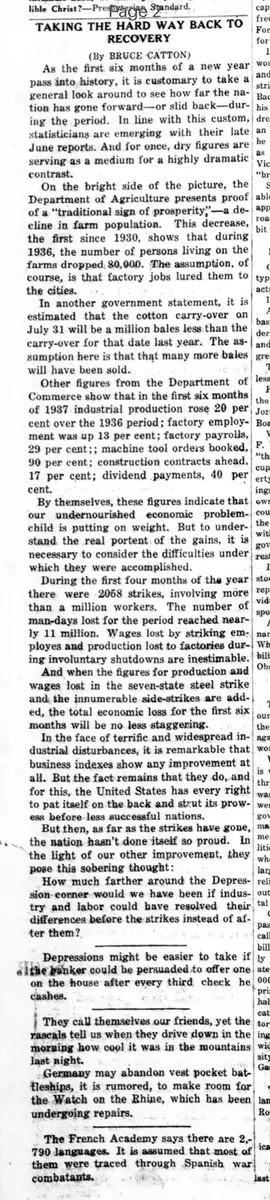
(By BRUCE CATTON)
As the first six months of a new year pass into history, it is customary to take a general look around to see how far the nation has gone forward—or slid back—during the period. In line with this custom, statisticians are emerging with their late June reports. And for once, dry figures are serving as a medium for a highly dramatic contrast.
On the bright side of the picture, the Department of Agriculture presents proof of a "traditional sign of prosperity"—a decline in farm population. This decrease, the first since 1930, shows that during 1936, the number of persons living on the farms dropped 80,000. The assumption, of course, is that factory jobs lured them to the cities.
In another government statement, it is estimated that the cotton carry-over on July 31 will be a million bales less than the carry-over for that date last year. The assumption here is that that many more bales will have been sold.
Other figures from the Department of Commerce show that in the first six months of 1937 industrial production rose 20 per cent over the 1936 period; factory employment was up 13 per cent; factory payrolls, 29 per cent; machine tool orders booked, 90 per cent; construction contracts ahead, 17 per cent; dividend payments, 40 per cent.
By themselves, these figures indicate that our undernourished economic problem-child is putting on weight. But to understand the real portent of the gains, it is necessary to consider the difficulties under which they were accomplished.
During the first four months of the year there were 2058 strikes, involving more than a million workers. The number of man-days lost for the period reached nearly 11 million. Wages lost by striking employees and production lost to factories during involuntary shutdowns are inestimable.
And when the figures for production and wages lost in the seven-state steel strike and the innumerable side-strikes are added, the total economic loss for the first six months will be no less staggering.
In the face of terrific and widespread industrial disturbances, it is remarkable that business indexes show any improvement at all. But the fact remains that they do, and for this, the United States has every right to pat itself on the back and strut its prowess before less successful nations.
But then, as far as the strikes have gone, the nation hasn't done itself so proud. In the light of our other improvement, they pose this sobering thought:
How much farther around the Depression-corner would we have been if industry and labor could have resolved their differences before the strikes instead of after them?
Depressions might be easier to take if the banker could be persuaded to offer one on the house after every third check he cashes.
They call themselves our friends, yet the rascals tell us when they drive down in the morning how cool it was in the mountains last night.
Germany may abandon vest pocket battleships, it is rumored, to make room for the Watch on the Rhine, which has been undergoing repairs.
The French Academy says there are 2,790 languages. It is assumed that most of them were traced through Spanish war combatants.
What sub-type of article is it?
What themes does it cover?
What keywords are associated?
Where did it happen?
Story Details
Location
United States
Event Date
First Six Months Of 1937
Story Details
Article examines U.S. economic recovery in early 1937, citing declines in farm population and cotton carry-over as prosperity signs, alongside rises in industrial production, employment, and payrolls. Contrasts these gains with losses from over 2,000 strikes involving a million workers, questioning progress without labor disputes. Includes humorous asides on depressions, friends, Germany, and languages.