Thank you for visiting SNEWPapers!
Sign up free
Literary
June 20, 1789
Gazette Of The United States
New York, New York County, New York
What is this article about?
This essay continuation examines Roman history, focusing on Manlius Capitolinus's trial and execution as a critique of aristocracy. It argues against simple aristocracy, highlighting envy, corruption, and threats to liberty, using Livy's account to warn of factionalism in assemblies.
Clipping
OCR Quality
98%
Excellent
Full Text
The Right Constitution of a Common Wealth Examined.
Continued from our last.
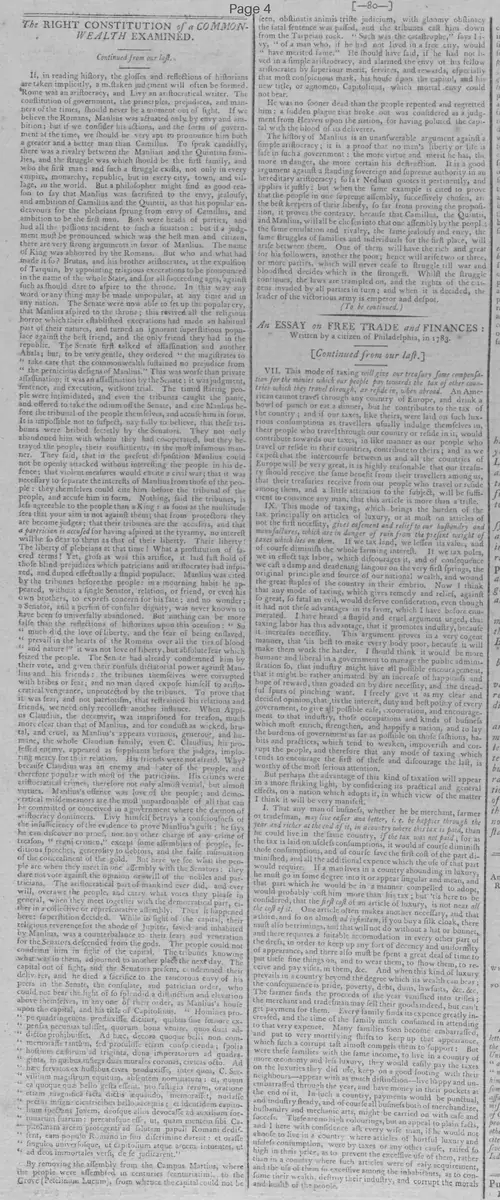
If, in reading history, the glofes and reflections of historians are taken implicitly, a mis-taken judgment will often be formed. Rome was an aristocracy, and Livy an aristocratical writer. The constitution of government, the principles, prejudices, and manners of the times, should never be a moment out of sight. If we believe the Romans, Manlius was actuated only by envy and ambition; but if we consider his actions, and the form of government at the time, we should be very apt to pronounce him both a greater and a better man than Camillus. To speak candidly, there was a rivalry between the Manlian and the Quintian families, and the struggle was which should be the first family, and who the first man: and such a struggle exists, not only in every empire, monarchy, republic, but in every city, town, and village, in the world. But a philosopher might find as good reason to say that Manlius was sacrificed to the envy, jealousy, and ambition of Camillus and the Quintii, as that his popular endeavours for the plebeians sprang from envy of Camillus, and ambition to be the first man. Both were heads of parties, and had all the passions incident to such a situation: but if a judgment must be pronounced which was the best man and citizen, there are very strong arguments in favor of Manlius. The name of King was abhorred by the Romans. But who and what had made it so? Brutus, and his brother aristocrates, at the expulsion of Tarquin, by appointing religious execrations to be pronounced in the name of the whole State, and for all succeeding ages, against such as should dare to aspire to the throne. In this way any word or any thing may be made unpopular, at any time and in any nation. The Senate were now able to set up the popular cry, that Manlius aspired to the throne; this revived all the religious horror which their established execrations had made an habitual part of their natures, and turned an ignorant superstitious populace against the best friend, and the only friend they had in the republic. The Senate first talked of assassination and another Ahala; but, to be very gentle, they ordered "the magistrates to take care that the commonwealth sustained no prejudice from the pernicious designs of Manlius." This was worse than private assassination; it was an assassination by the Senate: it was judgment, sentence, and execution, without trial. The timid staring people were intimidated, and even the tribunes caught the panic, and offered to take the odium off the Senate, and cite Manlius before the tribunal of the people themselves, and accuse him in form. It is impossible not to suspect, nay fully to believe, that these tribunes were bribed secretly by the Senators. They not only abandoned him with whom they had co-operated, but they betrayed the people, their constituents, in the most infamous manner. They said, that in the present disposition Manlius could not be openly attacked without interesting the people in his defence; that violent measures would excite a civil war; that it was necessary to separate the interests of Manlius from those of the people: they themselves could cite him before the tribunal of the people, and accuse him in form. Nothing, said the tribunes, is less agreeable to the people than a King: as soon as the multitude sees that your aim is not against them; that from protectors they are become judges; that their tribunes are the accusers, and that a patrician is accused for having aspired at the tyranny, no interest will be so dear to them as that of their liberty. Their liberty: The liberty of plebeians at that time! What a prostitution of sacred terms! Yet, gross as was this artifice, it laid fast hold of those blind prejudices which patricians and aristocrates had inspired, and duped effectually a stupid populace. Manlius was cited by the tribunes before the people: in a mourning habit he appeared, without a single Senator, relation, or friend, or even his own brothers, to express concern for his fate: and no wonder; a Senator, and a person of consular dignity, was never known to have been so universally abandoned. But nothing can be more false than the reflections of historians upon this occasion: "So much did the love of liberty, and the fear of being enslaved, prevail in the hearts of the Romans over all the ties of blood and nature!" it was not love of liberty, but absolute fear which seized the people. The Senate had already condemned him by their vote, and given their consuls dictatorial power against Manlius and his friends: the tribunes themselves were corrupted with bribes or fear; and no man dared expose himself to aristocratical vengeance, unprotected by the tribunes. To prove that it was fear, and not patriotism, that restrained his relations and friends, we need only recollect another instance. When Appius Claudius, the decemvir, was imprisoned for treason, much more clear than that of Manlius, and for conduct as wicked, brutal, and cruel, as Manlius's appears virtuous, generous, and humane, the whole Claudian family, even C. Claudius, his professed enemy, appeared as suppliants before the judges, imploring mercy for their relation. His friends were not afraid. Why? because Claudius was an enemy and hater of the people, and therefore popular with most of the patricians. His crimes were aristocratical crimes, therefore not only almost venial, but almost virtues. Manlius's offence was love of the people; and democratical misdemeanors are the most unpardonable of all that can be committed or conceived in a government where the daemon of aristocracy domineers. Livy himself betrays a consciousness of the insufficiency of the evidence to prove Manlius's guilt: he says he can discover no proof, nor any other charge of any crime of treason, "regni crimen," except some assemblies of people, seditious speeches, generosity to debtors, and the false insinuation of the concealment of the gold. But here we see what the people are when they meet in one assembly with the Senators: they dare not vote against the opinion or will of the nobles and patricians. The aristocratical part of mankind ever did, and ever will, overawe the people, and carry what votes they please in general, when they meet together with the democratical part, either in a collective or representative assembly. Thus it happened here: superstition decided. While in sight of the capital, their religious reverence for the abode of Jupiter, saved and inhabited by Manlius, was a counterbalance to their fears and veneration for the Senators descended from the gods. The people could not condemn him in sight of the capital. The tribunes knowing what was in them, adjourned to another place the next day. The capital out of sight, and the Senators present, condemned their deliverer, and he died a sacrifice to the rancorous envy of his peers in the Senate, the consulate, and patrician order, who could not bear the sight of so splendid a distinction and elevation above themselves, in any one of their order, as Manlius's house upon the capital, and his title of Capitolinus. "Homines prope quadringentos produxie dicitur, quibus sine faenore expensas pecunias tulisset, quorum bona venire, quos duci ad dictos prohibuisset. Ad haec, decora quoque belli non commemoratae tantum, sed protulisse etiam conpicienda; polia hostium captorum ad triginta, dona imperatorum ad quadraginta, in quibus inters duas murales coronas, civicas octo. Ad haec servatos ex hostibus cives produxie, inter quos, C. Servilium magistrum equitum, absentem nominatum: et, quum ea quoque qua bello gesta essent, pro fastigio rerum, oratione etiam magnificentâ facta dictis aequando, memorasset, nudae pectus insigni cicatricibus bello acceptis; et identidem capitolium inspectans Jovem, deoque alios devocans ad auxilium fortunarum suarum: precatusque eos, ut, quam mentem ibi Capitolium arcem protegenti ad salutem populi Romani dedissent, eam populo Romano in suo discrimine darent: et orans singulos universosque, ut capitolium atque arcem intuentes, ut ad deos immortales versî, de se judicarent."
By removing the assembly from the Campus Martius, where the people were assembled in centuries (centuriatim), to the Grove (Petelinum Lucum), from whence the capital could not be seen, obstinatis animis trite judicium, with gloomy obstinacy the fatal sentence was passed, and the tribunes cast him down from the Tarpeian rock. "Such was the catastrophe," says Livy, "of a man who, if he had not lived in a free city, would have merited fame." He should have said, if he had not lived in a simple aristocracy, and alarmed the envy of his fellow aristocrates by superior merit, services, and rewards, especially that most conspicuous mark, his house upon the capitol, and his new title, or agnomen, Capitolinus, which mortal envy could not bear.
He was no sooner dead than the people repented and regretted him: a sudden plague that broke out was considered as a judgment from Heaven upon the nation, for having polluted the capital with the blood of its deliverer.
The history of Manlius is an unanswerable argument against a simple aristocracy; it is a proof that no man's liberty or life is safe in such a government: the more virtue and merit he has, the more in danger, the more certain his destruction. It is a good argument against a standing sovereign and supreme authority in an hereditary aristocracy; so far Nedham quotes it pertinently, and applies it justly: but when the same example is cited to prove that the people in one supreme assembly, successively chosen, are the best keepers of their liberty, so far from proving the proposition, it proves the contrary, because that Camillus, the Quinti, and Manlius, will all be chosen into that one assembly by the people; the same emulation and rivalry, the same jealousy and envy, the same struggles of families and individuals for the first place, will arise between them. One of them will have the rich and great for his followers, another the poor; hence will arise two or three, or more parties, which will never cease to struggle till war and bloodshed decides which is the strongest. Whilst the struggle continues, the laws are trampled on, and the rights of the citizens invaded by all parties in turn; and when it is decided, the leader of the victorious army is emperor and despot.
(To be continued.)
Continued from our last.
If, in reading history, the glofes and reflections of historians are taken implicitly, a mis-taken judgment will often be formed. Rome was an aristocracy, and Livy an aristocratical writer. The constitution of government, the principles, prejudices, and manners of the times, should never be a moment out of sight. If we believe the Romans, Manlius was actuated only by envy and ambition; but if we consider his actions, and the form of government at the time, we should be very apt to pronounce him both a greater and a better man than Camillus. To speak candidly, there was a rivalry between the Manlian and the Quintian families, and the struggle was which should be the first family, and who the first man: and such a struggle exists, not only in every empire, monarchy, republic, but in every city, town, and village, in the world. But a philosopher might find as good reason to say that Manlius was sacrificed to the envy, jealousy, and ambition of Camillus and the Quintii, as that his popular endeavours for the plebeians sprang from envy of Camillus, and ambition to be the first man. Both were heads of parties, and had all the passions incident to such a situation: but if a judgment must be pronounced which was the best man and citizen, there are very strong arguments in favor of Manlius. The name of King was abhorred by the Romans. But who and what had made it so? Brutus, and his brother aristocrates, at the expulsion of Tarquin, by appointing religious execrations to be pronounced in the name of the whole State, and for all succeeding ages, against such as should dare to aspire to the throne. In this way any word or any thing may be made unpopular, at any time and in any nation. The Senate were now able to set up the popular cry, that Manlius aspired to the throne; this revived all the religious horror which their established execrations had made an habitual part of their natures, and turned an ignorant superstitious populace against the best friend, and the only friend they had in the republic. The Senate first talked of assassination and another Ahala; but, to be very gentle, they ordered "the magistrates to take care that the commonwealth sustained no prejudice from the pernicious designs of Manlius." This was worse than private assassination; it was an assassination by the Senate: it was judgment, sentence, and execution, without trial. The timid staring people were intimidated, and even the tribunes caught the panic, and offered to take the odium off the Senate, and cite Manlius before the tribunal of the people themselves, and accuse him in form. It is impossible not to suspect, nay fully to believe, that these tribunes were bribed secretly by the Senators. They not only abandoned him with whom they had co-operated, but they betrayed the people, their constituents, in the most infamous manner. They said, that in the present disposition Manlius could not be openly attacked without interesting the people in his defence; that violent measures would excite a civil war; that it was necessary to separate the interests of Manlius from those of the people: they themselves could cite him before the tribunal of the people, and accuse him in form. Nothing, said the tribunes, is less agreeable to the people than a King: as soon as the multitude sees that your aim is not against them; that from protectors they are become judges; that their tribunes are the accusers, and that a patrician is accused for having aspired at the tyranny, no interest will be so dear to them as that of their liberty. Their liberty: The liberty of plebeians at that time! What a prostitution of sacred terms! Yet, gross as was this artifice, it laid fast hold of those blind prejudices which patricians and aristocrates had inspired, and duped effectually a stupid populace. Manlius was cited by the tribunes before the people: in a mourning habit he appeared, without a single Senator, relation, or friend, or even his own brothers, to express concern for his fate: and no wonder; a Senator, and a person of consular dignity, was never known to have been so universally abandoned. But nothing can be more false than the reflections of historians upon this occasion: "So much did the love of liberty, and the fear of being enslaved, prevail in the hearts of the Romans over all the ties of blood and nature!" it was not love of liberty, but absolute fear which seized the people. The Senate had already condemned him by their vote, and given their consuls dictatorial power against Manlius and his friends: the tribunes themselves were corrupted with bribes or fear; and no man dared expose himself to aristocratical vengeance, unprotected by the tribunes. To prove that it was fear, and not patriotism, that restrained his relations and friends, we need only recollect another instance. When Appius Claudius, the decemvir, was imprisoned for treason, much more clear than that of Manlius, and for conduct as wicked, brutal, and cruel, as Manlius's appears virtuous, generous, and humane, the whole Claudian family, even C. Claudius, his professed enemy, appeared as suppliants before the judges, imploring mercy for their relation. His friends were not afraid. Why? because Claudius was an enemy and hater of the people, and therefore popular with most of the patricians. His crimes were aristocratical crimes, therefore not only almost venial, but almost virtues. Manlius's offence was love of the people; and democratical misdemeanors are the most unpardonable of all that can be committed or conceived in a government where the daemon of aristocracy domineers. Livy himself betrays a consciousness of the insufficiency of the evidence to prove Manlius's guilt: he says he can discover no proof, nor any other charge of any crime of treason, "regni crimen," except some assemblies of people, seditious speeches, generosity to debtors, and the false insinuation of the concealment of the gold. But here we see what the people are when they meet in one assembly with the Senators: they dare not vote against the opinion or will of the nobles and patricians. The aristocratical part of mankind ever did, and ever will, overawe the people, and carry what votes they please in general, when they meet together with the democratical part, either in a collective or representative assembly. Thus it happened here: superstition decided. While in sight of the capital, their religious reverence for the abode of Jupiter, saved and inhabited by Manlius, was a counterbalance to their fears and veneration for the Senators descended from the gods. The people could not condemn him in sight of the capital. The tribunes knowing what was in them, adjourned to another place the next day. The capital out of sight, and the Senators present, condemned their deliverer, and he died a sacrifice to the rancorous envy of his peers in the Senate, the consulate, and patrician order, who could not bear the sight of so splendid a distinction and elevation above themselves, in any one of their order, as Manlius's house upon the capital, and his title of Capitolinus. "Homines prope quadringentos produxie dicitur, quibus sine faenore expensas pecunias tulisset, quorum bona venire, quos duci ad dictos prohibuisset. Ad haec, decora quoque belli non commemoratae tantum, sed protulisse etiam conpicienda; polia hostium captorum ad triginta, dona imperatorum ad quadraginta, in quibus inters duas murales coronas, civicas octo. Ad haec servatos ex hostibus cives produxie, inter quos, C. Servilium magistrum equitum, absentem nominatum: et, quum ea quoque qua bello gesta essent, pro fastigio rerum, oratione etiam magnificentâ facta dictis aequando, memorasset, nudae pectus insigni cicatricibus bello acceptis; et identidem capitolium inspectans Jovem, deoque alios devocans ad auxilium fortunarum suarum: precatusque eos, ut, quam mentem ibi Capitolium arcem protegenti ad salutem populi Romani dedissent, eam populo Romano in suo discrimine darent: et orans singulos universosque, ut capitolium atque arcem intuentes, ut ad deos immortales versî, de se judicarent."
By removing the assembly from the Campus Martius, where the people were assembled in centuries (centuriatim), to the Grove (Petelinum Lucum), from whence the capital could not be seen, obstinatis animis trite judicium, with gloomy obstinacy the fatal sentence was passed, and the tribunes cast him down from the Tarpeian rock. "Such was the catastrophe," says Livy, "of a man who, if he had not lived in a free city, would have merited fame." He should have said, if he had not lived in a simple aristocracy, and alarmed the envy of his fellow aristocrates by superior merit, services, and rewards, especially that most conspicuous mark, his house upon the capitol, and his new title, or agnomen, Capitolinus, which mortal envy could not bear.
He was no sooner dead than the people repented and regretted him: a sudden plague that broke out was considered as a judgment from Heaven upon the nation, for having polluted the capital with the blood of its deliverer.
The history of Manlius is an unanswerable argument against a simple aristocracy; it is a proof that no man's liberty or life is safe in such a government: the more virtue and merit he has, the more in danger, the more certain his destruction. It is a good argument against a standing sovereign and supreme authority in an hereditary aristocracy; so far Nedham quotes it pertinently, and applies it justly: but when the same example is cited to prove that the people in one supreme assembly, successively chosen, are the best keepers of their liberty, so far from proving the proposition, it proves the contrary, because that Camillus, the Quinti, and Manlius, will all be chosen into that one assembly by the people; the same emulation and rivalry, the same jealousy and envy, the same struggles of families and individuals for the first place, will arise between them. One of them will have the rich and great for his followers, another the poor; hence will arise two or three, or more parties, which will never cease to struggle till war and bloodshed decides which is the strongest. Whilst the struggle continues, the laws are trampled on, and the rights of the citizens invaded by all parties in turn; and when it is decided, the leader of the victorious army is emperor and despot.
(To be continued.)
What sub-type of article is it?
Essay
What themes does it cover?
Political
Liberty Freedom
What keywords are associated?
Aristocracy
Roman History
Manlius Capitolinus
Camillus
Liberty
Senate
Tribunes
Political Rivalry
Envy
Government Constitution
Literary Details
Title
The Right Constitution Of A Common Wealth Examined.
Key Lines
The History Of Manlius Is An Unanswerable Argument Against A Simple Aristocracy; It Is A Proof That No Man's Liberty Or Life Is Safe In Such A Government: The More Virtue And Merit He Has, The More In Danger, The More Certain His Destruction.
"Such Was The Catastrophe," Says Livy, "Of A Man Who, If He Had Not Lived In A Free City, Would Have Merited Fame." He Should Have Said, If He Had Not Lived In A Simple Aristocracy, And Alarmed The Envy Of His Fellow Aristocrates By Superior Merit, Services, And Rewards, Especially That Most Conspicuous Mark, His House Upon The Capitol, And His New Title, Or Agnomen, Capitolinus, Which Mortal Envy Could Not Bear.
Their Liberty: The Liberty Of Plebeians At That Time! What A Prostitution Of Sacred Terms!