Thank you for visiting SNEWPapers!
Sign up free
The Worcester Spy
Worcester, Worcester County, Massachusetts
What is this article about?
A couple's delightful trolley journey from Worcester to Boston in July, guided by books, embracing the holiday spirit amid scenery and historical reflections on old stagecoaches, despite a minor delay.
Clipping
OCR Quality
Full Text
Take Along the Right Spirit And You're Happy.
It was Mr. Sylvester Baxter's article in the June Harper's on "The trolley in rural parts" that first suggested to our minds the possibility and desirability of making trolley trips an important part of our summer holidays, and once possessed by that idea, we did not rest until we had satisfied ourselves as to their practicability in our particular case.
We wished to go to Boston, to see Marblehead and Salem and then to get down to New Bedford before it should be time to cross over to Nantucket for 'Sconset and August, and it did not take us long, by the aid of guide books, to decide that we could do all this easily by trolley cars, and a great deal more beside, if there were time enough.
So one fair day in July we locked up the doors and windows, closed the shutters, carried the kitten away vi et armis to a suburban boarding house, and with the front door key rattling in my pocket and our wraps and light luggage in our hands, clambered into the Worcester and Marlboro car which was waiting at the head of Foster street, and started on our trolley pilgrimage.
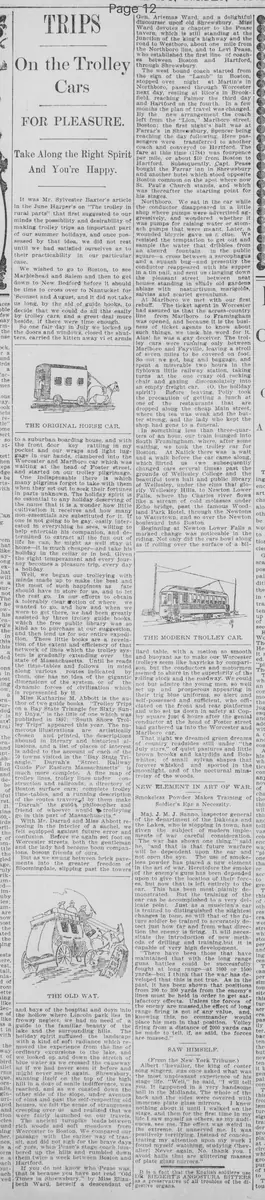
THE ORIGINAL HORSE CAR.
One indispensable there is which many pilgrims forget to take with them when they set out to seek their fortunes in parts unknown. The holiday spirit is so essential to any holiday deserving of the name that it is a wonder how little cultivation it receives and how many non-essentials are substituted for it. If one is not going to be gay, easily interested in everything he sees, willing to help entertain his companion, and determined to extract all the fun out of life he can, he might as well stay at home--it is much cheaper--and take his holiday in the cellar or in bed. Given the right temperament and every journey becomes a pleasure trip, every day a holiday.
Well, we began our trolleying with minds made up to make the best and the most of such happiness as fate should have in store for us, and to let the rest go. In our efforts to obtain a tolerably clear notion of where we wanted to go, and how and when we were to get there, we had been greatly assisted by three trolley guide books, which the free public library was so kind as to purchase at our suggestion, and then lend us for our entire expedition. These little books are a revelation of the extent and efficiency of that network of lines which the trolley system is gradually extending over the state of Massachusetts. Until he reads the time-tables and follows in mind along various routes indicated by them, one has no idea of the gigantic dimensions of the system, or of the dynamic forces of civilization which is represented by it.
Miss Katharine M. Abbott is the author of two guide books. "Trolley Trips on a Bay State Triangle for Sixty Sunny Days," is the title of one which was published in 1897: "South Shore Trolley Trips" appeared this year. The numerous illustrations are artistically chosen and printed, the descriptions abound in literary and historical allusions, and a list of places of interest is added to the account of each of the 70 towns visited in the "Bay State Triangle."
Darrah's "Street Railway Guide For Eastern Massachusetts" is much more complete. A fine map of trolley lines, trolley lines under construction and railroads: a directory of Boston surface cars: complete trolley time-tables, and a running description of the routes traversed by them make "Darrah" the guide, philosopher and friend of whoever would trolleying go in this part of Massachusetts.
With Mr. Darrah and Miss Abbott reposing in the interior of a satchel, we felt equipped against future error and confusion. Before we again set foot on Worcester streets, both the gentleman and the lady had become boon companions, bosom friends of ours.
But as we swung between brick pavements into the "greater freedom of Bloomingdale, slipping past the towers and bays of the hospital and down into the hollow where Lincoln park lies in frowsy neglect, we had no need of a guide to the familiar beauty of the lake and the surrounding hills. The holiday spirit suffused the landscape with a kind of soft radiance which removed the experience from the line of ordinary excursions to the lake, and we looked up and down the stretch of blue water as we crossed the causeway as if we had never seen it before and might never see it again. Shrewsbury, sunning itself on the top of the high hill in a doze of senile indifference, was reached, and as we coasted down the other side of the slope, under avenues of elms and past the self-respecting old houses, we felt the sense of strangeness creeping over us and realized that we were fairly launched on our travels.
THE OLD WAY.
The ancient turnpike leads between rich woods and soft meadows from Worcester to Boston. We compared our passage with the earlier way of transit, and did not sigh for the brave days of yore, when Pease's stage coach lumbered up the hills and rumbled down them twice a week between Boston and Hartford.
If you do not know who Pease was, that is because you have not read "Old Times in Shrewsbury," by Miss Elizabeth Ward, herself a descendant of Gen. Artemas Ward, and a delightful discourser upon old Shrewsbury. Miss Ward devotes a chapter to the Pease tavern, which is still standing at the junction of the king's highway and the road to Westboro, about one mile from the Northboro line, and to Levi Pease, who established the first line of coaches between Boston and Hartford through Shrewsbury.
The west bound coach started from the sign of the "Lamb" in Boston, stopped over night at Martin's in Northboro, passed through Worcester next day, resting at Rice's in Brookfield, reaching Palmer the third day and Hartford on the fourth. In a few months the plan of travel was changed. By the new arrangement the coach left from the "Lion," Marlboro street, Boston; the first night's halt was at Farrar's in Shrewsbury, Spencer being reached the day following. Here passengers were transferred to another coach and conveyed to Hartford. The fare at this time (1784) was fourpence per mile, or about $10 from Boston to Hartford. Subsequently, Capt. Pease bought the Farrar inn in Shrewsbury and another hotel which stood opposite Boston common on the spot where now St. Paul's Church stands, and which was thereafter the starting point for his stages.
Northboro. We sat in the car while the conductor disappeared in a little shop where pumps were advertised aggressively, and wondered whether it was pumps for raising water or stomach pumps that were meant. Later, a wounded bicycle gave us a clue. We resisted the temptation to get out and sample the water that dribbles from an absurd fountain in the public square-a cross between a sarcophagus and a squash bug-and presently the conductor reappeared with his supper in a tin pail, and sent us clanging down the pleasant street between neat houses standing in shady old gardens ablaze with nasturtiums, marigolds, salvias and scarlet geraniums.
At Marlboro we met with our first rebuff. The ticket agent in Worcester had assured us that the across-country line from Marlboro to Framingham was opened, and because it is the business of ticket agents to know about such things, we took his word for it. Alas! he was a gay deceiver. The trolley cars were running only between Marlboro and Fayville, leaving a stroll of seven miles to be covered on foot.
So out we got, bag and baggage, and spent a miserable two hours in the flyblown little railway station, taking turns at the one crazy old rocking chair and gazing disconsolately into an empty freight car. (O, the holiday spirit! Before leaving, Polly took the precaution of getting a lunch at one of the restaurants that are dropped along the cheap Main street, where the tea was weak and the butter strong, and the lady who kept the shop had gone to a funeral.)
In something less than three-quarters of an hour, our train lounged into South Framingham, where, after some waiting, we took the trolley car for Boston. At Natick there was a wait and a walk before the car came along, which flirted us (we subsequently changed cars several times) past the grounds of Wellesley College and the beautiful town hall and public library of Wellesley, under the elms that glorify Wellesley Hills, to Newton Lower Falls, where the Charles river flows like a stream of cold molasses under Echo bridge, past the famous Woodland Park Hotel, through the Newtons to Watertown, and so over the Newton boulevard into Boston.
THE MODERN TROLLEY CAR
Beginning at Newton Lower Falls a marked change was noticeable in the riding. Not only did the cars bowl along as if rolling over the surface of a billiard table, with a motion so smooth and buoyant as to make our Worcester trolleys seem like hayricks by comparison, but the conductors and motormen seemed to share in the superiority of the rolling stock and the roadway. We could not but admire the young men, so well set up and prosperous appearing in their trig blue uniforms, so alert and self-possessed and sufficient, who officiated on the front and rear platforms and who set us down in safety at Copley Square just 6 hours after the genial conductor at the head of Foster street had gathered us into the Worcester and Marlboro car.
That night we dreamed green dreams of country roadsides still under "the July stars," of quiet pastures and little brown brooks and katydids and Bob-whites; of small sylvan shapes that forever whisked and sported in the moonlight, and of the nocturnal minstrelsy of the woods.
What sub-type of article is it?
What themes does it cover?
What keywords are associated?
What entities or persons were involved?
Where did it happen?
Story Details
Key Persons
Location
Massachusetts, From Worcester To Boston Via Shrewsbury, Northboro, Marlboro, Framingham, Natick, Wellesley, Newton Lower Falls, Watertown
Event Date
One Fair Day In July
Story Details
Inspired by an article, the narrator and companion plan and undertake a trolley car trip from Worcester to Boston, using guidebooks by Abbott and Darrah, enjoying scenery and holiday spirit, recalling historical stagecoach travel by Levi Pease, facing a delay at Marlboro but arriving after 6 hours.