Thank you for visiting SNEWPapers!
Sign up free
Idaho Semi Weekly World
Idaho City, Boise County, Idaho
What is this article about?
T. J. Sutton from Atlanta, I.T., argues for the Banner route wagon road to Yankee Fork, citing its shorter distance (90 miles), lower cost, and strategic advantages for military and supply access to the rich mining district. He describes Yankee Fork's quartz ledges and recounts a challenging trip there involving snow and Chinese packers.
Merged-components note: Introductory announcement merged into the letter from Atlanta.
Clipping
OCR Quality
Full Text
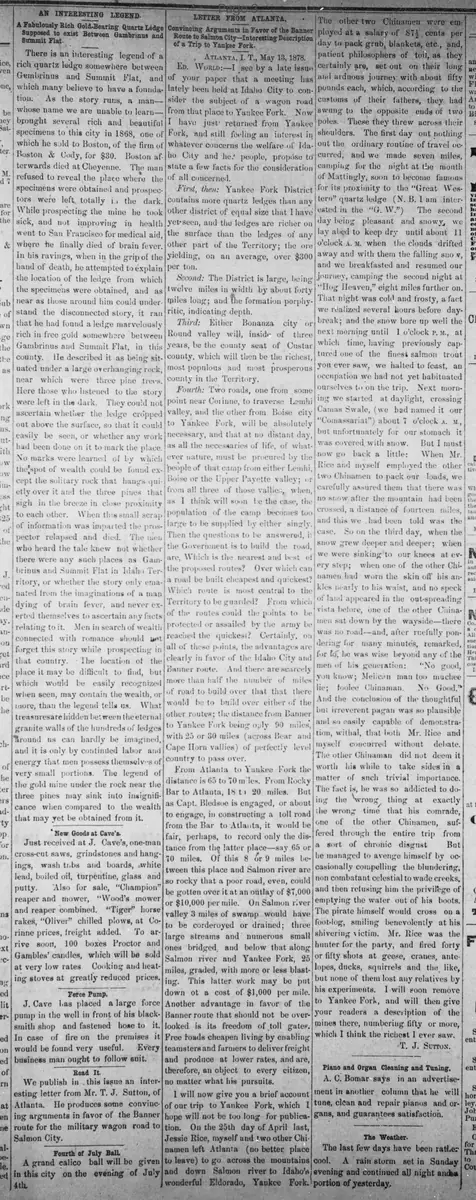
We publish in this issue an interesting letter from Mr. T. J. Sutton, of Atlanta. He produces some convincing arguments in favor of the Banner route for the military wagon road to Salmon City.
LETTER FROM ATLANTA.
Convincing Arguments in Favor of the Banner Route to Salmon City--Interesting Description of a Trip to Yankee Fork.
ATLANTA, I. T., May 13, 1878.
Ed. World:--I see by a late issue of your paper that a meeting has lately been held at Idaho City to consider the subject of a wagon road from that place to Yankee Fork. Now I have just returned from Yankee Fork, and still feeling an interest in whatever concerns the welfare of Idaho City and her people, propose to state a few facts for the consideration of all concerned.
First, then: Yankee Fork District contains more quartz ledges than any other district of equal size that I have yet seen, and the ledges are richer on the surface than the ledges of any other part of the Territory; the ore yielding, on an average, over $300 per ton.
Second: The District is large, being twelve miles in width by about forty miles long; and the formation porphyritic, indicating depth.
Third: Either Bonanza city or Round valley will, inside of three years, be the county seat of Custer county, which will then be the richest most populous and most prosperous county in the Territory.
Fourth: Two roads, one from some point near Corinne, to traverse Lemhi valley, and the other from Boise city to Yankee Fork, will be absolutely necessary, and that at no distant day as all the necessaries of life, of whatever nature, must be procured by the people of that camp from either Lemhi Boise or the Upper Payette valley; or from all three of those valleys, when, as I think will soon be the case, the population of the camp becomes too large to be supplied by either singly Then the questions to be answered, if the Government is to build the road are, Which is the nearest and best of the proposed routes? Over which can a road be built cheapest and quickest? Which route is most central to the Territory to be guarded? From which of the routes could the points to be protected or assailed by the army be reached the quickest? Certainly, on all of these points, the advantages are clearly in favor of the Idaho City and Banner route. And there are scarcely more than half the number of miles of road to build over that than there would be to build over either of the other routes; the distance from Banner to Yankee Fork being only 90 miles, with 25 or 30 miles (across Bear and Cape Horn valleys) of perfectly level country to pass over.
From Atlanta to Yankee Fork the distance is 65 to 70 miles. From Rocky Bar to Atlanta, 18 to 20 miles. But as Capt. Bledsoe is engaged, or about to engage, in constructing a toll road from the Bar to Atlanta, it would be fair, perhaps, to record only the distance from the latter place--say 65 or 70 miles. Of this 8 or 9 miles between this place and Salmon river are so rocky that a poor road, even, could be gotten over it at an outlay of $7,000 or $10,000 per mile. On Salmon river valley 3 miles of swamp would have to be corduroyed or drained: three large streams and numerous small ones bridged and below that along Salmon river and Yankee Fork, 25 miles, graded, with more or less blasting. This latter work may be put down at a cost of $1,000 per mile.
Another advantage in favor of the Banner route that should not be overlooked is its freedom of toll gates. Free roads cheapen living by enabling teamsters and farmers to deliver freight and produce at lower rates, and are therefore, an object to every citizen, no matter what his pursuits.
I will now give you a brief account of our trip to Yankee Fork, which I hope will not be too long for publication. On the 25th day of April last, Jessie Rice, myself and two other Chinamen left Atlanta (no better place to leave) to go across the mountains and down Salmon river to Idaho's wonderful Eldorado, Yankee Fork.
The other two Chinamen were employed at a salary of $7 cents per day to pack grub, blankets, etc., and, patient philosophers of toil, as they certainly are, set out on their long and arduous journey with about fifty pounds each, which, according to the customs of their fathers, they had swung to the opposite ends of two poles. These they threw across their shoulders. The first day out nothing but the ordinary routine of travel occurred, and we made seven miles camping for the night at the mouth of Mattingly, soon to become famous for its proximity to the "Great Western" quartz ledge (N. B. I am interested in the "G. W.") The second day being pleasant and snowy we lay abed to keep dry until about 11 o'clock A. M. when the clouds drifted away and with them the falling snow, and we breakfasted and resumed our journey, camping the second night at "Hog Heaven," eight miles further on. That night was cold and frosty, a fact we realized several hours before day-break: and the snow bore up well the next morning until 1 o'clock p. M., at which time, having previously captured one of the finest salmon trout you ever saw, we halted to feast, an occupation we had not yet habituated ourselves to on the trip. Next morning we started at daylight, crossing Camas Swale, (we had named it our "Commissariat") about 7 o'clock A. M. but unfortunately for our stomach it was covered with snow. But I must now go back a little: When Mr. Rice and myself employed the other two Chinamen to pack our loads, we carefully assured them that there was no snow after the mountain had been crossed, a distance of fourteen miles. and this we had been told was the case. So on the third day, when the snow grew deeper and deeper; when we were sinking to our knees at every step; when one of the other Chinamen had worn the skin off his ankles nearly to his waist, and no speck of land appeared in the out-spreading vista before, one of the other Chinamen sat down by the wayside--there was no road--and, after ruefully pondering for many minutes, remarked, for lo, he was wise beyond any of the men of his generation: "No good, you know; Melican man too muchee lie: foolee Chinaman. No Good." And the conclusion of the thoughtful but irreverent pagan was so plausible and so easily capable of demonstration, withal, that both Mr. Rice and myself concurred without debate. The other Chinaman did not deem it worth his while to take sides in a matter of such trivial importance. The fact is, he was so addicted to doing the wrong thing at exactly the wrong time that his comrade, one of the other Chinamen, suffered through the entire trip from a sort of chronic disgust But he managed to avenge himself by occasionally compelling the blundering non combatant celestial to wade creeks, and then refusing him the privilege of emptying the water out of his boots. The pirate himself would cross on a foot-log, smiling benevolently at his shivering victim. Mr. Rice was the hunter for the party, and fired forty or fifty shots at geese, cranes, antelopes, ducks, squirrels and the like, but none of them lost any relatives by his experiments. I will soon remove to Yankee Fork, and will then give your readers a description of the mines there, numbering fifty or more which I think the richest I ever saw.
T. J. SUTTON.
What sub-type of article is it?
What themes does it cover?
What keywords are associated?
What entities or persons were involved?
Letter to Editor Details
Author
T. J. Sutton
Recipient
Ed. World
Main Argument
the banner route from idaho city to yankee fork is the nearest, cheapest, quickest, and most central for military protection and supply to the rich mining district, with only 90 miles to build compared to longer alternatives.
Notable Details