Thank you for visiting SNEWPapers!
Sign up free
Montana Labor News
Butte, Silver Bow County, Montana
What is this article about?
Washington report on the Senate Finance Committee's advisory council meeting December 4-5 to revise the 1935 Social Security Act. Commissioner Albert J. Altmeyer proposes expanding coverage to self-employed, disabled workers, and others, while increasing benefits due to inflation since 1939. Council, led by Edward R. Stettinius Jr., to recommend improvements.
Merged-components note: Merging main story on page 1 with its explicit continuation on page 4, as indicated by 'Continued from Page One'.
Clippings
1 of 2
OCR Quality
Full Text
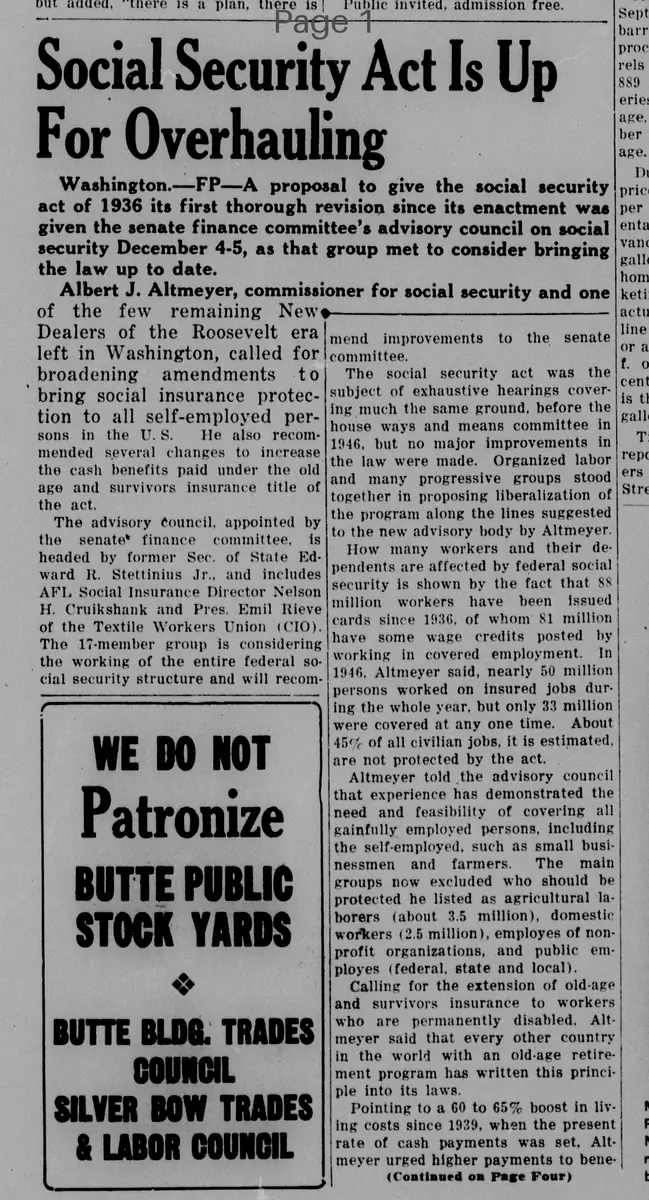
Washington.-FP-A proposal to give the social security act of 1935 its first thorough revision since its enactment was given the senate finance committee's advisory council on social security December 4-5, as that group met to consider bringing the law up to date.
Albert J. Altmeyer, commissioner for social security and one of the few remaining New Dealers of Roosevelt era left in Washington, called for broadening amendments to bring social insurance protection to all self-employed persons in the U.S. He also recommended several changes to increase the cash benefits paid under the old age and survivors insurance title of the act.
The advisory council, appointed by the senate finance committee, is headed by former Sec. of State Edward R. Stettinius Jr., and includes AFL Social Insurance Director Nelson H. Cruikshank and Pres. Emil Rieve of the Textile Workers Union (CIO). The 17-member group is considering the working of the entire federal social security structure and will recommend improvements to the senate committee.
The social security act was the subject of exhaustive hearings covering much the same ground, before the house ways and means committee in 1946. but no major improvements in the law were made. Organized labor and many progressive groups stood together in proposing liberalization of the program along the lines suggested to the new advisory body by Altmeyer.
How many workers and their dependents are affected by federal social security is shown by the fact that 85 million workers have been issued cards since 1935, of whom 81 million have some wage credits posted by working in covered employment. In 1946. Altmeyer said, nearly 50 million persons worked on insured jobs during the whole year, but only 33 million were covered at any one time. About 45% of all civilian jobs, it is estimated, are not protected by the act.
Altmeyer told the advisory council that experience has demonstrated the need and feasibility of covering all gainfully employed persons, including the self-employed, such as small businessmen and farmers. The main groups now excluded who should be protected he listed as agricultural laborers (about 3.5 million), domestic workers (2.5 million), employes of non-profit organizations, and public employees (federal. state and local).
Calling for the extension of old-age and survivors insurance to workers who are permanently disabled. Altmeyer said that every other country in the world with an old-age retirement program has written this principle into its laws.
Pointing to a 60 to 65% boost in living costs since 1939, when the present rate of cash payments was set, Altmeyer urged higher payments to beneficiaries.
Contributions to the fund are now higher, he showed, since average wages of workers with social accounts rose from $881 in 1939 to $1,370 in 1946.
Among his specific recommendations:
1. Increase the wage base for both contributions and benefit payments from the first $3,000 earnings in a year, to the first $4,800.
2. Raise the minimum monthly payment from $10 to $20.
3. Boost the maximum payment to a retired worker and his dependents from the present $85 to $120.
4. Reduce the retirement age for women workers from 65 to 60.
5. Permit retired workers to earn up to $40 monthly while drawing benefits, rather than only $15 as at present.
Permit those over 70 to draw benefits whatever their other income.
The price of an average house in Los Angeles is 201.4% more today than during the 1935-39 period.
What sub-type of article is it?
What themes does it cover?
What keywords are associated?
What entities or persons were involved?
Where did it happen?
Story Details
Key Persons
Location
Washington
Event Date
December 4 5
Story Details
The Senate Finance Committee's advisory council meets to revise the Social Security Act of 1935. Commissioner Altmeyer proposes broadening coverage to self-employed, agricultural laborers, domestic workers, non-profit employees, public employees, and disabled workers, while increasing benefits and adjusting eligibility rules to account for inflation and wage growth.