Thank you for visiting SNEWPapers!
Sign up free
Story
December 30, 1930
The Milwaukee Leader
Milwaukee, Milwaukee County, Wisconsin
What is this article about?
At a Cleveland meeting, statisticians critique President Hoover's unemployment figures, advocating a 3.3 million baseline from April's census and noting a 14.1% employment drop in manufacturing by November.
Clipping
OCR Quality
95%
Excellent
Full Text
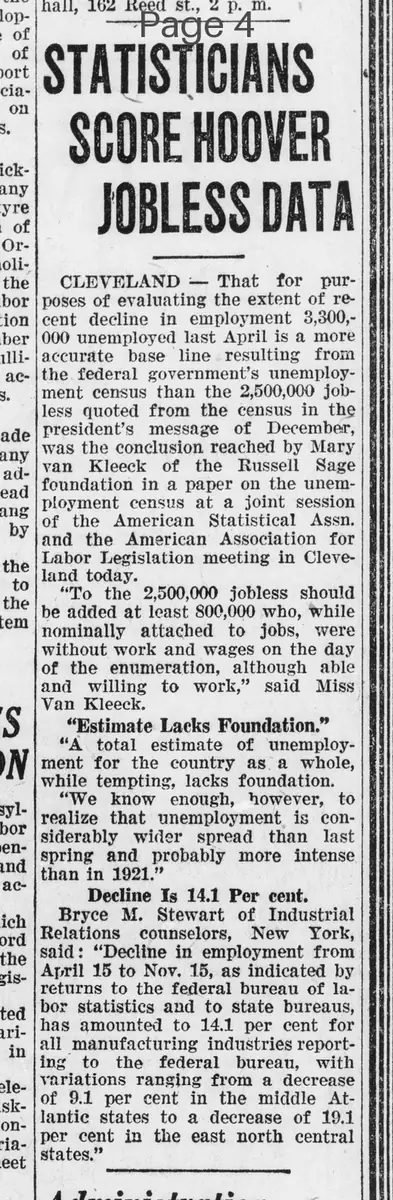
STATISTICIANS SCORE HOOVER JOBLESS DATA
CLEVELAND—That for purposes of evaluating the extent of recent decline in employment 3,300,000 unemployed last April is a more accurate base line resulting from the federal government's unemployment census than the 2,500,000 jobless quoted from the census in the president's message of December, was the conclusion reached by Mary van Kleeck of the Russell Sage foundation in a paper on the unemployment census at a joint session of the American Statistical Assn. and the American Association for Labor Legislation meeting in Cleveland today.
"To the 2,500,000 jobless should be added at least 800,000 who, while nominally attached to jobs, were without work and wages on the day of the enumeration, although able and willing to work," said Miss Van Kleeck.
"Estimate Lacks Foundation."
"A total estimate of unemployment for the country as a whole while tempting, lacks foundation.
"We know enough, however, to realize that unemployment is considerably wider spread than last spring and probably more intense than in 1921."
Decline Is 14.1 Per cent
Bruce M. Stewart of Industrial Relations counselors, New York, said: "Decline in employment from April 15 to Nov. 15, as indicated by returns to the federal bureau of labor statistics and to state bureaus has amounted to 14.1 per cent for all manufacturing industries reporting to the federal bureau, with variations ranging from a decrease of 9.1 per cent in the middle Atlantic states to a decrease of 19.1 per cent in the east north central states."
CLEVELAND—That for purposes of evaluating the extent of recent decline in employment 3,300,000 unemployed last April is a more accurate base line resulting from the federal government's unemployment census than the 2,500,000 jobless quoted from the census in the president's message of December, was the conclusion reached by Mary van Kleeck of the Russell Sage foundation in a paper on the unemployment census at a joint session of the American Statistical Assn. and the American Association for Labor Legislation meeting in Cleveland today.
"To the 2,500,000 jobless should be added at least 800,000 who, while nominally attached to jobs, were without work and wages on the day of the enumeration, although able and willing to work," said Miss Van Kleeck.
"Estimate Lacks Foundation."
"A total estimate of unemployment for the country as a whole while tempting, lacks foundation.
"We know enough, however, to realize that unemployment is considerably wider spread than last spring and probably more intense than in 1921."
Decline Is 14.1 Per cent
Bruce M. Stewart of Industrial Relations counselors, New York, said: "Decline in employment from April 15 to Nov. 15, as indicated by returns to the federal bureau of labor statistics and to state bureaus has amounted to 14.1 per cent for all manufacturing industries reporting to the federal bureau, with variations ranging from a decrease of 9.1 per cent in the middle Atlantic states to a decrease of 19.1 per cent in the east north central states."
What sub-type of article is it?
Historical Event
What themes does it cover?
Misfortune
What keywords are associated?
Unemployment Census
Jobless Data
Employment Decline
Statistical Analysis
Manufacturing Industries
What entities or persons were involved?
Mary Van Kleeck
Bruce M. Stewart
Where did it happen?
Cleveland
Story Details
Key Persons
Mary Van Kleeck
Bruce M. Stewart
Location
Cleveland
Story Details
Mary van Kleeck argues that the unemployment baseline should be 3,300,000 rather than 2,500,000, adding 800,000 partially employed workers. Bruce M. Stewart reports a 14.1% decline in manufacturing employment from April 15 to November 15.