Thank you for visiting SNEWPapers!
Sign up free
Staunton Spectator
Staunton, Virginia
What is this article about?
Wealthy flour merchant Peter Dalton snubs his daughter's suitor, militia captain Norton Parker, in favor of a fraudulent English lord who burgles his home. After a mob riots at his warehouse over high flour prices, Parker's militia intervenes to save it, leading Dalton to accept the match and value the volunteers.
Clipping
OCR Quality
Full Text
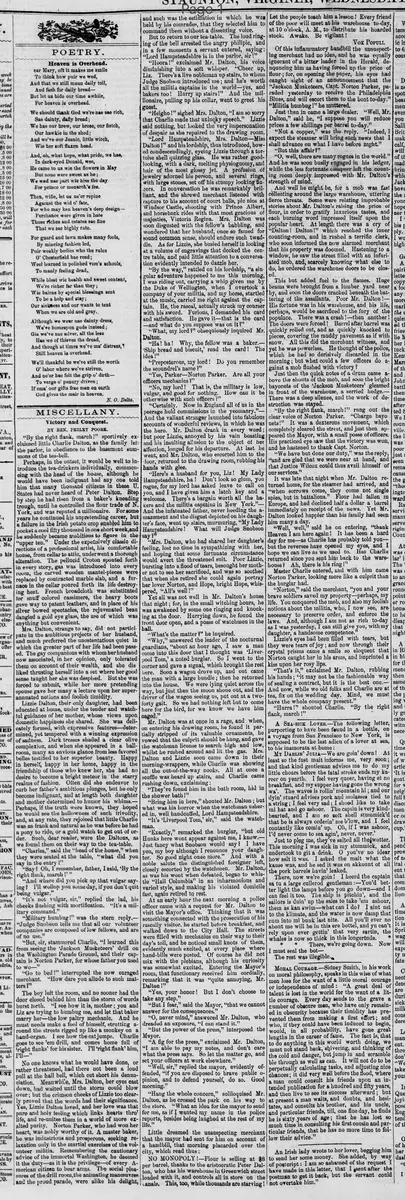
Victory and Conquest.
BY BEN. PERLEY POORE.
"By the right flank, march!" sportively exclaimed little Charlie Dalton, as the family left the parlor, in obedience to the basement summons of the tea-bell.
Perhaps, in the outset, it would be well to introduce the tea-drinkers individually, commencing with the head of the house, although he would have been indignant had any one told him that many thousand citizens in these United States had never heard of Peter Dalton. Step by step he had risen from a baker's kneading trough, until he controlled the flour trade of New York, and was reputed a millionaire. For some years he continued his unpretending career, but a failure in the Irish potato crop enabled him to pocket a cool fifty thousand in one short week, and he suddenly became ambitious to figure in the "upper ten." Under the expensively classic directions of a professional artist, his comfortable house, from cellar to attic, underwent a thorough alteration. The pellucid Croton spouted forth in every story, gas was introduced into every room, the carved wooden mantel-pieces were replaced by contracted marble slabs, and a furnace in the cellar poured forth its life-destroying heat. French broadcloth was substituted for snuff-colored cassimere, the heavy boots gave way to patent leathers, and in place of his silver-bowed spectacles, the rejuvenated beau dangled a gold eye-glass, the use of which was anything but convenient.
Mrs. Dalton, strange to say, did not participate in the ambitious projects of her husband, and much preferred the unostentatious quiet in which the greater part of her life had been passed. The gay companions with whom her husband now associated, in her opinion, only tolerated them on account of their wealth, and she disliked thrusting herself into a set where her good sense taught her she was despised. But she was forced to submit, while her more pretending spouse gave her many a lecture upon her superannuated notions and foolish timidity.
Lizzie Dalton, their only daughter, had been educated at home, under the tender and watchful guidance of her mother, whose views upon domestic happiness she shared. She was delicately formed, with expressive features—determined, yet tempered with a winning expression of sadness. Dark tresses shaded a clear olive complexion, and when she appeared in a ball-room, many an envious glance from less favored belles testified to her superior beauty. Happy in herself, happy in her home, happy in the friendship of those who knew her, she had no desire to become a bright meteor in the starry realms of fashion. Often did she endeavor to curb her father's ambitious plunges, but he only became indignant, and at length both daughter and mother determined to humor his whims. Perhaps, if the truth were known, they hoped he would see the hollowness of such frivolity, and, at any rate, they rejoiced that little Charlie was as frank and natural as he was before he had a pony to ride, or a gold watch to get out of order. Such, dear reader, were the Daltons, as we found them on their way to the tea-table.
"Charles," said the "head of the house," when they were seated at the table, "what did you say in the entry?"
"Say? Oh, I remember, father, I said, By the right flank, march!"
"And where did you pick up that vulgar saying? I'll wollop you some day, if you don't quit being vulgar."
"It's not vulgar, sir," replied the lad, his cheeks flushing with mortification. "It's a military command."
"Military humbug!" was the stern reply.—"Judge Snobson tells me that all our volunteer companies are composed of low fellows, and are of no use."
"But, sir," stammered Charlie, "I learned this from seeing the Jackson Musketeers' drill on the Washington Parade Ground, and their captain is Norton Parker, for whose father you used to wo—"
"Go to bed!" interrupted the now enraged merchant. "How dare you allude to such matters?"
The boy left the room, and no sooner had the door closed behind him than the storm of words burst forth. "I see how it is, mother; you and Liz are trying to humbug me, and let that baker marry her—the low paltry mechanic. And he must needs make a fool of himself, strutting a-round the streets rigged up like a monkey on a hand-organ. I see how the cat jumps. Charlie goes to see 'em drill, and comes home full of right flanks' for his sister. I'll 'right flank' him, I'll—"
No one knows what he would have done, or rather threatened, had there not been a loud pull at the hall bell, which cut short his denunciation. Meanwhile, Mrs. Dalton, her eyes cast down, had waited until the storm could blow over; but the crimson cheeks of Lizzie too clearly proved that the words had their significance.
Yes, Lizzie Dalton loved, and her love was that pure and holy feeling which links hearts through life, and re-unites them in a world of more exalted purity. Norton Parker, who had won her heart, was nobly worthy of it. A master baker, he was industrious and prosperous, seeking relaxation only in the martial exercises of the volunteer militia. Remembering the cautionary advice of the immortal Washington, he deemed it the duty—as it is the privilege—of every American citizen to bear arms. The social pleasures of the drill room, the animating manoeuvres and the proud parade, were alike his delight. And such was the estimation in which he was held by his comrades, that they selected him to command them without a dissenting voice.
But to return to our tea-table. The loud ringing of the bell arrested the angry philippic, and in a few moments a servant entered, saying:
"Lord Hampsteadshire is in the parlor, sir!"
"Hoora!" exclaimed Mr. Dalton, his voice diminishing into a soft whisper. "Cheer up, Liz. There's a live nobleman up stairs, to whom Judge Snobson introduced me; and he's worth all the militia captains in the world—yes, and bakers too! Hurry up stairs!" And the millionaire, pulling up his collar, went to greet his guest.
"Heigho!" sighed Mrs. Dalton, "I am so sorry that Charlie made that unlucky speech." Lizzie said nothing, but looked the very impersonation of despair as she repaired to the drawing room.
"Lord Hampsteadshire, Mrs. Dalton—Miss Dalton!" and his lordship, thus introduced, bowed condescendingly, eyeing Lizzie through a tortoise-shell quizzing glass. He was rather good-looking, with a dark, melting physiognomy, and hair of the most glossy jet. A profusion of jewelry adorned his person, and several rings, with large stones, set off his stumpy-looking fingers. In conversation he was remarkably brilliant, and the shrewd merchant listened with rapture to his account of court balls, pic-nics at Windsor Castle, shooting with Prince Albert, and horseback rides with that most gracious of majesties, Victoria Regina. Mrs. Dalton was soon disgusted with the fellow's babbling, and wondered that her husband, once so famed for sound common sense, should endure such twaddle. As for Lizzie, she busied herself in looking at a volume of engravings that decked the centre table, and paid little attention to a conversation evidently intended to dazzle her.
"By the way," rattled on his lordship, "a singular adventure happened to me this morning. I was riding out, carrying a whip given me by the Duke of Wellington, when I overtook a company of your militia, and my horse, startled at the music, carried me right against the captain. He, the rascal, actually struck my courser with his sword. Furious, I demanded his card and satisfaction. He gave it—that is the card—and what do you suppose was on it?"
"What, my lord?" obsequiously inquired Mr. Dalton.
"Ha! ha! Why, the fellow was a baker.—'Ship bread and biscuit,' read the card! The idea!"
"Preposterous, my lord! Do you remember the scoundrel's name?"
"Yes, Parker—Norton Parker. Are all your officers mechanics?"
"No, my lord! That is, the military is low vulgar, and good for nothing. How can it be otherwise with such officers?"
"Certainly. Now in England all of us in the peerage hold commissions in the yeomanry." And the valiant stranger launched into fabulous accounts of wonderful reviews, in which he was the hero. Mr. Dalton drank in every word; but poor Lizzie, annoyed by his vain boasting and his insulting allusion to the object of her affection, longed for his departure. At last he went, and Mr. Dalton, who escorted him to the door, returned to the drawing room, rubbing his hands with glee.
"Here's a husband for you, Liz! My Lady Hampsteadshire, ha! Don't look so glum, you rogue, for my lord has asked leave to call on you, and I have given him a latch key and a welcome. There's a bargain worth all the bakers and the militia captains in New York."
And the infatuated father, never heeding the amazement and the disgust depicted on his daughter's face, went up stairs, murmuring, "My Lady Hampsteadshire! What will Judge Snobson say?"
Mrs. Dalton, who had shared her daughter's feeling, lost no time in sympathizing with her, and hoping that some fortunate circumstance would avert the threatened suit. Poor Lizzie, bursting into a flood of tears, besought her mother not to see her sacrificed, and was so soothed that when she retired she could again portray her lover Norton, and Hope, bright Hope, whispered, "All's well!"
Yet all was not well in Mr. Dalton's house that night; for, in the small witching hours, he was awakened by some one ringing and knocking at the door. Hurrying down, he found the front door open, and a posse of watchmen in the hall.
"What's the matter?" he inquired.
"Why," answered the leader of the nocturnal guardians, "about an hour ago, I saw a man come into this door that I thought was 'Liverpool Tom,' a noted burglar. So I went to the corner and gave a signal, which brought the rest here. Soon a wagon drove up, and out came the man with a large bundle; then he returned into the house. We were lying quiet across the way, but just then the moon shone out, and the driver of the wagon seeing us, put out at a two-forty gait. So we had nothing left but to come here for the bird, for we know we have him caged."
Mr. Dalton was at once in a rage, and when, on entering his drawing room, he found it partially stripped of its valuable ornaments, he vowed that the culprit should be hung, and gave the watchman license to search high and low, whilst he rushed around and lit the gas. Mrs. Dalton and Lizzie soon came down in their morning-wrappers, while Charlie was showing all the out-of-the-way nooks. All at once a scuffle was heard up stairs, and Charlie came rushing down, exclaiming:
"They've found him in the bath room, hid in the shower bath!"
"Bring him in here," shouted Mr. Dalton; but what was his horror when the watchman ushered in, well handcuffed, Lord Hampsteadshire.
"It's 'Liverpool Tom,' sir," said the watchman.
"Exactly," remarked the burglar, "but old Hunks here won't appear against me, I know.—Just fancy what Snobson would say? I have you, my boy although I renounce your daughter. So good night once more." And with a noble salute the distinguished foreigner left, closely escorted by the watchmen. Mr. Dalton, as was his wont when defeated, began to whistle "Hail Columbia" in an inharmonious and varied style, and making his violated domicile fast, again retired to rest.
At an early hour the next morning a police officer came with a request for Mr. Dalton to visit the Mayor's office. Thinking that it was something connected with the prosecution of his rascally visitor, he started before breakfast, and walked down to the City Hall. The streets were filled with mechanics on their way to their day's toil, and he noticed small knots of them, evidently much excited, at every place where hand-bills were posted. Of course he did not mix with the plebeians, although his curiosity was somewhat excited. Entering the Mayor's room, that functionary received him cordially, remarking that it was "quite annoying, Mr. Dalton!"
"Yes, your honor! But I don't choose to take any step."
"But I fear," said the Mayor, "that we cannot answer for the consequences."
"O, never mind," answered Mr. Dalton, who dreaded an exposure, "I can stand it."
"But the power of the press," interposed the Mayor.
"A fig for the press," exclaimed Mr. Dalton, "I am able to pay my notes, and don't care what the press says. So let the matter go, and set your officers at work elsewhere."
"Well, sir," replied the mayor, evidently offended, "if you are disposed to brave public opinion, and to defend yourself, do so. Good morning.'"
"Hang the whole concern," soliloquised Mr. Dalton, as he crossed the park on his way to the store. "What an idea for the mayor to send for me, as if I wanted my name in the police reports, besides being laughed at the rest of my life."
Little dreamed the unsuspecting merchant that the mayor had sent for him on account of a handbill, that morning placarded over the city, which read thus:
NO MONOPOLY!—Flour is selling at $8 per barrel, thanks to the aristocratic Peter Dalton, who has his warehouse in Greenwich street loaded with it, and controls all in store on the canals. This, too, while thousands are starving!
Let the people teach him a lesson! Every friend of the poor will meet at his warehouse to-day at 10 o'clock, A. M., to distribute his hoarded stock. Awake. Be vigilant!
Vox Populi.
Of this inflammatory handbill the unsuspecting merchant had no idea, and he was equally ignorant of a bitter leader in the Herald, denouncing him as having forced up the price of flour; for, on opening the paper, his eyes had caught sight of an announcement that the "Jackson Musketeers, Capt. Norton Parker, paraded yesterday to receive the Philadelphia Blues, and will escort them to the boat to-day."
"Militia humbug!" he muttered.
Just then in came a large dealer. "Well, Mr. Dalton," said he, "I suppose you will reduce prices a few shillings per barrel to-day."
"Not a copper," was the reply. "Indeed, I expect the steamer will bring such news that shall advance on what I have to-night."
"But this affair?"
"O, well, there are many rogues in the world." And he was soon busily engaged in his ledger, while the less fortunate cooper left the counting room deeply impressed with Mr. Dalton's strength of mind.
And well he might be, for a mob was fast collecting around the large warehouse, uttering fierce threats. Some were relating improbable stories about Mr. Dalton's raising the price of flour, in order to gratify luxurious tastes, and each burning word impressed itself upon the popular heart. At length there was a cry of "Dalton! Dalton!" which reached the inner counting-room, and in rushed a terrified clerk, who soon informed the now alarmed merchant that his property was doomed. Hastening to a window, he saw the street filled with an infuriated mob, and, scarcely knowing what else to do, he ordered the warehouse doors to be closed.
This but added fuel to the flames. Huge beams were brought from a lumber yard near by, and soon the doors cracked beneath the battering of the assailants. Poor Mr. Dalton!—His fortune was in his warehouse, and his life, perhaps, would be sacrificed to the fury of the populace. There was a crash!—then another! The doors were forced! Barrel after barrel was quickly rolled out, and as quickly knocked to pieces, covering the muddy pavement as if with snow. All this did the merchant witness, and yet he was powerless. He thought of the police, which he had so derisively discarded in the morning; but what could a few officers do against a mob flushed with victory?
Just then the quick notes of a drum came above the shouts of the mob, and soon the bright bayonets of the 'Jackson Musketeers' gleamed in front of the warehouse, a serried hedge.—There was a deep silence, and the work of destruction was stayed.
"By the right flank, march!" rung out the clear voice of Norton Parker. "Charge bayonets!" It was a dexterous movement, which completely cleared the street, and just then appeared the Mayor, with a small posse of officers. His practiced eye saw that the victory was won, and he hastened to thank Capt. Norton.
"We have but done our duty," was the reply. "and are glad that we were near at hand, and that Justice Wilcox could thus avail himself of our services."
It was late that night when Mr. Dalton returned home, for the steamer had arrived, and "when sorrows come, they come not single spies, but in battalions." Flour had fallen in Europe, and had declined half a dollar a barrel immediately on receipt of the news. Yet Mr. Dalton looked happier than his family had seen him many a day.
"Well, well" said he on entering, "thank Heaven I am here again! It has been a hard day for me—as Charlie has probably told you—but the reverses have opened my eyes, and I hope we can live as we used to. Has Charlie returned since you sent him back to the warehouse? Ah, there is his ring!"
Master Charlie entered, and with him came Norton Parker, looking more like a culprit than the burglar had.
"Norton," said the merchant, "you and your brave soldiers saved my property—perhaps, my life. You conquered the mob, and also my foolish notions about the militia, who, I now see, are necessary to preserve order, and enforce the laws. And, although I am not as rich to-day as I was yesterday, I can still give you, with my daughter, a handsome competence."
Lizzie's eyes had been filled with tears, but they were tears of joy; and now through their crystal prisms came a smile so eloquent that Norton caught her in his arms, and imprinted a kiss upon her rosy lips.
"That's it," exclaimed Mr. Dalton, rubbing his hands; "it may not be the fashionable way of sealing a contract, but it is the best one. And now, while we old folks and Charlie are at tea, fix on the wedding day. Mind, we must have the whole company present."
"Hurra!" shouted Charlie. "By the right flank, march!"
What sub-type of article is it?
What themes does it cover?
What keywords are associated?
What entities or persons were involved?
Where did it happen?
Story Details
Key Persons
Location
New York, Greenwich Street Warehouse, City Hall, Washington Parade Ground
Story Details
Peter Dalton, risen from poverty to wealth, seeks social status and pushes his daughter Lizzie toward a fraudulent English lord, dismissing her suitor Norton Parker, a baker and militia captain. The lord burgles Dalton's home, and a mob attacks his flour warehouse over high prices. Parker's militia disperses the mob, saving Dalton's property. Humbled by losses and revelations, Dalton consents to the marriage and praises the militia.