Thank you for visiting SNEWPapers!
Sign up free
Story
March 13, 1869
The New Orleans Crescent
New Orleans, Orleans County, Louisiana
What is this article about?
John C. Breckinridge, former Confederate general and Kentucky native, returns home to Lexington on March 9, 1869, after four years in exile, welcomed by crowds and friends despite rain; he plans to resume law practice and avoid politics.
Clipping
OCR Quality
95%
Excellent
Full Text
PETITION
The New Orleans Crescent
OFFICIAL JOURNAL OF THE CITY OF NEW ORLEANS
SATURDAY MORNING, MARCH 13, 1869.
THE EXILES RETURN.
GENERAL JOHN C. BRECKINRIDGE AT HOME-RECEPTION BY HIS FRIENDS AND NEIGHBORS.
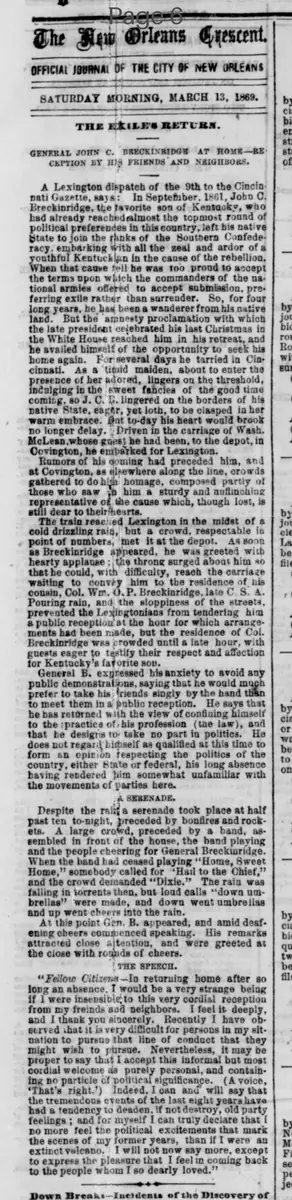
A Lexington dispatch of the 9th to the Cincinnati Gazette, says: In September, 1861, John C. Breckinridge, the favorite son of Kentucky, who had already reached almost the topmost round of political preferment in this country, left his native State to join the ranks of the Southern Confederacy, embarking with all the zeal and ardor of a youthful Kentuckian in the cause of the rebellion.
When that cause fell he was too proud to accept the terms upon which the commanders of the national armies offered to accept submission, preferring exile rather than surrender. So, for four long years, he has been a wanderer from his native land. But the amnesty proclamation with which the late president celebrated his last Christmas in the White House reached him in his retreat, and he availed himself of the opportunity to seek his home again. For several days he tarried in Cincinnati. As a timid maiden, about to enter the presence of her adored, lingers on the threshold, indulging in the sweet fancies of the good time coming, so J. C. B. lingered on the borders of his native State, eager, yet loth, to be clasped in her warm embrace. At to-day his heart would brook no longer delay. Driven in the carriage of Wash. McLean, whose guest he had been, to the depot, in Covington, he embarked for Lexington.
Rumors of his coming had preceded him, and at Covington, as elsewhere along the line, crowds gathered to do him homage, composed partly of those who saw in him a sturdy and unflinching representative of the cause which, though lost, is still dear to their hearts.
The train reached Lexington in the midst of a cold drizzling rain, but a crowd, respectable in point of numbers, met it at the depot. As soon as Breckinridge appeared, he was greeted with hearty applause; the throng surged about him so that he could, with difficulty, reach the carriage waiting to convey him to the residence of his cousin, Col. Wm. O. P. Breckinridge, late C. S. A.
Pouring rain, and the sloppiness of the streets, prevented the Lexingtonians from tendering him a public reception at the hour for which arrangements had been made, but the residence of Col. Breckinridge was crowded until a late hour, with guests eager to testify their respect and affection for Kentucky's favorite son.
General B. expressed his anxiety to avoid any public demonstrations, saying that he would much prefer to take his friends singly by the hand than to meet them in a public reception. He says that he has returned with the view of confining himself to the practice of his profession (the law), and that he designs to take no part in politics. He does not regard himself as qualified at this time to form an opinion respecting the politics of the country, either State or federal, his long absence having rendered him somewhat unfamiliar with the movements of parties here.
A SERENADE.
Despite the rain a serenade took place at half past ten to-night, preceded by bonfires and rockets. A large crowd, preceded by a band, assembled in front of the house, the band playing and the people cheering for General Breckinridge.
When the band had ceased playing "Home, Sweet Home," somebody called for "Hail to the Chief," and the crowd demanded "Dixie." The rain was falling in torrents then, but loud calls "down umbrellas" were made, and down went umbrellas and up went cheers into the rain.
At this point Gen. B. appeared, and amid deafening cheers commenced speaking. His remarks attracted close attention, and were greeted at the close with rounds of cheers.
THE SPEECH.
"Fellow Citizens--In returning home after so long an absence, I would be a very strange being if I were insensible to this very cordial reception from my friends and neighbors. I feel it deeply, and I thank you sincerely. Recently I have observed that it is very difficult for persons in my situation to pursue that line of conduct that they might wish to pursue. Nevertheless, it may be proper to say that I accept this informal but most cordial welcome as purely personal, and containing no particle of political significance. (A voice, 'That's right.') Indeed. I can and will say that the tremendous events of the last eight years have had a tendency to deaden, if not destroy, old party feelings; and for myself I can truly declare that I no more feel the political excitements that mark the scenes of my former years, than if I were an extinct volcano. I will not now say more, except to express the pleasure that I feel in coming back to the people whom I so dearly loved."
The New Orleans Crescent
OFFICIAL JOURNAL OF THE CITY OF NEW ORLEANS
SATURDAY MORNING, MARCH 13, 1869.
THE EXILES RETURN.
GENERAL JOHN C. BRECKINRIDGE AT HOME-RECEPTION BY HIS FRIENDS AND NEIGHBORS.
A Lexington dispatch of the 9th to the Cincinnati Gazette, says: In September, 1861, John C. Breckinridge, the favorite son of Kentucky, who had already reached almost the topmost round of political preferment in this country, left his native State to join the ranks of the Southern Confederacy, embarking with all the zeal and ardor of a youthful Kentuckian in the cause of the rebellion.
When that cause fell he was too proud to accept the terms upon which the commanders of the national armies offered to accept submission, preferring exile rather than surrender. So, for four long years, he has been a wanderer from his native land. But the amnesty proclamation with which the late president celebrated his last Christmas in the White House reached him in his retreat, and he availed himself of the opportunity to seek his home again. For several days he tarried in Cincinnati. As a timid maiden, about to enter the presence of her adored, lingers on the threshold, indulging in the sweet fancies of the good time coming, so J. C. B. lingered on the borders of his native State, eager, yet loth, to be clasped in her warm embrace. At to-day his heart would brook no longer delay. Driven in the carriage of Wash. McLean, whose guest he had been, to the depot, in Covington, he embarked for Lexington.
Rumors of his coming had preceded him, and at Covington, as elsewhere along the line, crowds gathered to do him homage, composed partly of those who saw in him a sturdy and unflinching representative of the cause which, though lost, is still dear to their hearts.
The train reached Lexington in the midst of a cold drizzling rain, but a crowd, respectable in point of numbers, met it at the depot. As soon as Breckinridge appeared, he was greeted with hearty applause; the throng surged about him so that he could, with difficulty, reach the carriage waiting to convey him to the residence of his cousin, Col. Wm. O. P. Breckinridge, late C. S. A.
Pouring rain, and the sloppiness of the streets, prevented the Lexingtonians from tendering him a public reception at the hour for which arrangements had been made, but the residence of Col. Breckinridge was crowded until a late hour, with guests eager to testify their respect and affection for Kentucky's favorite son.
General B. expressed his anxiety to avoid any public demonstrations, saying that he would much prefer to take his friends singly by the hand than to meet them in a public reception. He says that he has returned with the view of confining himself to the practice of his profession (the law), and that he designs to take no part in politics. He does not regard himself as qualified at this time to form an opinion respecting the politics of the country, either State or federal, his long absence having rendered him somewhat unfamiliar with the movements of parties here.
A SERENADE.
Despite the rain a serenade took place at half past ten to-night, preceded by bonfires and rockets. A large crowd, preceded by a band, assembled in front of the house, the band playing and the people cheering for General Breckinridge.
When the band had ceased playing "Home, Sweet Home," somebody called for "Hail to the Chief," and the crowd demanded "Dixie." The rain was falling in torrents then, but loud calls "down umbrellas" were made, and down went umbrellas and up went cheers into the rain.
At this point Gen. B. appeared, and amid deafening cheers commenced speaking. His remarks attracted close attention, and were greeted at the close with rounds of cheers.
THE SPEECH.
"Fellow Citizens--In returning home after so long an absence, I would be a very strange being if I were insensible to this very cordial reception from my friends and neighbors. I feel it deeply, and I thank you sincerely. Recently I have observed that it is very difficult for persons in my situation to pursue that line of conduct that they might wish to pursue. Nevertheless, it may be proper to say that I accept this informal but most cordial welcome as purely personal, and containing no particle of political significance. (A voice, 'That's right.') Indeed. I can and will say that the tremendous events of the last eight years have had a tendency to deaden, if not destroy, old party feelings; and for myself I can truly declare that I no more feel the political excitements that mark the scenes of my former years, than if I were an extinct volcano. I will not now say more, except to express the pleasure that I feel in coming back to the people whom I so dearly loved."
What sub-type of article is it?
Historical Event
Biography
Personal Triumph
What themes does it cover?
Triumph
Fortune Reversal
What keywords are associated?
Breckinridge Return
Exile Homecoming
Lexington Reception
Civil War Amnesty
Serenade Speech
What entities or persons were involved?
John C. Breckinridge
Col. Wm. O. P. Breckinridge
Wash. Mclean
Where did it happen?
Lexington, Kentucky
Story Details
Key Persons
John C. Breckinridge
Col. Wm. O. P. Breckinridge
Wash. Mclean
Location
Lexington, Kentucky
Event Date
March 9, 1869
Story Details
John C. Breckinridge returns to Lexington after four years in exile following the Civil War, greeted by crowds despite rain, receives a serenade, and expresses intent to practice law without political involvement.