Thank you for visiting SNEWPapers!
Sign up free
Literary
October 5, 1837
Watchman Of The South
Richmond, Virginia
What is this article about?
An essay excerpt from an old author critiques the idolization of Nature by ancients and focuses on Pelagius's fifth-century error denying divine grace, tracing its evolution through Semipelagianism, Popish doctrines, and Arminianism. It portrays Pelagius as a trimmer of human will against grace, supported by historical accounts from Vossius, Hierom, Chrysostom, and Augustine.
Clipping
OCR Quality
95%
Excellent
Full Text
PELAGIUS.
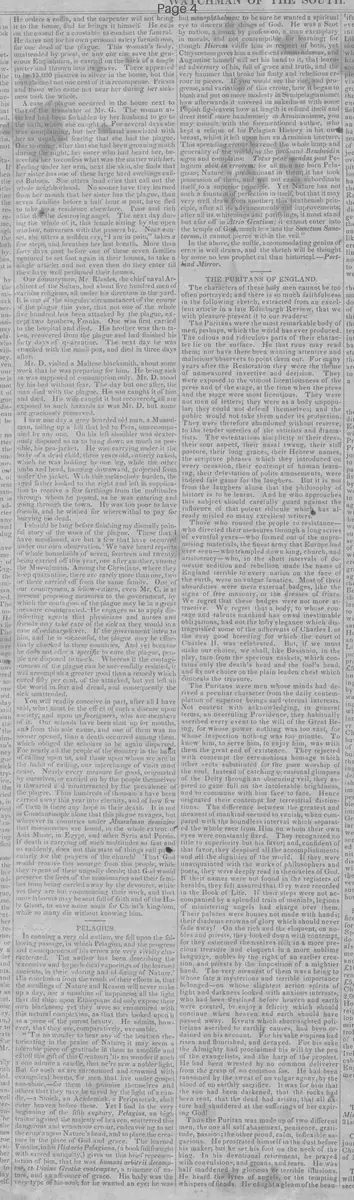
In conning a very old author, we fell upon the following passage, in which Pelagius, and the progress and consequences of his errors are very vividly characterized. The author has been describing the 'excessive and hyperbolical vaporings of the learned ancients, in their adoring and idolizing of Nature.' His conclusion from the result of their efforts is, that the snuffings of Nature and Reason will never make up a day, nor a sunshine of happiness; all the light that did shine upon Ethiopians did only expose their own blackness; yet they were so enamoured with this natural complexion, as that they looked upon it as a piece of the purest beauty. He admits, however, that they are, comparatively, excusable.
"'Tis no wonder to hear any of the heathen rhetoricating in the praise of Nature; it may seem a tolerable piece of gratitude in them to amplify and extoll this gift of their Creator; 'tis no wonder if such a one admire a candle, that ne'er saw a nobler light. But for such as are surrounded and crowned with evangelical beams, for men that live under gospel sun-shine,—for them to promise themselves and others that they may be saved by the light of a candle,—a Stoick, an Academick, a Peripatetick, shall enter heaven before these. Yet I find in the very beginning of the fifth century, Pelagius, an high traitor against the majesty of heaven, scattered this dangerous and venomous error, endeavoring to set the crown upon Nature's head, and to place the creature in the place of God and grace. The learned Vossius, in his Historia Pelagiana, (a book full fraught with sacred antiquity,) gives us this brief representation of him, that he was humani arbitrii decomptor, et Divine Gratiae contemptor, a trimmer of nature, and an affronter of grace. His body was the very type of his soul; for he wanted an eye; he was but monophthalmos: to be sure he wanted a spiritual eye to discern the things of God. He was a Scot by nation, a monk by profession, a man exemplary in morals, and not contemptible for learning; for though Hierom vilified him in respect of both, yet Chrysostom gives him a sufficient commendamus, and Augustine himself will set his hand to it, that learned adversary of his, full of grace and truth, and the very hammer that broke his flinty and rebellious error in pieces. If you would see the rise, and progress, and variations of this error, how it began to blush and put on more modesty in Semipelagianism: how afterwards it covered its nakedness with some Popish fig-leaves: how at length it refined itself and drest itself more handsomely in Arminianism, you may consult with the forementioned author, who kept a relique of his Pelagian History in his own breast, whilst it left upon him an Arminian tincture. This spreading error leavened the whole lump and generality of the world, as the profound Bradividin signs and complains: Totus pene mundus post Pelagium abiit in errorem: for all men are born Pelagians; Nature is predominant in them; it has took possession of them, and will not easily subordinate itself to a superior principle. Yet Nature has not such a fountain of perfection in itself, but that it may very well draw from another; this heathenish principle, after all its advancements and improvements; after all its whitenings and purifyings, it must stand but afar off in Atrio Gentium; it cannot enter into the temple of God, much less into the Sanctum Sanctorum, it cannot pierce within the veil."
In the above, the subtle, accommodating genius of error is well drawn, and the sketch will be thought by some no less prophetical than historical.—Portband Mirror.
In conning a very old author, we fell upon the following passage, in which Pelagius, and the progress and consequences of his errors are very vividly characterized. The author has been describing the 'excessive and hyperbolical vaporings of the learned ancients, in their adoring and idolizing of Nature.' His conclusion from the result of their efforts is, that the snuffings of Nature and Reason will never make up a day, nor a sunshine of happiness; all the light that did shine upon Ethiopians did only expose their own blackness; yet they were so enamoured with this natural complexion, as that they looked upon it as a piece of the purest beauty. He admits, however, that they are, comparatively, excusable.
"'Tis no wonder to hear any of the heathen rhetoricating in the praise of Nature; it may seem a tolerable piece of gratitude in them to amplify and extoll this gift of their Creator; 'tis no wonder if such a one admire a candle, that ne'er saw a nobler light. But for such as are surrounded and crowned with evangelical beams, for men that live under gospel sun-shine,—for them to promise themselves and others that they may be saved by the light of a candle,—a Stoick, an Academick, a Peripatetick, shall enter heaven before these. Yet I find in the very beginning of the fifth century, Pelagius, an high traitor against the majesty of heaven, scattered this dangerous and venomous error, endeavoring to set the crown upon Nature's head, and to place the creature in the place of God and grace. The learned Vossius, in his Historia Pelagiana, (a book full fraught with sacred antiquity,) gives us this brief representation of him, that he was humani arbitrii decomptor, et Divine Gratiae contemptor, a trimmer of nature, and an affronter of grace. His body was the very type of his soul; for he wanted an eye; he was but monophthalmos: to be sure he wanted a spiritual eye to discern the things of God. He was a Scot by nation, a monk by profession, a man exemplary in morals, and not contemptible for learning; for though Hierom vilified him in respect of both, yet Chrysostom gives him a sufficient commendamus, and Augustine himself will set his hand to it, that learned adversary of his, full of grace and truth, and the very hammer that broke his flinty and rebellious error in pieces. If you would see the rise, and progress, and variations of this error, how it began to blush and put on more modesty in Semipelagianism: how afterwards it covered its nakedness with some Popish fig-leaves: how at length it refined itself and drest itself more handsomely in Arminianism, you may consult with the forementioned author, who kept a relique of his Pelagian History in his own breast, whilst it left upon him an Arminian tincture. This spreading error leavened the whole lump and generality of the world, as the profound Bradividin signs and complains: Totus pene mundus post Pelagium abiit in errorem: for all men are born Pelagians; Nature is predominant in them; it has took possession of them, and will not easily subordinate itself to a superior principle. Yet Nature has not such a fountain of perfection in itself, but that it may very well draw from another; this heathenish principle, after all its advancements and improvements; after all its whitenings and purifyings, it must stand but afar off in Atrio Gentium; it cannot enter into the temple of God, much less into the Sanctum Sanctorum, it cannot pierce within the veil."
In the above, the subtle, accommodating genius of error is well drawn, and the sketch will be thought by some no less prophetical than historical.—Portband Mirror.
What sub-type of article is it?
Essay
What themes does it cover?
Religious
Moral Virtue
What keywords are associated?
Pelagius
Divine Grace
Nature
Theological Error
Arminianism
Semipelagianism
Augustine
Vossius
Literary Details
Title
Pelagius.
Subject
On Pelagius And The Progress Of His Errors Against Divine Grace
Form / Style
Prose Reflection Quoting Historical Theological Critique
Key Lines
'Tis No Wonder To Hear Any Of The Heathen Rhetoricating In The Praise Of Nature; It May Seem A Tolerable Piece Of Gratitude In Them To Amplify And Extoll This Gift Of Their Creator; 'Tis No Wonder If Such A One Admire A Candle, That Ne'er Saw A Nobler Light.
Pelagius, An High Traitor Against The Majesty Of Heaven, Scattered This Dangerous And Venomous Error, Endeavoring To Set The Crown Upon Nature's Head, And To Place The Creature In The Place Of God And Grace.
He Was Humani Arbitrii Decomptor, Et Divine Gratiae Contemptor, A Trimmer Of Nature, And An Affronter Of Grace.
All Men Are Born Pelagians; Nature Is Predominant In Them; It Has Took Possession Of Them, And Will Not Easily Subordinate Itself To A Superior Principle.