Thank you for visiting SNEWPapers!
Sign up free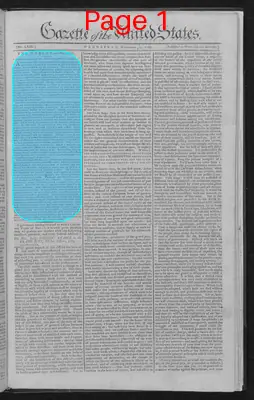
Editorial
December 9, 1789
Gazette Of The United States
New York, New York County, New York
What is this article about?
This editorial emphasizes the importance of experience over genius or imitation in crafting effective laws and government. It reflects on the challenges of U.S. governance, urging patience, candor, and careful observation among citizens and rulers to navigate uncharted legislative territories.
Clipping
OCR Quality
98%
Excellent
Full Text
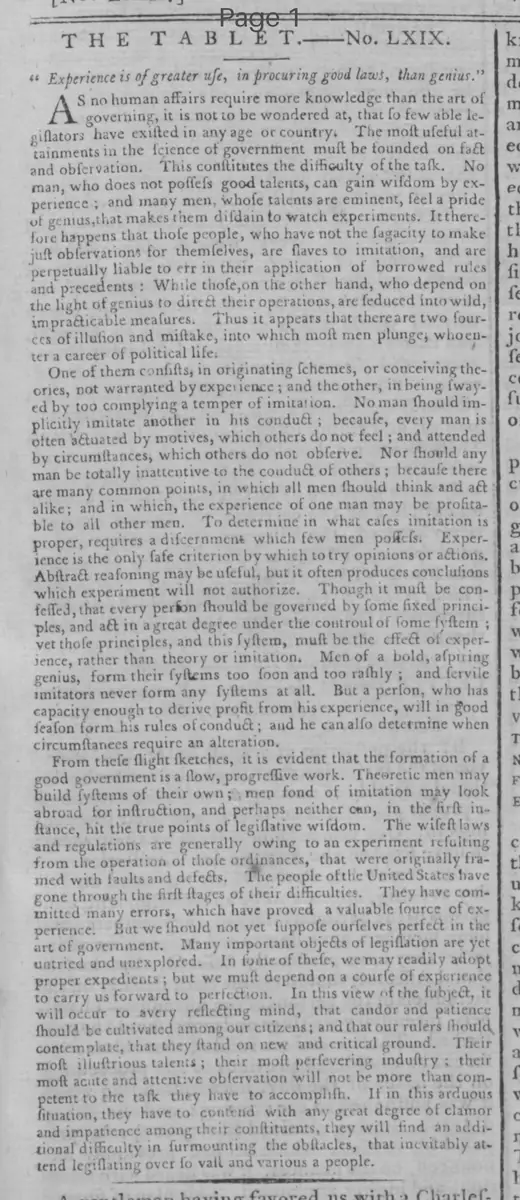
THE TABLET.--No. LXIX.
"Experience is of greater use, in procuring good laws, than genius."
No human affairs require more knowledge than the art of governing, it is not to be wondered at, that so few able legislators have existed in any age or country. The most useful attainments in the science of government must be founded on fact and observation. This constitutes the difficulty of the task. No man, who does not possess good talents, can gain wisdom by experience; and many men, whose talents are eminent, feel a pride of genius, that makes them disdain to watch experiments. It therefore happens that those people, who have not the sagacity to make just observations for themselves, are slaves to imitation, and are perpetually liable to err in their application of borrowed rules and precedents: While those, on the other hand, who depend on the light of genius to direct their operations, are seduced into wild, impracticable measures. Thus it appears that there are two sources of illusion and mistake, into which most men plunge, who enter a career of political life.
One of them consists, in originating schemes, or conceiving theories, not warranted by experience; and the other, in being swayed by too complying a temper of imitation. No man should implicitly imitate another in his conduct; because, every man is often actuated by motives, which others do not feel; and attended by circumstances, which others do not observe. Nor should any man be totally inattentive to the conduct of others; because there are many common points, in which all men should think and act alike; and in which, the experience of one man may be profitable to all other men. To determine in what cases imitation is proper, requires a discernment which few men possess. Experience is the only safe criterion by which to try opinions or actions. Abstract reasoning may be useful, but it often produces conclusions which experiment will not authorize. Though it must be confessed, that every person should be governed by some fixed principles, and act in a great degree under the control of some system; yet those principles, and this system, must be the effect of experience, rather than theory or imitation. Men of a bold, aspiring genius, form their systems too soon and too rashly; and servile imitators never form any systems at all. But a person, who has capacity enough to derive profit from his experience, will in good season form his rules of conduct; and he can also determine when circumstances require an alteration.
From these slight sketches, it is evident that the formation of a good government is a slow, progressive work. Theoretic men may build systems of their own; men fond of imitation may look abroad for instruction, and perhaps neither can, in the first instance, hit the true points of legislative wisdom. The wisest laws and regulations are generally owing to an experiment resulting from the operation of those ordinances, that were originally framed with faults and defects. The people of the United States have gone through the first stages of their difficulties. They have committed many errors, which have proved a valuable source of experience. But we should not yet suppose ourselves perfect in the art of government. Many important objects of legislation are yet untried and unexplored. In some of these, we may readily adopt proper expedients; but we must depend on a course of experience to carry us forward to perfection. In this view of the subject, it will occur to every reflecting mind, that candor and patience should be cultivated among our citizens; and that our rulers should contemplate, that they stand on new and critical ground. Their most illustrious talents; their most persevering industry; their most acute and attentive observation will not be more than competent to the task they have to accomplish. If in this arduous situation, they have to contend with any great degree of clamor and impatience among their constituents, they will find an additional difficulty in surmounting the obstacles, that inevitably attend legislating over so vast and various a people.
"Experience is of greater use, in procuring good laws, than genius."
No human affairs require more knowledge than the art of governing, it is not to be wondered at, that so few able legislators have existed in any age or country. The most useful attainments in the science of government must be founded on fact and observation. This constitutes the difficulty of the task. No man, who does not possess good talents, can gain wisdom by experience; and many men, whose talents are eminent, feel a pride of genius, that makes them disdain to watch experiments. It therefore happens that those people, who have not the sagacity to make just observations for themselves, are slaves to imitation, and are perpetually liable to err in their application of borrowed rules and precedents: While those, on the other hand, who depend on the light of genius to direct their operations, are seduced into wild, impracticable measures. Thus it appears that there are two sources of illusion and mistake, into which most men plunge, who enter a career of political life.
One of them consists, in originating schemes, or conceiving theories, not warranted by experience; and the other, in being swayed by too complying a temper of imitation. No man should implicitly imitate another in his conduct; because, every man is often actuated by motives, which others do not feel; and attended by circumstances, which others do not observe. Nor should any man be totally inattentive to the conduct of others; because there are many common points, in which all men should think and act alike; and in which, the experience of one man may be profitable to all other men. To determine in what cases imitation is proper, requires a discernment which few men possess. Experience is the only safe criterion by which to try opinions or actions. Abstract reasoning may be useful, but it often produces conclusions which experiment will not authorize. Though it must be confessed, that every person should be governed by some fixed principles, and act in a great degree under the control of some system; yet those principles, and this system, must be the effect of experience, rather than theory or imitation. Men of a bold, aspiring genius, form their systems too soon and too rashly; and servile imitators never form any systems at all. But a person, who has capacity enough to derive profit from his experience, will in good season form his rules of conduct; and he can also determine when circumstances require an alteration.
From these slight sketches, it is evident that the formation of a good government is a slow, progressive work. Theoretic men may build systems of their own; men fond of imitation may look abroad for instruction, and perhaps neither can, in the first instance, hit the true points of legislative wisdom. The wisest laws and regulations are generally owing to an experiment resulting from the operation of those ordinances, that were originally framed with faults and defects. The people of the United States have gone through the first stages of their difficulties. They have committed many errors, which have proved a valuable source of experience. But we should not yet suppose ourselves perfect in the art of government. Many important objects of legislation are yet untried and unexplored. In some of these, we may readily adopt proper expedients; but we must depend on a course of experience to carry us forward to perfection. In this view of the subject, it will occur to every reflecting mind, that candor and patience should be cultivated among our citizens; and that our rulers should contemplate, that they stand on new and critical ground. Their most illustrious talents; their most persevering industry; their most acute and attentive observation will not be more than competent to the task they have to accomplish. If in this arduous situation, they have to contend with any great degree of clamor and impatience among their constituents, they will find an additional difficulty in surmounting the obstacles, that inevitably attend legislating over so vast and various a people.
What sub-type of article is it?
Constitutional
Legal Reform
What keywords are associated?
Experience In Government
Legislative Wisdom
Political Imitation
American Governance
Patience In Legislation
What entities or persons were involved?
People Of The United States
Rulers
Citizens
Editorial Details
Primary Topic
Importance Of Experience In Forming Good Government
Stance / Tone
Reflective Advocacy For Patience And Observation In Governance
Key Figures
People Of The United States
Rulers
Citizens
Key Arguments
Experience Is More Useful Than Genius For Procuring Good Laws
Blind Imitation And Untested Theories Lead To Errors In Politics
Governance Requires Discernment To Balance Imitation And Originality
Formation Of Good Government Is A Slow, Progressive Process Based On Experience
U.S. Leaders And Citizens Must Cultivate Candor And Patience Amid New Challenges