Thank you for visiting SNEWPapers!
Sign up free
Iron County Register
Ironton, Iron County, Missouri
What is this article about?
Analysis of the 1892 U.S. presidential election reveals lower-than-expected turnout, with Cleveland securing a 391,379 plurality over Harrison amid Republican indifference, Australian ballot issues, and Populist gains in the West. Democratic vote grew due to tariff reform support.
Clipping
OCR Quality
Full Text
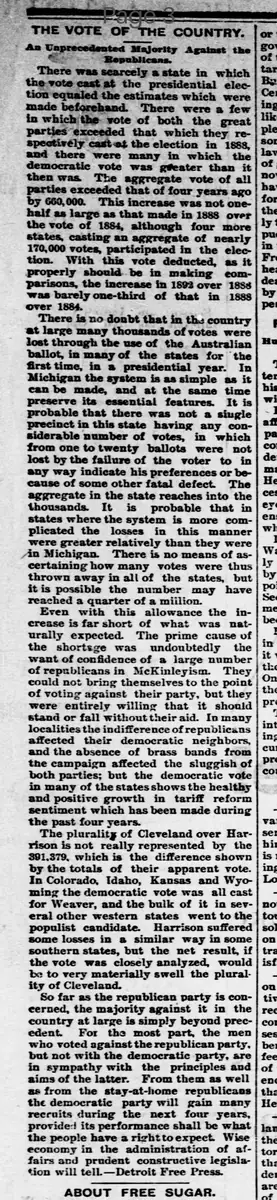
An Unprecedented Majority Against the Republicans.
There was scarcely a state in which the vote cast at the presidential election equaled the estimates which were made beforehand. There were a few in which the vote of both the great parties exceeded that which they respectively cast at the election in 1888, and there were many in which the democratic vote was greater than it then was. The aggregate vote of all parties exceeded that of four years ago by 660,000. This increase was not one-half as large as that made in 1888 over the vote of 1884, although four more states, casting an aggregate of nearly 170,000 votes, participated in the election. With this vote deducted, as it properly should be in making comparisons, the increase in 1892 over 1888 was barely one-third of that in 1888 over 1884.
There is no doubt that in this country at large many thousands of votes were lost through the use of the Australian ballot, in many of the states for the first time, in a presidential year. In Michigan the system is as simple as it can be made, and at the same time preserve its essential features. It is probable that there was not a single precinct in this state having any considerable number of votes, in which from one to twenty ballots were not lost by the failure of the voter to in any way indicate his preferences or because of some other fatal defect. The aggregate in the state reaches into the thousands. It is probable that in states where the system is more complicated the losses in this manner were greater relatively than they were in Michigan. There is no means of ascertaining how many votes were thus thrown away in all of the states, but it is possible the number may have reached a quarter of a million.
Even with this allowance the increase is far short of what was naturally expected. The prime cause of the shortage was undoubtedly the want of confidence of a large number of republicans in McKinleyism. They could not bring themselves to the point of voting against their party, but they were entirely willing that it should stand or fall without their aid. In many localities the indifference of republicans affected their democratic neighbors, and the absence of brass bands from the campaign affected the sluggish of both parties; but the democratic vote in many of the states shows the healthy and positive growth in tariff reform sentiment which has been made during the past four years.
The plurality of Cleveland over Harrison is not really represented by the 391,379, which is the difference shown by the totals of their apparent vote. In Colorado, Idaho, Kansas and Wyoming the democratic vote was all cast for Weaver, and the bulk of it in several other western states went to the populist candidate. Harrison suffered some losses in a similar way in some southern states, but the net result, if the vote was closely analyzed, would be to very materially swell the plurality of Cleveland.
So far as the republican party is concerned, the majority against it in the country at large is simply beyond precedent. For the most part, the men who voted against the republican party, but not with the democratic party, are in sympathy with the principles and aims of the latter. From them as well as from the stay-at-home republicans the democratic party will gain many recruits during the next four years, provided its performance shall be what the people have a right to expect. Wise economy in the administration of affairs and prudent constructive legislation will tell.-Detroit Free Press.
What sub-type of article is it?
What keywords are associated?
What entities or persons were involved?
Where did it happen?
Domestic News Details
Primary Location
United States
Event Date
1892
Key Persons
Outcome
cleveland's plurality over harrison: 391,379; unprecedented majority against republicans; aggregate vote increase of 660,000 over 1888, but short of expectations due to australian ballot losses and republican indifference.
Event Details
Analysis of the 1892 presidential election vote showing lower turnout than expected, impact of Australian ballot causing lost votes, Republican disaffection, Democratic growth in tariff reform sentiment, and shifts to Populist Weaver in western states.